
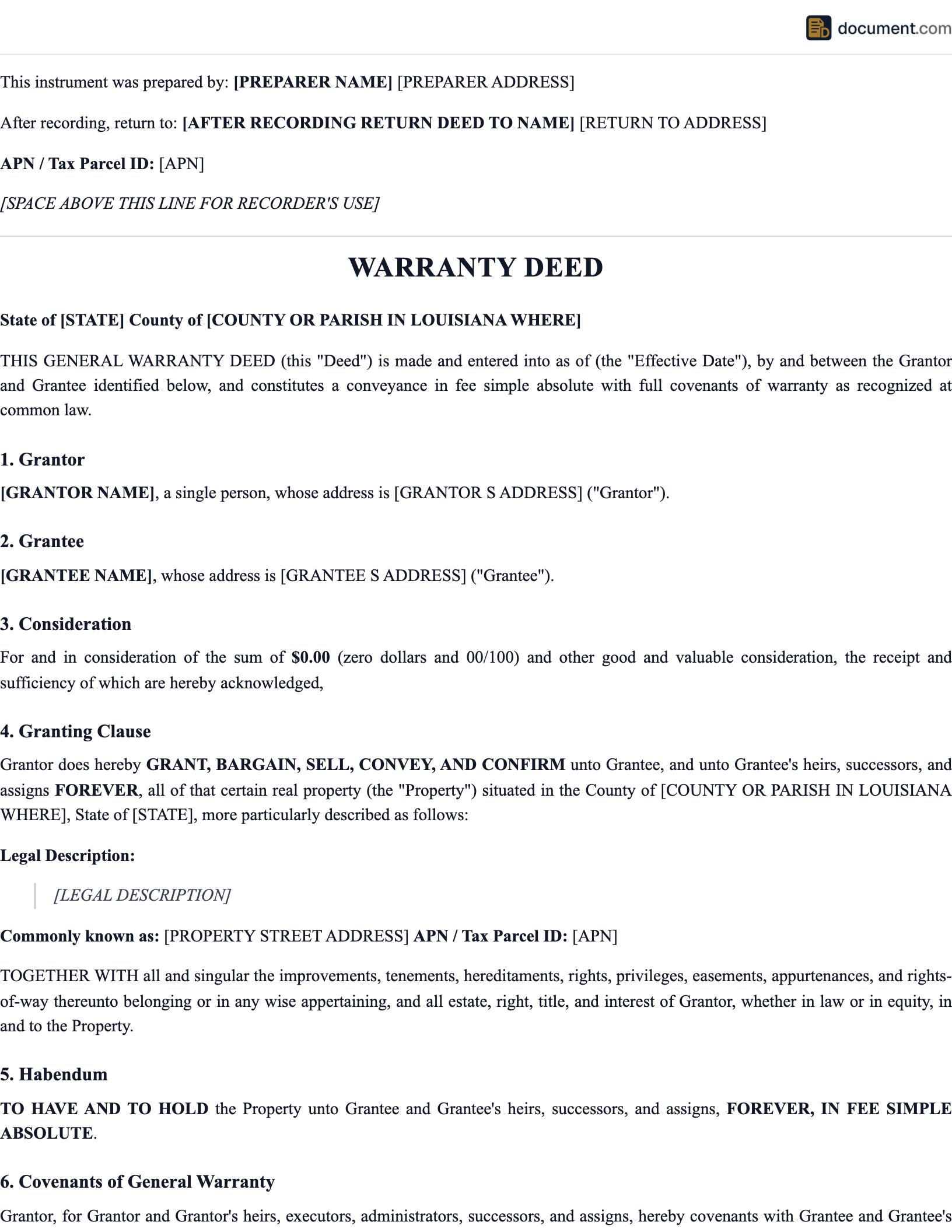



Virginia Warranty Deed Overview
In Virginia, warranty deeds are recorded with the Circuit Court Clerk of the county or independent city where the property sits. Virginia's deed law is codified primarily under Virginia Code Section 55.1-300 et seq., which governs conveyances, covenants of title, and recording requirements. A general warranty deed in Virginia carries the grantor's covenant to defend the grantee's title against any claim from any source, including claims arising before the grantor ever owned the property. This is the strongest form of title covenant available under Virginia law.
Virginia imposes a grantor's tax and a grantee's tax on real property conveyances, each at $0.25 per $100 of consideration. That combined $0.50 per $100 rate means transfer taxes on a Northern Virginia home sale can be substantial given the region's property values. Base recording fees start around $25 but increase with per-page charges. All deeds must be notarized, and the instrument must meet the formatting standards in Virginia Code Section 55.1-105 before the clerk will accept it for recording.
$25
Recording fee
$0.25 per $100
Transfer tax
Required
Notarization
0
Witnesses required
Virginia Requirements
Virginia's Circuit Court Clerks are strict about deed formatting and completeness. An instrument submitted with missing elements, an improper acknowledgment, or inadequate margins will be rejected and returned, delaying the transfer. Getting this right before submission avoids costly refiling and potential gaps in the chain of title.
Virginia Specific Note
Virginia imposes separate grantor and grantee transfer taxes of $0.25 per $100 each. In high-value markets like Northern Virginia, these amounts add up quickly. Recording fees start at $25 but increase based on page count. Virginia Code Section 55.1-105 requires a three-inch top margin on the first page, at least one-inch margins elsewhere, minimum 8-point font, and clear identification of the tax parcel. The deed must also name the person who prepared it and include a return address for the recorded document.
Document Requirements
- Notarization: Must be notarized by a Virginia notary public or authorized notary
- Witnesses: Virginia requires 0 additional witness(es)
- Legal Description: Complete legal description as it appears on the current deed of record
- Parcel Number: Assessor's parcel number or tax ID
- Return Address: Mailing address for returning the recorded document
- Formatting: Standard formatting with adequate margins, black ink, minimum 10-point font
How to File in Virginia
Filing in Virginia involves preparing the document, getting it notarized, and recording it. Follow these steps for a smooth process.
Prepare the Document
Fill in the full legal names of all grantors and grantees, copy the legal description verbatim from the current recorded deed, include the tax parcel number, and verify the document meets Virginia's formatting requirements under Code Section 55.1-105 (three-inch top margin, at least one-inch side and bottom margins, minimum 8-point font)
Get the Document Notarized
The grantor must sign before a Virginia notary public with valid ID. The notary completes the acknowledgment block, which must include the date, the notary's name, commission number, and expiration date. Virginia does not require additional witnesses beyond the notary
Submit to the Circuit Court Clerk
Bring or mail the notarized original to the Circuit Court Clerk's office in the county or independent city where the property is located. Many Virginia clerks also accept e-recording through services like Simplifile. The clerk assigns a deed book and page reference, which becomes the permanent record identifier
Pay Recording and Transfer Tax Fees
The grantor pays $0.25 per $100 of consideration as the grantor's transfer tax, and the grantee owes the same amount as the grantee's transfer tax. These are separate obligations. Base recording fees start at $25 but increase with page count. Confirm exact amounts with the clerk before filing
Update Tax Records and Notify Relevant Parties
After recording, notify the county Commissioner of Revenue or assessor so the property tax records reflect the new owner. If the grantor had a deed of trust on the property, the lender must separately release that lien by recording a deed of release. Title insurance policies should also be updated to reflect the new ownership
Virginia Fees & Costs
Typical costs for filing in Virginia. Actual fees may vary by county.
| Fee / Tax | Amount |
|---|---|
| Recording Fee | $25 |
| Transfer Tax | $0.25 per $100 |
| Notarization | $5 - $25 per signature |
| Certified Copy | $1 - $10 per page |
| Attorney Review (optional) | $150 - $500 |
Virginia Tax Implications
Virginia imposes a split transfer tax structure that is unusual enough to catch buyers and sellers off guard. The grantor (seller) owes $0.25 per $100 of consideration as a state grantor's tax. The grantee (buyer) separately owes $0.25 per $100 as a grantee's tax. These are two distinct line items, not one shared tax, and both must be paid at recording. On a $750,000 Northern Virginia home, that works out to approximately $1,875 for each party, or $3,750 combined. Some localities in Virginia may also impose an additional recordation tax on top of the state rates, so checking with the specific clerk is always a good idea.
For gift transfers of Virginia real estate, federal gift tax rules apply. Gifts exceeding the annual exclusion amount require the donor to file IRS Form 709. The recipient takes the donor's carryover cost basis rather than a stepped-up basis, which has capital gains implications when the property is eventually sold. This is meaningfully different from an inherited property, where the heir typically receives a stepped-up basis to fair market value at the date of death under IRC Section 1014.
Virginia generally does not have a separate capital gains tax, as capital gains are taxed as ordinary income under Virginia's individual income tax rate structure. However, federal capital gains tax applies to profitable real estate sales, and the primary residence exclusion under IRC Section 121 can shelter up to $250,000 ($500,000 for married couples filing jointly) of gain if the ownership and use tests are satisfied. Virginia also has no estate tax, which simplifies planning for deeds involving estate transfers.
Sample Virginia Warranty Deed
Preview of our Virginia-specific template. Your document will include all fields required for recording in any Virginia county.
WARRANTY DEED (GENERAL WARRANTY DEED)
STATE OF VIRGINIA
Legal Document
PARTY INFORMATION
Name: [Full Legal Name]
Address: [Virginia Address]
County: [County]
PROPERTY DESCRIPTION
County: [County] State: Virginia
Legal Description: [Per Recorded Plat]
Parcel No.: [APN]
Virginia Warranty Deed FAQ
Common questions about filing in Virginia, including requirements, fees, and tax implications.
Official Virginia Resources
Official state resources for verifying requirements and finding your local recording office.
Important Considerations
Virginia's independent city structure is one of the first things to understand. Virginia has 38 independent cities that are legally separate from the surrounding counties. If you own property in the City of Fairfax, you record with the Fairfax City Circuit Court Clerk, not the Fairfax County Circuit Court Clerk. Using the wrong office delays your recording and can create gaps in the chain of title. Always verify the exact recording jurisdiction based on the property address before submitting.
Northern Virginia transactions deserve particular attention to transfer tax amounts. Because property values in Fairfax County, Arlington County, Loudoun County, and Alexandria are among the highest in the state, the grantor's and grantee's transfer taxes on a typical sale can each reach several thousand dollars. Buyers and sellers sometimes negotiate who bears which tax, but both obligations must be satisfied before the clerk records the deed.
If the property is encumbered by a deed of trust (Virginia's equivalent of a mortgage), that lien does not disappear automatically when you convey the property. The existing lender must separately record a deed of release or deed of reconveyance. Delivering a warranty deed without also clearing existing liens puts the buyer in a difficult position and creates a title defect that a title company will flag in any future transaction.
Virginia Attorney Consideration
Virginia does not require attorneys to supervise real estate closings by statute, but many lenders and title companies involve attorneys anyway, particularly for transactions in Northern Virginia where values are high. If your deed involves an estate, a trust, a business entity, a property with an unusual legal description, or a transaction where the parties have not reached clear agreement on all terms, having a Virginia-licensed real estate attorney review the instrument before recording is a straightforward way to protect a significant investment.
Related Documents
Depending on your situation, you may need additional documents alongside this one. Below are commonly related documents that are frequently used together in real estate transactions.
Important Considerations
Before proceeding with your document, there are several important factors to consider. Each real estate transaction is unique, and understanding the specific requirements and implications of your situation will help ensure a smooth and legally compliant process.
Real estate laws and regulations are subject to change, and local requirements may differ from state-level rules. It is always advisable to verify current requirements with your local recording office before submitting any documents for recording.
If your transaction involves complex circumstances such as multiple parties, commercial properties, trusts, estates, or interstate elements, consulting with a licensed real estate attorney is strongly recommended. An attorney can provide guidance specific to your situation and help you avoid potential legal issues.
Keep copies of all documents related to your real estate transaction in a safe place. Recorded documents become part of the public record, but having your own copies ensures you can reference the terms and conditions at any time. Digital copies stored securely are also recommended as a backup.
Professional Recommendation
While our templates are designed to be comprehensive and legally compliant, we recommend having your completed document reviewed by a licensed attorney before recording, especially for high-value transactions or complex situations. Many attorneys offer flat-fee document review services that provide peace of mind at a reasonable cost.
Related Documents
Depending on your situation, you may need additional documents alongside this one. Below are commonly related documents that are frequently used together in real estate transactions.
Create your Virginia Warranty Deed in under 5 minutes.
Answer a few questions and download a Virginia-compliant document, ready for the state agency.