



Vermont Warranty Deed Overview
Vermont has a land recording system unlike most other states: deeds are recorded at the town level, not the county level. Each of Vermont's 246 towns and gores maintains its own land records through the Town Clerk's office. This means that before you can record a warranty deed, you must identify the correct town. Vermont's land records are governed by 27 V.S.A. Chapter 5, and a warranty deed gives the grantee the full benefit of title covenants, with the grantor obligated to defend against all claims. Vermont follows a race-notice recording rule.
Vermont's Property Transfer Tax applies to most real estate conveyances, with a graduated rate structure: 0.5% on the first $100,000 of the purchase price and 1.45% on the amount above that threshold. Buyers who are Vermont residents purchasing a principal residence may qualify for the reduced rate on the first $110,000. A Property Transfer Tax Return (Form PTT-172) must accompany the deed at the time of recording. Vermont also has a land gains tax that can apply to properties sold within six years of acquisition, making it one of the more tax-complex states for short-term real estate investors.
$15
Recording fee
1.25%-1.45%
Transfer tax
Required
Notarization
0
Witnesses required
Vermont Requirements
Vermont Town Clerks record deeds under 27 V.S.A. Section 341. Because recording is handled at the town level rather than centrally, you must bring or send your deed to the correct town clerk, not a county office. Each town may have different hours, fees, and submission preferences. Most Vermont towns require in-person or mail-in filing, and e-recording remains limited compared to other states.
Vermont Specific Note
Vermont's Property Transfer Tax must be paid and Form PTT-172 filed at the time of recording. The rate is 0.5% on the first $100,000 and 1.45% above that. Vermont also has a land gains tax on property sold within six years of acquisition, with rates that decline the longer the property is held. A notary acknowledgment is required. Vermont deeds traditionally reference the prior deed's book and page number. If the property is subject to an Act 250 environmental permit, the deed must convey subject to those permit conditions.
Document Requirements
- Notarization: Must be notarized by a Vermont notary public or authorized notary
- Witnesses: Vermont requires 0 additional witness(es)
- Legal Description: Complete legal description as it appears on the current deed of record
- Parcel Number: Assessor's parcel number or tax ID
- Return Address: Mailing address for returning the recorded document
- Formatting: Standard formatting with adequate margins, black ink, minimum 10-point font
How to File in Vermont
Recording in Vermont is done at the town level, not the county level, which is the most important procedural difference from almost every other state. The Vermont Property Transfer Tax Return must also be submitted at the same time as the deed.
Prepare the Deed and the Transfer Tax Return
Draft the warranty deed with the grantor's and grantee's full legal names and addresses, the town where the property is located, the complete legal description, the consideration paid, and the prior deed reference (book and page). You must also prepare Vermont Form PTT-172 (Property Transfer Tax Return), which must accompany the deed at recording.
Get the Document Notarized
The grantor signs before a Vermont notary public or another officer authorized by 27 V.S.A. Section 341 to take acknowledgments. No additional witnesses are required. Vermont accepts acknowledgments taken before out-of-state notaries if the grantor is not in Vermont at the time of signing.
Bring the Deed to the Town Clerk (Not the County)
Bring the notarized deed and the completed Form PTT-172 to the Town Clerk of the Vermont town where the property is located. Vermont has 246 towns, each with its own clerk and hours. Do not confuse the town with the county; there is no county-level recording in Vermont. Call the Town Clerk in advance to confirm hours and accepted payment methods.
Pay the Transfer Tax and Recording Fee
Pay the Property Transfer Tax, calculated at 0.5% on the first $100,000 and 1.45% on the amount above that. Also pay the town's recording fee, typically around $15. If you are claiming the principal residence reduced rate or an exemption, have documentation ready. The land gains tax is reported and paid to the Vermont Department of Taxes separately, not at the Town Clerk's office.
Retain the Recorded Document and Update the Grand List
The Town Clerk records the deed in the town's land records and returns the original to you. Vermont maintains a "Grand List" of taxable property in each town, and the new owner should notify the town assessor of the transfer so that property tax billing reflects the current ownership. Vermont property taxes are collected at the town level, not the county level.
Vermont Fees & Costs
Typical costs for filing in Vermont. Actual fees may vary by county.
| Fee / Tax | Amount |
|---|---|
| Recording Fee | $15 |
| Transfer Tax | 1.25%-1.45% |
| Notarization | $5 - $25 per signature |
| Certified Copy | $1 - $10 per page |
| Attorney Review (optional) | $150 - $500 |
Vermont Tax Implications
Vermont has one of the more complex property transfer tax structures in the country. The Property Transfer Tax, imposed under 32 V.S.A. Chapter 231, applies at 0.5% on the first $100,000 of the purchase price and 1.45% on the amount above $100,000. A reduced rate applies for qualifying principal residence purchases by Vermont residents on the first $110,000. Certain transfers are fully exempt, including those between spouses incident to divorce, transfers to nonprofit organizations, and some government transfers. All buyers, sellers, and their agents must sign Form PTT-172, which is submitted to the Vermont Department of Taxes through the Town Clerk at recording.
Vermont's land gains tax is an additional consideration that surprises many buyers and investors. Under 32 V.S.A. Chapter 236, a seller who acquired the land within the six years preceding the sale may owe a land gains tax on the profit from the sale. The rate is highest for short holding periods, starting at 60% of the gain for property held less than one year and declining to zero for property held six or more years. The tax applies to land and, in certain circumstances, to land sold separately from improvements. It is paid directly to the Vermont Department of Taxes and is separate from the Property Transfer Tax collected at recording.
Vermont also has a state income tax on capital gains from the sale of real property. Gains that survive the federal primary residence exclusion under IRC Section 121 are subject to Vermont income tax at the applicable graduated rate. Vermont property is assessed for property tax purposes by municipal listers and the state Director of Property Valuation and Review. Ownership changes do not automatically trigger a reassessment, but the municipal lister should be notified of the transfer so tax bills are directed to the correct owner.
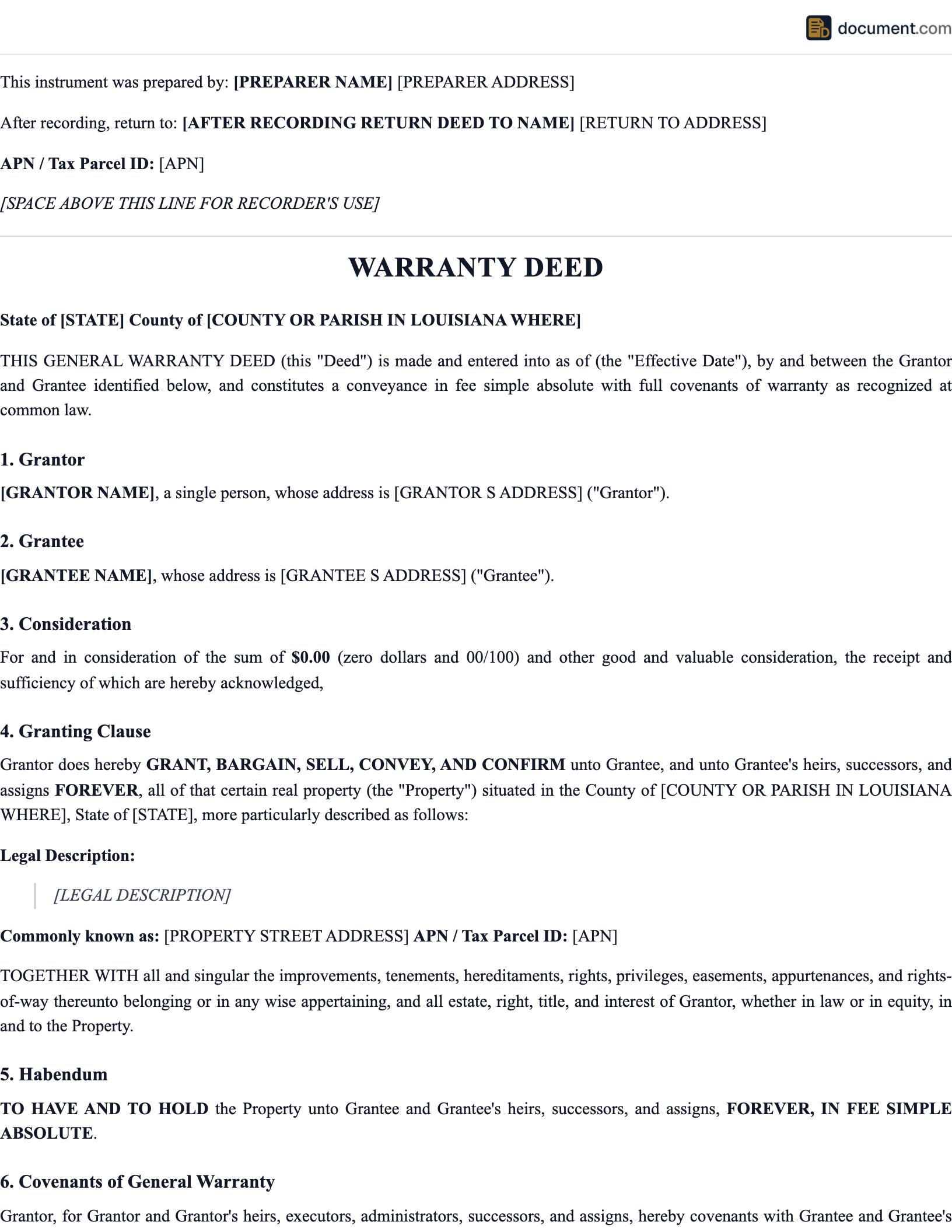
Sample Vermont Warranty Deed
Preview of our Vermont-specific template. Your document will include all fields required for recording in any Vermont county.
WARRANTY DEED (GENERAL WARRANTY DEED)
STATE OF VERMONT
Legal Document
PARTY INFORMATION
Name: [Full Legal Name]
Address: [Vermont Address]
County: [County]
PROPERTY DESCRIPTION
County: [County] State: Vermont
Legal Description: [Per Recorded Plat]
Parcel No.: [APN]
Vermont Warranty Deed FAQ
Common questions about filing in Vermont, including requirements, fees, and tax implications.
Official Vermont Resources
Official state resources for verifying requirements and finding your local recording office.
Important Considerations
Vermont's land gains tax catches many out-of-state buyers off guard when they later sell. If you are purchasing Vermont property as an investment and plan to sell within six years, budget for the land gains tax in your return projections. The tax is calculated on the gain, not the sale price, and the rate drops sharply after the first two years. Holding the property through the six-year threshold eliminates the tax entirely.
Act 250 permits can significantly affect what a buyer can do with Vermont property. If the property you are acquiring was previously developed under an Act 250 permit, the permit runs with the land and binds the new owner to all its conditions. Some permits limit uses, require environmental monitoring, or restrict further development. A thorough title search and review of any Act 250 permit conditions should be completed before closing.
Vermont's recording system requires you to search each town's records separately. Unlike states with a centralized county recorder database, Vermont title searches must be conducted in the specific town where the property is located. If the property straddles a town boundary, records must be searched in both towns. Vermont attorneys play a more active role in closings than in many other states, in part because of this complexity.
Vermont Closing Practice
Vermont real estate closings almost always involve an attorney. While Vermont law does not mandate attorney-supervised closings for every transaction, the Property Transfer Tax Return (Form PTT-172), the land gains tax considerations, and the town-based recording system make attorney involvement the norm rather than the exception. Vermont title insurance is available through national underwriters, and attorneys typically act as agents for title insurance companies in Vermont.
Related Documents
Depending on your situation, you may need additional documents alongside this one. Below are commonly related documents that are frequently used together in real estate transactions.
Important Considerations
Before proceeding with your document, there are several important factors to consider. Each real estate transaction is unique, and understanding the specific requirements and implications of your situation will help ensure a smooth and legally compliant process.
Real estate laws and regulations are subject to change, and local requirements may differ from state-level rules. It is always advisable to verify current requirements with your local recording office before submitting any documents for recording.
If your transaction involves complex circumstances such as multiple parties, commercial properties, trusts, estates, or interstate elements, consulting with a licensed real estate attorney is strongly recommended. An attorney can provide guidance specific to your situation and help you avoid potential legal issues.
Keep copies of all documents related to your real estate transaction in a safe place. Recorded documents become part of the public record, but having your own copies ensures you can reference the terms and conditions at any time. Digital copies stored securely are also recommended as a backup.
Professional Recommendation
While our templates are designed to be comprehensive and legally compliant, we recommend having your completed document reviewed by a licensed attorney before recording, especially for high-value transactions or complex situations. Many attorneys offer flat-fee document review services that provide peace of mind at a reasonable cost.
Related Documents
Depending on your situation, you may need additional documents alongside this one. Below are commonly related documents that are frequently used together in real estate transactions.
Create your Vermont Warranty Deed in under 5 minutes.
Answer a few questions and download a Vermont-compliant document, ready for the state agency.