



Utah Warranty Deed Overview
Utah warranty deeds are recorded with the County Recorder in the county where the property is situated, under the authority of Utah Code Title 17, Chapter 21. The statutory form for a warranty deed in Utah is set out in Utah Code 57-1-12. A warranty deed conveys the property with full title covenants, binding the grantor to defend the title against any claim. Utah uses a race-notice recording system, meaning a subsequent purchaser who records first and had no knowledge of a prior unrecorded conveyance will generally prevail.
Utah does not impose a real estate transfer tax, which makes the out-of-pocket cost at recording relatively modest. Recording fees are set at the county level and typically start around $15 for the first page. A notary acknowledgment is required before recording; no witnesses beyond the notary are needed. Utah is an equitable distribution state, not a community property state, so married couples should specify their vesting clearly in the deed. Utah also imposes a flat-rate state income tax on capital gains, which sellers should factor into their planning before closing.
$15
Recording fee
None
Transfer tax
Required
Notarization
0
Witnesses required
Utah Requirements
Utah County Recorders follow the requirements set out in Utah Code Title 57. A warranty deed that lacks a proper notary acknowledgment, contains an incomplete legal description, or fails to meet basic formatting standards will be rejected and returned unfiled. Utah's recording system is organized by county, and each county may have minor variations in fee schedules and accepted payment methods.
Utah Specific Note
Utah has no real estate transfer tax. Recording fees start around $15 per page, varying slightly by county. A notary acknowledgment is required under Utah Code 57-3-101. Utah is not a community property state, so married couples should specify their vesting clearly (joint tenancy or tenants in common). If the grantor is an LLC or trust, bring documentation confirming authority to sign. Utah permits remote online notarization under the Remote Online Notary Act.
Document Requirements
- Notarization: Must be notarized by an Utah notary public or authorized notary
- Witnesses: Utah requires 0 additional witness(es)
- Legal Description: Complete legal description as it appears on the current deed of record
- Parcel Number: Assessor's parcel number or tax ID
- Return Address: Mailing address for returning the recorded document
- Formatting: Standard formatting with adequate margins, black ink, minimum 10-point font
How to File in Utah
Recording a Utah warranty deed is handled at the County Recorder's office. Utah has no state transfer tax, so there is no tax return to file alongside the deed. The process is relatively straightforward, but make sure the notary acknowledgment is complete before you arrive at the recorder's office.
Prepare the Document
Fill in all required information: the grantor's and grantee's full legal names and addresses, the county where the property is located, the complete legal description from the current deed of record, the county parcel number, and the consideration. If the grantee is taking title with another person, specify the vesting (joint tenancy or tenants in common). Leave the signature and acknowledgment lines blank until you are before a notary.
Get the Document Notarized
The grantor must sign before a Utah notary public, who will complete the acknowledgment required by Utah Code 57-3-101. Bring a government-issued photo ID. No witnesses beyond the notary are needed. Utah permits remote online notarization under its RON Act, which is helpful when the grantor is located out of state.
Present the Deed to the County Recorder
Take or send the notarized original to the County Recorder's office in the county where the property is located. Many Utah county recorders, including Salt Lake County and Utah County, offer e-recording through approved vendors. Check the specific county recorder's website for submission options and current hours.
Pay the Recording Fee
Pay the recording fee, which varies by county but generally starts around $15 for the first page. Utah has no real estate transfer tax, so no additional tax payment is required at recording. Some counties charge per page, so a multi-page deed will cost more.
Retain the Recorded Document and Update Tax Records
The County Recorder stamps the deed with the entry number, recording date, and book and page information. Store the recorded original in a secure location. The new owner should contact the county assessor to update the ownership records and ensure property tax notices are sent to the correct address going forward.
Utah Fees & Costs
Typical costs for filing in Utah. Actual fees may vary by county.
| Fee / Tax | Amount |
|---|---|
| Recording Fee | $15 |
| Transfer Tax | None |
| Notarization | $5 - $25 per signature |
| Certified Copy | $1 - $10 per page |
| Attorney Review (optional) | $150 - $500 |
Utah Tax Implications
Utah has no state real estate transfer tax. This keeps out-of-pocket recording costs low compared to states like Vermont or Tennessee. There is no documentary stamp tax or excise tax based on the sale price owed at the time of recording.
Utah does impose a state income tax on capital gains. Utah conforms to federal adjusted gross income, meaning the federal primary residence exclusion under IRC Section 121 flows through to the Utah return and reduces state taxable income in the same way. For gains that do not qualify for the exclusion, Utah taxes the gain at the state's flat income tax rate. Sellers should also account for federal capital gains tax, which applies at 0%, 15%, or 20% depending on the seller's income level and how long the property was held.
Gifts of real property in Utah do not trigger a state gift tax, but federal gift tax rules apply to transfers exceeding the annual exclusion amount. Recipients of gifted property take the property at the grantor's adjusted basis, not at fair market value on the date of the gift. This can create a significant capital gains exposure if the property later appreciates. By contrast, property inherited at death receives a stepped-up basis to the fair market value at the date of death, which often eliminates the built-in gain. Utah property is assessed by county assessors on an annual basis, and ownership changes should be reported to the county assessor to ensure accurate billing records.
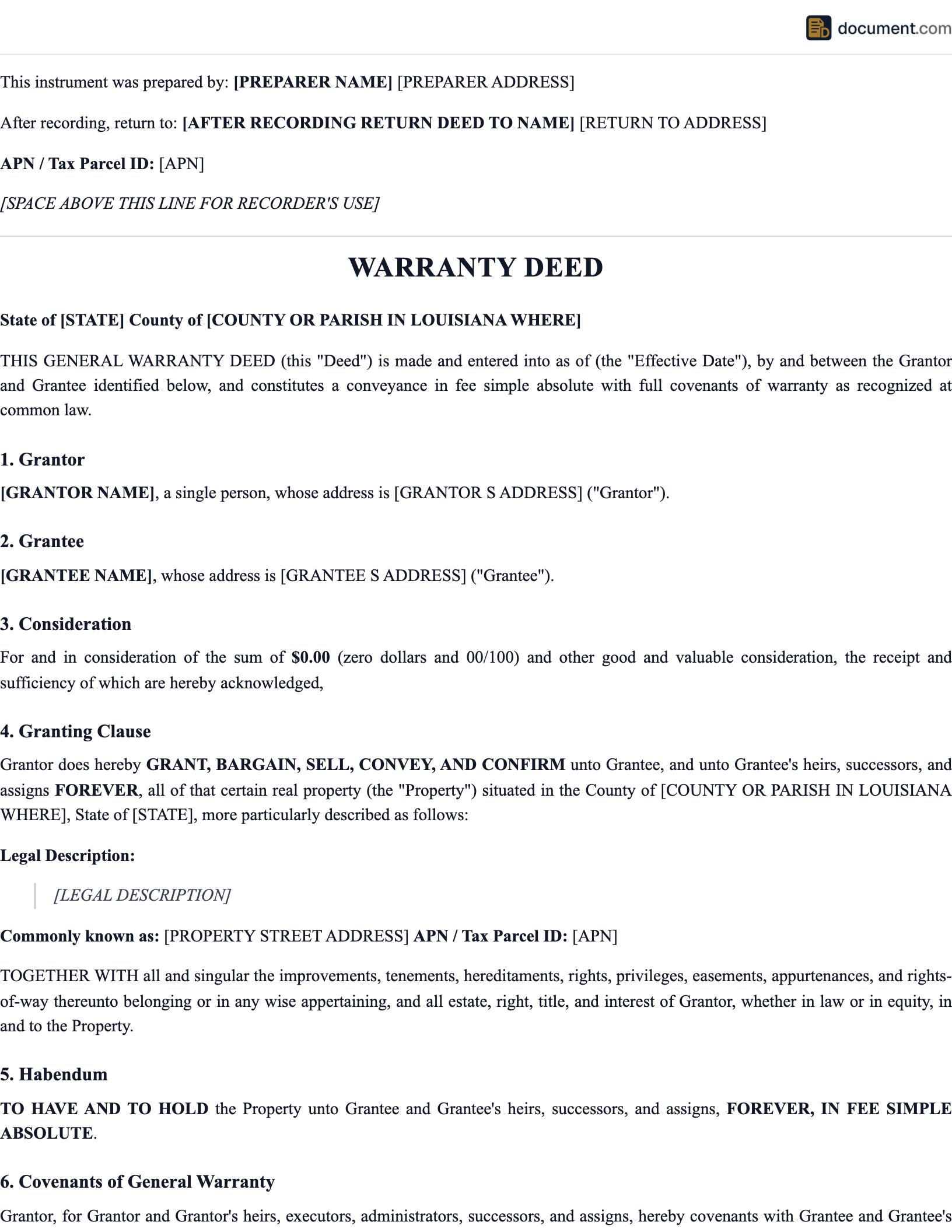
Sample Utah Warranty Deed
Preview of our Utah-specific template. Your document will include all fields required for recording in any Utah county.
WARRANTY DEED (GENERAL WARRANTY DEED)
STATE OF UTAH
Legal Document
PARTY INFORMATION
Name: [Full Legal Name]
Address: [Utah Address]
County: [County]
PROPERTY DESCRIPTION
County: [County] State: Utah
Legal Description: [Per Recorded Plat]
Parcel No.: [APN]
Utah Warranty Deed FAQ
Common questions about filing in Utah, including requirements, fees, and tax implications.
Official Utah Resources
Official state resources for verifying requirements and finding your local recording office.
Important Considerations
Utah is not a community property state, which has practical consequences for married buyers and sellers. When two spouses acquire property together in Utah, they hold it as joint tenants or tenants in common unless the deed specifies otherwise. Joint tenancy carries the right of survivorship, meaning the surviving spouse automatically inherits the deceased spouse's interest without probate. Tenants in common each hold a divisible and devisable interest. The choice matters for estate planning and should be made intentionally.
Utah's rapidly growing real estate market, particularly along the Wasatch Front in Salt Lake, Utah, and Davis counties, has led to a high volume of deed transactions involving LLC grantees. When a Utah LLC is acquiring property, the deed should name the LLC properly (matching the articles of organization), and the person signing as the LLC's representative must have authority to bind the entity. The county recorder may request an operating agreement or statement of authority from the LLC, particularly for large commercial transactions.
Utah has seen significant growth in short-term rental activity, and some Utah counties and municipalities have enacted zoning restrictions that affect short-term rentals. A warranty deed conveys the property subject to all existing zoning restrictions, CC&Rs, and local ordinances. Buyers should research applicable short-term rental rules before closing, as these restrictions are not always disclosed in a standard title search.
Utah Legal Description Tip
Utah uses the Public Land Survey System for most property descriptions outside of platted subdivisions. Rural Utah properties may have metes-and-bounds descriptions or section-township-range descriptions that can be difficult to interpret without a survey. If there is any doubt about the accuracy of the legal description, order a new survey before closing. Recording a deed with an incorrect legal description can cloud the title for years and require a court action to correct.
Related Documents
Depending on your situation, you may need additional documents alongside this one. Below are commonly related documents that are frequently used together in real estate transactions.
Important Considerations
Before proceeding with your document, there are several important factors to consider. Each real estate transaction is unique, and understanding the specific requirements and implications of your situation will help ensure a smooth and legally compliant process.
Real estate laws and regulations are subject to change, and local requirements may differ from state-level rules. It is always advisable to verify current requirements with your local recording office before submitting any documents for recording.
If your transaction involves complex circumstances such as multiple parties, commercial properties, trusts, estates, or interstate elements, consulting with a licensed real estate attorney is strongly recommended. An attorney can provide guidance specific to your situation and help you avoid potential legal issues.
Keep copies of all documents related to your real estate transaction in a safe place. Recorded documents become part of the public record, but having your own copies ensures you can reference the terms and conditions at any time. Digital copies stored securely are also recommended as a backup.
Professional Recommendation
While our templates are designed to be comprehensive and legally compliant, we recommend having your completed document reviewed by a licensed attorney before recording, especially for high-value transactions or complex situations. Many attorneys offer flat-fee document review services that provide peace of mind at a reasonable cost.
Related Documents
Depending on your situation, you may need additional documents alongside this one. Below are commonly related documents that are frequently used together in real estate transactions.
Create your Utah Warranty Deed in under 5 minutes.
Answer a few questions and download a Utah-compliant document, ready for the state agency.