



Texas Warranty Deed Overview
In Texas, warranty deeds are recorded with the County Clerk in the county where the property is located. The Texas Property Code governs real estate conveyances, and a general warranty deed is the standard and expected form in arms-length transactions. Under Texas law, a general warranty deed conveys the property with full covenants, meaning the grantor warrants the title against all encumbrances and claims, regardless of when they arose. Texas uses a race-notice recording statute, so recording promptly after closing is critical to protecting the grantee's priority.
Texas levies no state real estate transfer tax, which keeps closing costs lower than in many states. Recording fees are set by statute. Notarization is required for recording, and no additional witnesses are needed. One Texas-specific issue that frequently surprises buyers is the homestead law: if the property being transferred is the grantor's homestead, the non-titled spouse must sign the deed even if their name does not appear on the title. Failure to get that signature can invalidate the conveyance. Mineral rights are also commonly severed from the surface estate in Texas and must be addressed explicitly in the deed language.
$16
Recording fee
None
Transfer tax
Required
Notarization
0
Witnesses required
Texas Requirements
Each Texas County Clerk's office has recording requirements set by the Texas Local Government Code. Formatting errors, missing acknowledgments, or incomplete legal descriptions are the most common reasons a deed is rejected. Texas also has specific rules around homestead property and mineral rights that must be addressed in the deed itself, not just ancillary documents.
Texas Specific Note
Texas has no real estate transfer tax. If the property is the grantor's homestead, the non-titled spouse must sign the deed or the conveyance may be void. Mineral rights are frequently severed from the surface estate in Texas; your deed should state clearly whether minerals are included or reserved. A notary acknowledgment is required for recording. Recording fees are set by statute and start at $16 for the first page. Texas permits remote online notarization, which may be an option for out-of-state grantors.
Document Requirements
- Notarization: Must be notarized by a Texas notary public or authorized notary
- Witnesses: Texas requires 0 additional witness(es)
- Legal Description: Complete legal description as it appears on the current deed of record
- Parcel Number: Assessor's parcel number or tax ID
- Return Address: Mailing address for returning the recorded document
- Formatting: Standard formatting with adequate margins, black ink, minimum 10-point font
How to File in Texas
Recording a Texas warranty deed is handled at the County Clerk's office. Texas has no transfer tax return to file, so the process is largely about the deed itself plus the recording fee. Homestead and mineral rights issues should be resolved before you present the deed for recording.
Prepare the Document
Complete the deed with the grantor's and grantee's full legal names and addresses, the county where the property is located, the complete legal description, and the consideration. If the property is the grantor's homestead, the non-titled spouse must be identified and their signature block included. Specify whether mineral rights are conveyed or reserved.
Get the Document Notarized
All required signers, including a non-titled homestead spouse if applicable, must sign before a Texas notary public. The notary verifies identities and completes the acknowledgment. Texas permits remote online notarization under the RON law, which is useful when signers are in different locations. No additional witnesses are required.
Present the Deed to the County Clerk
Bring the notarized original to the County Clerk in the county where the property sits. Most Texas County Clerk offices accept walk-in filings, and many now offer e-recording through approved vendors. Harris County, Dallas County, and other large jurisdictions have robust online submission options.
Pay the Recording Fee
Pay the recording fee set by state statute, typically $16 for the first page and $4 per additional page. Texas has no state real estate transfer tax. Confirm the exact fee with the County Clerk before submission, as some offices have minor variations.
Retain the Recorded Document and Update the Tax Roll
The County Clerk stamps the deed with the instrument number, date, and recording information and returns the original to you. Keep it in a safe place. Notify the county appraisal district of the ownership change so future tax notices go to the correct party. In Texas, the appraisal district and the county tax office are separate entities, so you may need to contact both.
Texas Fees & Costs
Typical costs for filing in Texas. Actual fees may vary by county.
| Fee / Tax | Amount |
|---|---|
| Recording Fee | $16 |
| Transfer Tax | None |
| Notarization | $5 - $25 per signature |
| Certified Copy | $1 - $10 per page |
| Attorney Review (optional) | $150 - $500 |
Texas Tax Implications
Texas levies no state real estate transfer tax on deed conveyances. This is one of the areas where Texas stands apart from most states. The only amount you pay at recording is the county clerk's fee, which is set by statute. There is no documentary stamp tax, no excise tax based on the purchase price, and no state tax return to file alongside the deed.
Texas has no state income tax of any kind, which means there is no state-level capital gains tax on the sale of real property. All capital gains from Texas property sales are taxed solely at the federal level. The federal primary residence exclusion under IRC Section 121 allows homeowners who have lived in the property as their primary residence for at least two of the past five years to exclude up to $250,000 of gain from federal income tax ($500,000 for married couples filing jointly). Texas sellers who do not qualify for this exclusion owe federal capital gains tax at rates of 0%, 15%, or 20% depending on their income bracket.
Texas property taxes are among the highest in the country as a trade-off for the absence of a state income tax. Property is appraised annually by the county appraisal district. When a property is sold, the appraisal district may revisit the assessed value, which can significantly increase the annual property tax bill for the new owner. A change of ownership also affects homestead exemption eligibility: the new owner must apply for the homestead exemption for the property to qualify. Homestead exemptions reduce the assessed value for property tax purposes and must be filed with the county appraisal district by April 30 of the year following acquisition.
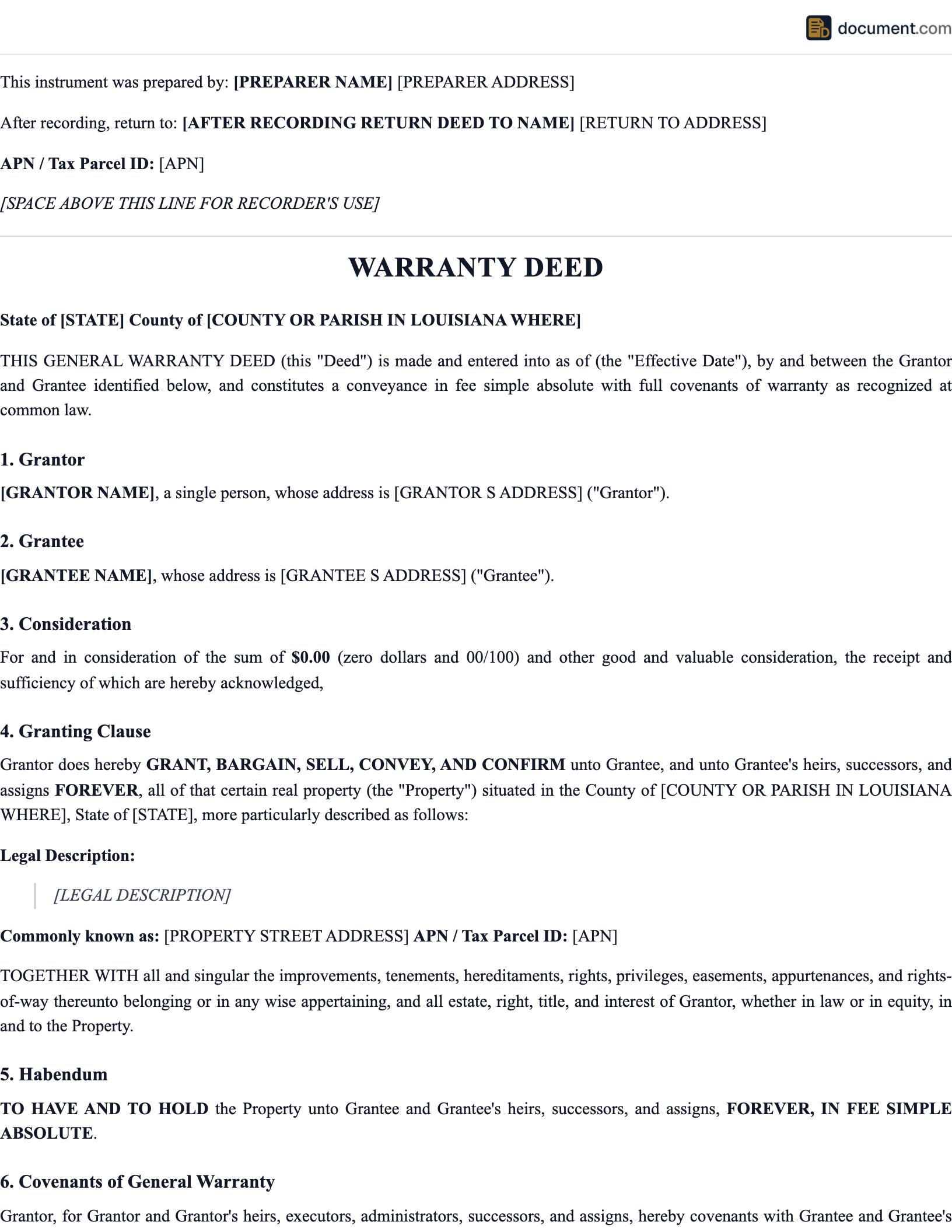
Sample Texas Warranty Deed
Preview of our Texas-specific template. Your document will include all fields required for recording in any Texas county.
WARRANTY DEED (GENERAL WARRANTY DEED)
STATE OF TEXAS
Legal Document
PARTY INFORMATION
Name: [Full Legal Name]
Address: [Texas Address]
County: [County]
PROPERTY DESCRIPTION
County: [County] State: Texas
Legal Description: [Per Recorded Plat]
Parcel No.: [APN]
Texas Warranty Deed FAQ
Common questions about filing in Texas, including requirements, fees, and tax implications.
Official Texas Resources
Official state resources for verifying requirements and finding your local recording office.
Important Considerations
Texas homestead law is the most common source of warranty deed complications in the state. If the property is or was ever designated as the grantor's homestead, the non-titled spouse must sign the deed for it to be valid. This applies even if the non-titled spouse has no ownership interest, has been separated for years, or lives out of state. A deed executed without the required spousal signature on a homestead property can be voided by the non-signing spouse or their heirs.
Mineral rights in Texas have enormous value in certain parts of the state, particularly in the Permian Basin, the Eagle Ford Shale, and the Barnett Shale regions. Before executing a warranty deed, confirm whether mineral rights are already severed from the surface estate by reviewing prior deeds in the chain of title. If the current owner holds the minerals, the deed must expressly address whether they are conveyed to the buyer or reserved by the seller. A deed that does not address minerals may inadvertently convey them.
Texas property tax rates are set by individual taxing entities, including counties, cities, school districts, and special districts. The annual property tax burden can change significantly when a property sells, because the county appraisal district may adjust the assessed value to reflect the sale price. New owners should also promptly apply for any applicable exemptions, including the homestead exemption, which is not automatic and must be filed with the county appraisal district.
Texas Title Insurance Practice
Texas is one of the few states with state-regulated title insurance rates, set by the Texas Department of Insurance. Every licensed title company charges the same premium for the same coverage amount. This means Texas buyers should shop for title companies based on service quality, local knowledge, and closing fees, not on policy premiums. In most Texas markets, the seller pays for the owner's title policy as part of the closing costs, though this is a negotiable term.
Related Documents
Depending on your situation, you may need additional documents alongside this one. Below are commonly related documents that are frequently used together in real estate transactions.
Important Considerations
Before proceeding with your document, there are several important factors to consider. Each real estate transaction is unique, and understanding the specific requirements and implications of your situation will help ensure a smooth and legally compliant process.
Real estate laws and regulations are subject to change, and local requirements may differ from state-level rules. It is always advisable to verify current requirements with your local recording office before submitting any documents for recording.
If your transaction involves complex circumstances such as multiple parties, commercial properties, trusts, estates, or interstate elements, consulting with a licensed real estate attorney is strongly recommended. An attorney can provide guidance specific to your situation and help you avoid potential legal issues.
Keep copies of all documents related to your real estate transaction in a safe place. Recorded documents become part of the public record, but having your own copies ensures you can reference the terms and conditions at any time. Digital copies stored securely are also recommended as a backup.
Professional Recommendation
While our templates are designed to be comprehensive and legally compliant, we recommend having your completed document reviewed by a licensed attorney before recording, especially for high-value transactions or complex situations. Many attorneys offer flat-fee document review services that provide peace of mind at a reasonable cost.
Related Documents
Depending on your situation, you may need additional documents alongside this one. Below are commonly related documents that are frequently used together in real estate transactions.
Create your Texas Warranty Deed in under 5 minutes.
Answer a few questions and download a Texas-compliant document, ready for the state agency.