



Tennessee Warranty Deed Overview
Tennessee warranty deeds are filed with the Register of Deeds in the county where the property is located. Tennessee has 95 counties, and each Register of Deeds office maintains the official chain of title records under a race-notice recording system. A warranty deed gives the grantee the benefit of the grantor's full title covenants, obligating the grantor to defend against claims from any source, including those predating the grantor's ownership. This makes it the strongest form of deed protection available in Tennessee.
Tennessee imposes a realty transfer tax of $0.37 per $100 of consideration, one of the costs buyers and sellers plan for at closing. If the purchase is financed, a separate mortgage tax of $0.115 per $100 of indebtedness also applies. Notarization is required for recording; no witnesses beyond the notary are needed. Tennessee has no income tax on wages, and the Hall income tax on investment income was fully repealed in 2021, meaning there is no state capital gains tax on property sales.
$10
Recording fee
$0.37 per $100
Transfer tax
Required
Notarization
0
Witnesses required
Tennessee Requirements
Tennessee's Register of Deeds offices across all 95 counties follow state-mandated recording requirements, though fees can vary slightly by county. A deed that is missing required elements will be rejected at the counter, and a rejected deed provides no legal notice of the conveyance. Before visiting the Register of Deeds, confirm the current fee schedule and any local formatting preferences.
Tennessee Specific Note
Tennessee charges a realty transfer tax of $0.37 per $100 of value and a separate mortgage tax of $0.115 per $100 of indebtedness for financed purchases. Both must be paid at recording. Certain exempt transfers require documentation of the exemption. The deed must include the Tennessee statutory warranty language, and the grantor's signature must be notarized. Tennessee no longer has a Hall income tax, so there is no state capital gains tax on property sales.
Document Requirements
- Notarization: Must be notarized by a Tennessee notary public or authorized notary
- Witnesses: Tennessee requires 0 additional witness(es)
- Legal Description: Complete legal description as it appears on the current deed of record
- Parcel Number: Assessor's parcel number or tax ID
- Return Address: Mailing address for returning the recorded document
- Formatting: Standard formatting with adequate margins, black ink, minimum 10-point font
How to File in Tennessee
Recording a Tennessee warranty deed requires handling both the deed itself and the realty transfer tax payment. Plan to bring your payment for both the recording fee and the applicable transfer tax when you visit the Register of Deeds.
Prepare the Document
Complete the deed with the grantor's and grantee's full legal names and addresses, the property's county, the complete legal description from the current deed of record, the parcel identification number, and the consideration paid. Use Tennessee's statutory warranty language. Do not sign until in front of a notary.
Get the Document Notarized
The grantor must sign before a Tennessee notary public, who will verify identity, witness the signing, and complete the acknowledgment. No additional witnesses are required. Tennessee notaries are commissioned by the Secretary of State and must act within their county of commission, though exceptions apply for attorneys licensed in Tennessee.
Present the Deed to the Register of Deeds
Bring the notarized original to the Register of Deeds in the county where the property is located. Many Tennessee counties also accept e-recording through approved vendors, which can speed up the process significantly for closing attorneys and title companies.
Pay the Transfer Tax and Recording Fees
Pay the realty transfer tax ($0.37 per $100 of value), the recording fee (typically around $10 per page), and the mortgage tax ($0.115 per $100) if the purchase is financed. If you are claiming an exemption from the transfer tax, bring documentation supporting the exemption.
Retain the Recorded Document and Update Tax Records
The Register of Deeds stamps the deed and returns it to you. Keep the recorded original. Notify the county assessor's office so that annual property tax notices are directed to the new owner. In Tennessee, property taxes are assessed as of January 1 each year, so the timing of a transfer can affect who receives the next tax bill.
Tennessee Fees & Costs
Typical costs for filing in Tennessee. Actual fees may vary by county.
| Fee / Tax | Amount |
|---|---|
| Recording Fee | $10 |
| Transfer Tax | $0.37 per $100 |
| Notarization | $5 - $25 per signature |
| Certified Copy | $1 - $10 per page |
| Attorney Review (optional) | $150 - $500 |
Tennessee Tax Implications
Tennessee imposes a realty transfer tax at the rate of $0.37 per $100 of the property's value or the consideration paid, whichever is greater. This is collected at the time of recording. For a $400,000 property, the transfer tax comes to $1,480. When the purchase is financed, a separate mortgage tax of $0.115 per $100 of the principal amount of the loan also applies. Both taxes are typically handled at the closing table by the title company or closing attorney.
Tennessee does not have a state income tax on wages, and the Hall income tax on dividends and investment income was fully repealed effective January 1, 2021. This means Tennessee sellers owe no state capital gains tax on the sale of real property. Federal capital gains tax rules continue to apply. The IRC Section 121 primary residence exclusion is available to Tennessee residents who meet the two-of-five-year ownership and use tests, allowing them to exclude up to $500,000 of gain if married filing jointly.
Tennessee property is appraised on a four-year cycle for property tax purposes. A transfer of ownership does not automatically trigger a reappraisal, but it can bring the property to the assessor's attention. Certain transfers, such as those between family members for no consideration, may qualify for exemption from the realty transfer tax. Exemptions must be claimed at the time of recording and require supporting documentation. Consult a Tennessee real estate attorney or tax advisor if you believe your transfer qualifies for an exemption.
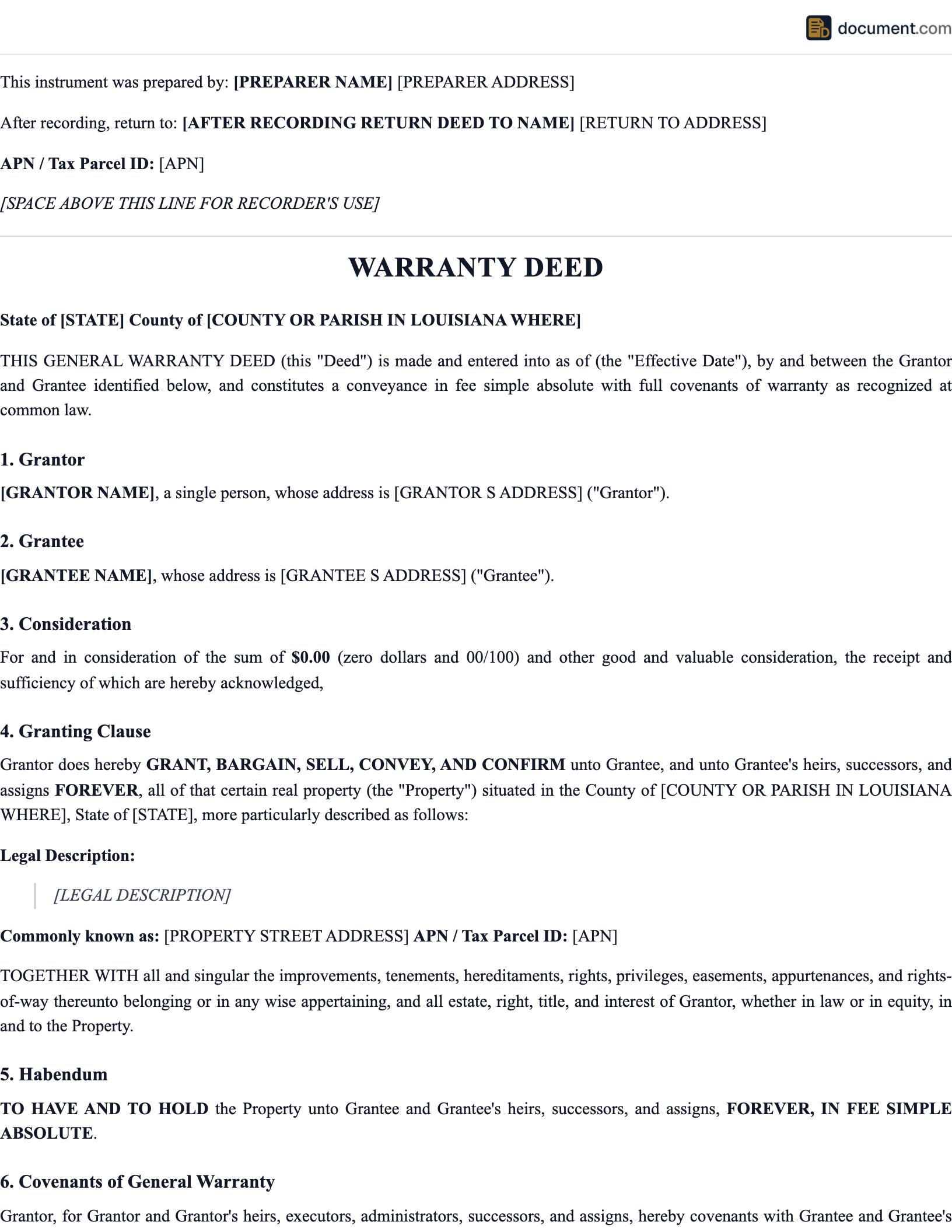
Sample Tennessee Warranty Deed
Preview of our Tennessee-specific template. Your document will include all fields required for recording in any Tennessee county.
WARRANTY DEED (GENERAL WARRANTY DEED)
STATE OF TENNESSEE
Legal Document
PARTY INFORMATION
Name: [Full Legal Name]
Address: [Tennessee Address]
County: [County]
PROPERTY DESCRIPTION
County: [County] State: Tennessee
Legal Description: [Per Recorded Plat]
Parcel No.: [APN]
Tennessee Warranty Deed FAQ
Common questions about filing in Tennessee, including requirements, fees, and tax implications.
Official Tennessee Resources
Official state resources for verifying requirements and finding your local recording office.
Important Considerations
Tennessee uses a race-notice recording system, meaning that a later buyer who records first and had no actual notice of a prior unrecorded conveyance will prevail. This makes prompt recording essential. Do not let a signed deed sit unrecorded, even for a few days, as other claims or liens against the grantor could attach in the interim.
Tennessee's realty transfer tax exemptions are narrow and must be claimed with supporting documentation at the time of recording. Common claimed exemptions include transfers between spouses, transfers pursuant to a divorce decree, and certain gifts to direct descendants. If you claim an exemption without proper support, the Register of Deeds may reject the filing or the Department of Revenue may later assess the tax with interest and penalties.
Tennessee allows marital tenancy by the entirety, which provides asset protection benefits not available under joint tenancy. Spouses who want to hold property in a way that protects it from one spouse's individual creditors should consider using "tenants by the entirety" language in the deed rather than simply "joint tenants." This option is only available to legally married couples.
Tennessee Closing Practice
Most Tennessee residential real estate closings are handled by title companies or closing attorneys. Tennessee does not require attorney-supervised closings by statute, but the complexity of the realty transfer tax, mortgage tax, and proper legal description preparation makes professional involvement worthwhile. Many Tennessee counties offer e-recording, which speeds up the recording process significantly for title companies that have established accounts with the Register of Deeds.
Related Documents
Depending on your situation, you may need additional documents alongside this one. Below are commonly related documents that are frequently used together in real estate transactions.
Important Considerations
Before proceeding with your document, there are several important factors to consider. Each real estate transaction is unique, and understanding the specific requirements and implications of your situation will help ensure a smooth and legally compliant process.
Real estate laws and regulations are subject to change, and local requirements may differ from state-level rules. It is always advisable to verify current requirements with your local recording office before submitting any documents for recording.
If your transaction involves complex circumstances such as multiple parties, commercial properties, trusts, estates, or interstate elements, consulting with a licensed real estate attorney is strongly recommended. An attorney can provide guidance specific to your situation and help you avoid potential legal issues.
Keep copies of all documents related to your real estate transaction in a safe place. Recorded documents become part of the public record, but having your own copies ensures you can reference the terms and conditions at any time. Digital copies stored securely are also recommended as a backup.
Professional Recommendation
While our templates are designed to be comprehensive and legally compliant, we recommend having your completed document reviewed by a licensed attorney before recording, especially for high-value transactions or complex situations. Many attorneys offer flat-fee document review services that provide peace of mind at a reasonable cost.
Related Documents
Depending on your situation, you may need additional documents alongside this one. Below are commonly related documents that are frequently used together in real estate transactions.
Create your Tennessee Warranty Deed in under 5 minutes.
Answer a few questions and download a Tennessee-compliant document, ready for the state agency.