



South Dakota Warranty Deed Overview
South Dakota warranty deeds are recorded with the Register of Deeds in the county where the property sits. South Dakota law governing real property conveyances is found primarily in Title 43 of the South Dakota Codified Laws. A general warranty deed transfers title with full covenants, meaning the grantor warrants the title against all claims, not just those arising during their period of ownership. This is the standard form used in most residential and commercial transactions across the state.
South Dakota is one of a small number of states with no real estate transfer tax. The legislature repealed it, making recording costs here among the lowest in the region. Recording fees are set by each county, typically starting around $10. A notary acknowledgment is required; no additional witnesses are needed. South Dakota also has no state income tax, so sellers face no state-level capital gains tax on appreciated property.
$10
Recording fee
$0.50 per $500
Transfer tax
Required
Notarization
0
Witnesses required
South Dakota Requirements
South Dakota's Register of Deeds offices maintain specific formatting and content requirements for recording real property documents. Getting these right before you present the deed for recording will prevent rejection and avoid delays. Recording a defective deed, or failing to record at all, leaves the grantee's title vulnerable to subsequent claims by third parties.
South Dakota Specific Note
South Dakota has no real estate transfer tax. Recording fees vary by county but typically start around $10. The grantor's signature must be acknowledged before a notary public. If the property is held by a trust or entity, bring documentation of signing authority. South Dakota allows married couples to voluntarily establish community property treatment through a Community Property Trust, which requires additional documentation separate from the deed itself.
Document Requirements
- Notarization: Must be notarized by a South Dakota notary public or authorized notary
- Witnesses: South Dakota requires 0 additional witness(es)
- Legal Description: Complete legal description as it appears on the current deed of record
- Parcel Number: Assessor's parcel number or tax ID
- Return Address: Mailing address for returning the recorded document
- Formatting: Standard formatting with adequate margins, black ink, minimum 10-point font
How to File in South Dakota
Recording a warranty deed in South Dakota is straightforward compared to many states. There is no transfer tax return to file, and the process typically moves quickly at the county level.
Prepare the Document
Enter the full legal names and addresses of the grantor and grantee, the complete legal description exactly as written in the current deed of record, and the county parcel number. Leave the signature lines blank until you are in front of a notary.
Get the Document Notarized
The grantor must sign the deed in front of a commissioned South Dakota notary public or another officer authorized to take acknowledgments. The notary will verify identity, witness the signature, and affix their seal. No additional witnesses are required under South Dakota law.
Present the Deed to the Register of Deeds
Take the notarized original to the Register of Deeds in the county where the property is located. Confirm the office's hours and payment methods in advance. South Dakota does not require a transfer tax return, so there is no additional form to submit alongside the deed.
Pay the Recording Fee
Pay the recording fee, which typically starts around $10 for the first page plus a per-page charge for additional pages. South Dakota has no real estate transfer tax, so no tax payment is required at recording.
Retain the Recorded Document
The Register of Deeds will stamp the deed with the recording date, time, book, and page or document number before returning it to you. Store the recorded original in a secure place. The grantee should also notify the county assessor's office of the ownership change to ensure future tax statements are sent to the correct address.
South Dakota Fees & Costs
Typical costs for filing in South Dakota. Actual fees may vary by county.
| Fee / Tax | Amount |
|---|---|
| Recording Fee | $10 |
| Transfer Tax | $0.50 per $500 |
| Notarization | $5 - $25 per signature |
| Certified Copy | $1 - $10 per page |
| Attorney Review (optional) | $150 - $500 |
South Dakota Tax Implications
South Dakota has repealed its real estate transfer tax, so there is no state-level tax owed at the time of recording based on the sale price. This is a genuine advantage over neighboring states that still charge documentary stamp or transfer taxes.
South Dakota also has no state income tax, which means there is no state capital gains tax on the sale of appreciated real property. All capital gains are reported exclusively at the federal level. If the property was your primary residence for at least two of the five years preceding the sale, the federal exclusion under IRC Section 121 allows you to exclude up to $250,000 of gain ($500,000 for married couples filing jointly) from your taxable income.
Gift transfers of real property with a value exceeding the annual federal gift tax exclusion require the grantor to file IRS Form 709. The recipient of a gift takes the property at the grantor's adjusted cost basis, not the fair market value at the time of the gift, which means a large built-in gain could be triggered upon a future sale. Unlike at-death transfers, gift transfers do not receive a step-up in basis. Property taxes in South Dakota are assessed at the county level; ownership transfers do not automatically trigger a reassessment, but the county assessor should be notified of the change.
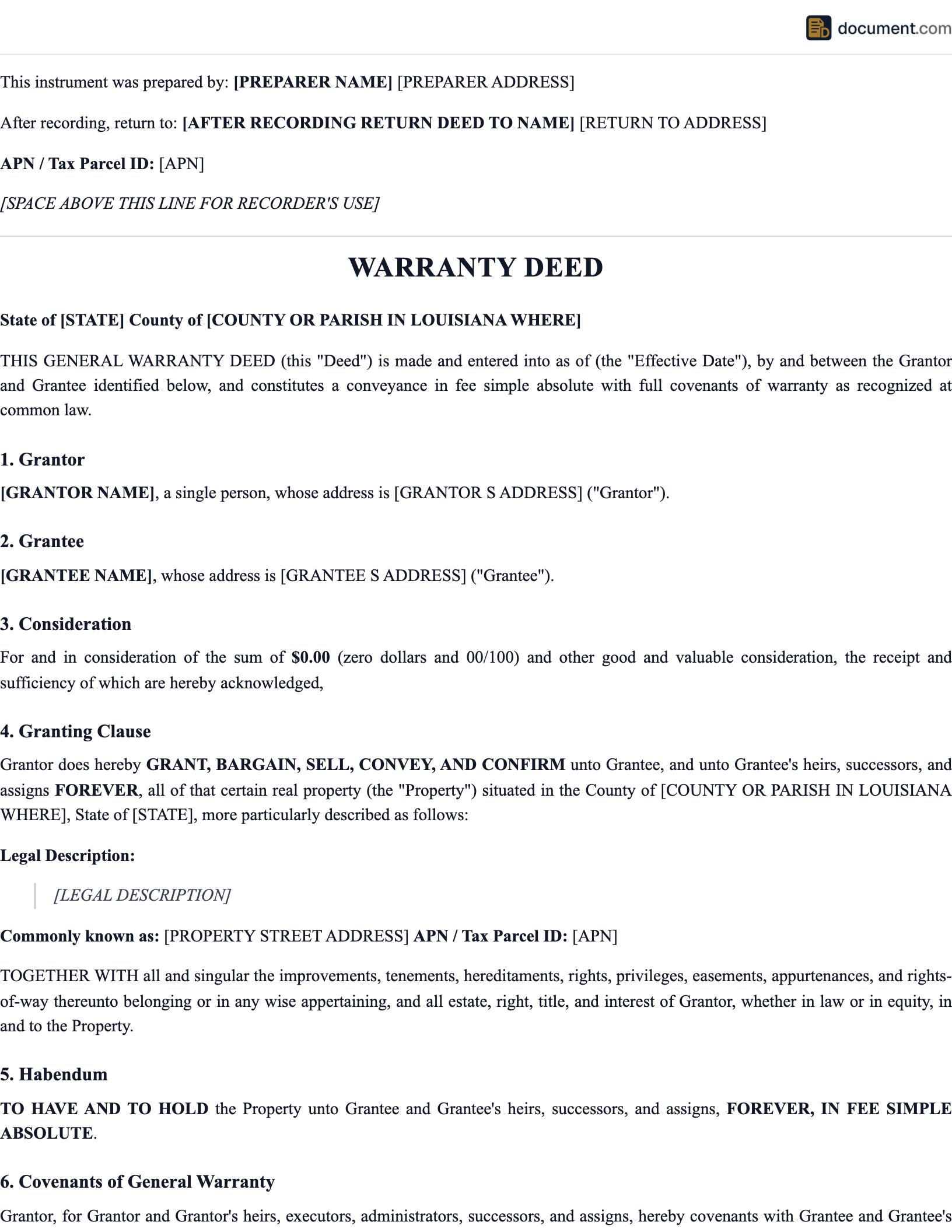
Sample South Dakota Warranty Deed
Preview of our South Dakota-specific template. Your document will include all fields required for recording in any South Dakota county.
WARRANTY DEED (GENERAL WARRANTY DEED)
STATE OF SOUTH DAKOTA
Legal Document
PARTY INFORMATION
Name: [Full Legal Name]
Address: [South Dakota Address]
County: [County]
PROPERTY DESCRIPTION
County: [County] State: South Dakota
Legal Description: [Per Recorded Plat]
Parcel No.: [APN]
South Dakota Warranty Deed FAQ
Common questions about filing in South Dakota, including requirements, fees, and tax implications.
Official South Dakota Resources
Official state resources for verifying requirements and finding your local recording office.
Important Considerations
South Dakota's lack of a transfer tax and state income tax makes it one of the cleaner states for real property transactions from a cost standpoint, but that simplicity can lead buyers and sellers to skip steps they shouldn't. The legal description is the single most common source of deed defects in South Dakota. Always pull the current deed of record from the county Register of Deeds and copy the legal description verbatim. Do not rely on the address, the tax parcel number, or a rough boundary description.
If the grantor acquired the property through a trust, LLC, or estate, the person signing the deed must have documented authority to convey. The Register of Deeds may require a copy of the trust agreement, LLC operating agreement, or letters testamentary to verify the signer's authority before accepting the deed for recording.
South Dakota is one of a small number of states that permits married couples to hold property under a Community Property Trust arrangement. This is not automatic and requires a separate trust document. If you are considering this option for tax planning purposes, consult a South Dakota estate planning attorney before drafting the deed.
A Note on South Dakota Recording
South Dakota's 66 counties vary in size, staffing, and technology. Smaller counties in the western part of the state may not offer e-recording and may have limited walk-in hours. Call the Register of Deeds before making a trip, especially in rural counties. Deadwood, Rapid City, and Sioux Falls area offices are generally better resourced for quick turnaround.
Related Documents
Depending on your situation, you may need additional documents alongside this one. Below are commonly related documents that are frequently used together in real estate transactions.
Important Considerations
Before proceeding with your document, there are several important factors to consider. Each real estate transaction is unique, and understanding the specific requirements and implications of your situation will help ensure a smooth and legally compliant process.
Real estate laws and regulations are subject to change, and local requirements may differ from state-level rules. It is always advisable to verify current requirements with your local recording office before submitting any documents for recording.
If your transaction involves complex circumstances such as multiple parties, commercial properties, trusts, estates, or interstate elements, consulting with a licensed real estate attorney is strongly recommended. An attorney can provide guidance specific to your situation and help you avoid potential legal issues.
Keep copies of all documents related to your real estate transaction in a safe place. Recorded documents become part of the public record, but having your own copies ensures you can reference the terms and conditions at any time. Digital copies stored securely are also recommended as a backup.
Professional Recommendation
While our templates are designed to be comprehensive and legally compliant, we recommend having your completed document reviewed by a licensed attorney before recording, especially for high-value transactions or complex situations. Many attorneys offer flat-fee document review services that provide peace of mind at a reasonable cost.
Related Documents
Depending on your situation, you may need additional documents alongside this one. Below are commonly related documents that are frequently used together in real estate transactions.
Create your South Dakota Warranty Deed in under 5 minutes.
Answer a few questions and download a South Dakota-compliant document, ready for the state agency.