
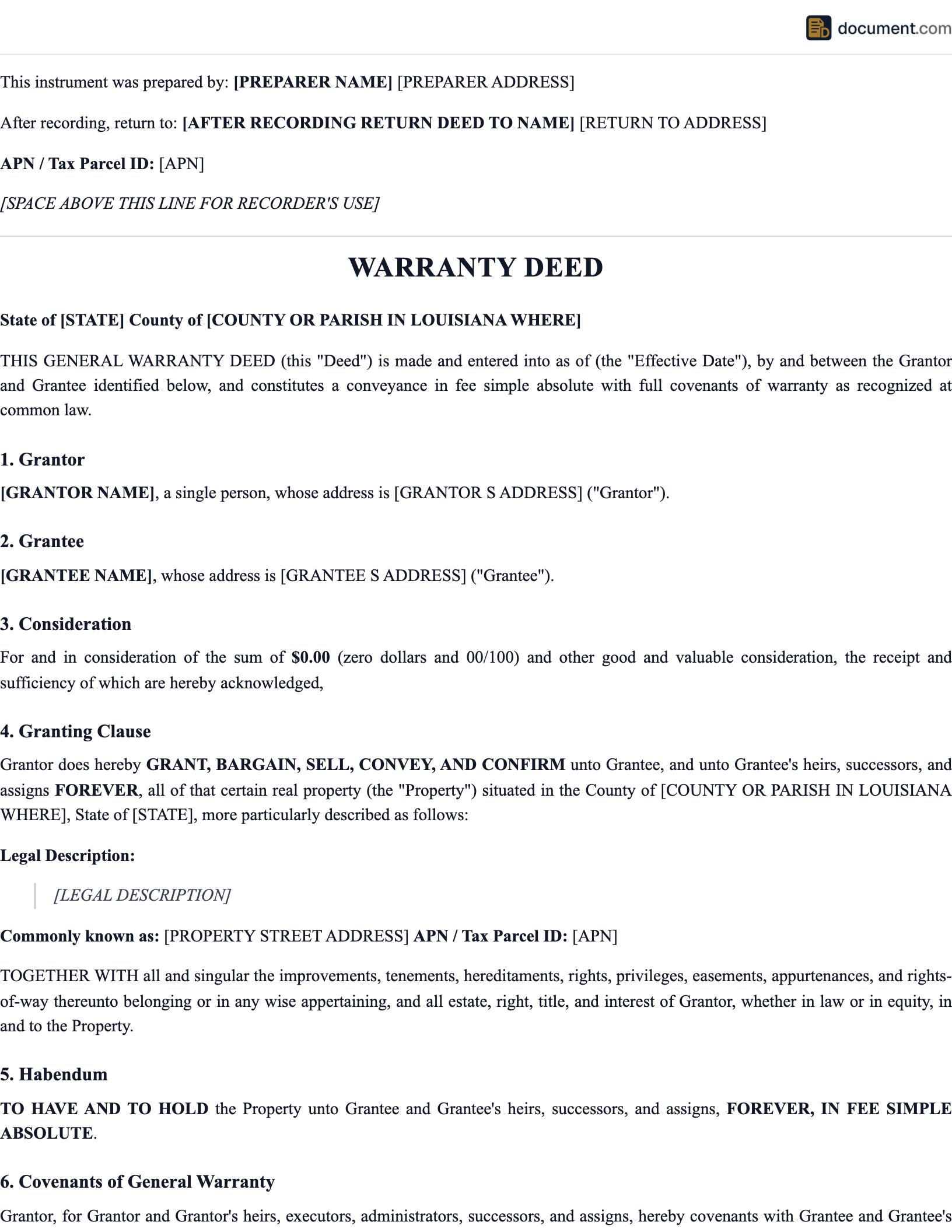



South Carolina Warranty Deed Overview
South Carolina warranty deeds are recorded with the Register of Deeds in the county where the property is located. South Carolina's deed stamp tax of $1.85 per $500 of consideration is collected at the time of recording and is typically paid by the seller by custom, though the parties can negotiate otherwise in their purchase agreement. South Carolina also has specific requirements around legal descriptions and marital status disclosure that set it apart from many other states.
One of the most practically important South Carolina requirements is the legal description standard. South Carolina requires that the legal description in a deed be tied to a recorded plat or a metes and bounds survey from a licensed surveyor. A tax map number or assessor description by itself is not sufficient for deed recording purposes. Additionally, the grantor's marital status must appear on the deed, and a married grantor's non-titled spouse may need to join in the conveyance to convey full marketable title.
$10
Recording fee
$1.85 per $500
Transfer tax
Required
Notarization
0
Witnesses required
South Carolina Requirements
The Register of Deeds in each of South Carolina's 46 counties handles deed recordings. South Carolina has requirements that are specific and enforced: the legal description must come from a recorded plat or licensed surveyor's metes and bounds description, and the grantor's marital status must be stated on the face of the deed.
South Carolina Specific Note
South Carolina imposes a deed stamp tax of $1.85 per $500 of consideration, paid at the time of recording with the Register of Deeds. By custom the seller pays, but this is negotiable. Critically, South Carolina requires that the legal description be derived from a recorded plat or metes and bounds survey prepared by a licensed surveyor. Using a tax map number or assessor description alone is not acceptable. The grantor's marital status must be disclosed on the deed, and a married grantor's non-titled spouse may need to sign to convey marital rights in the property.
Document Requirements
- Notarization: Must be notarized by a South Carolina notary public or authorized notary
- Witnesses: South Carolina requires 0 additional witness(es)
- Legal Description: Complete legal description as it appears on the current deed of record
- Parcel Number: Assessor's parcel number or tax ID
- Return Address: Mailing address for returning the recorded document
- Formatting: Standard formatting with adequate margins, black ink, minimum 10-point font
How to File in South Carolina
South Carolina's recording process flows through the county Register of Deeds. Before preparing the deed, obtain a copy of the current recorded deed and a current survey plat from the Register of Deeds or a licensed surveyor to confirm the legal description and verify the grantor's marital status.
Prepare the Document
Fill in all grantor and grantee names in full. Include the grantor's marital status on the face of the deed. If the grantor is married, include the non-titled spouse's signature line if their marital rights are being conveyed. Use a legal description derived from a recorded plat or metes and bounds survey, not a tax map number alone. Include the county tax map number (TMS number) as a supplemental identifier.
Get the Document Notarized
All signing parties, including any non-titled spouse joining in the conveyance, must sign in the physical presence of a South Carolina notary public. The notary completes the acknowledgment block with the date and their official seal. South Carolina does not require additional witnesses beyond the notary for standard deed acknowledgments.
Submit to the Register of Deeds
Bring the original notarized deed to the Register of Deeds office in the county where the property is located. Many South Carolina counties now accept e-recording through approved vendors. Check your county's Register of Deeds website for current filing options and hours.
Pay Recording Fees and Deed Stamps
At the time of recording, pay the Register of Deeds filing fee (typically around $10 for the first page, plus per-page charges) plus the deed stamp tax of $1.85 per $500 of consideration. The Register of Deeds will calculate the deed stamps based on the consideration stated in the deed. Bring the correct amount or ask about accepted payment methods in advance.
Notify County Assessor and Retain Recorded Copy
After recording, the Register of Deeds stamps the deed and returns it with the recording reference. Retain this recorded copy. In South Carolina, the county assessor uses deed transfer data to update ownership records and may reassess the property's value for tax purposes. Confirm with the county assessor that the ownership transfer has been registered in their records.
South Carolina Fees & Costs
Typical costs for filing in South Carolina. Actual fees may vary by county.
| Fee / Tax | Amount |
|---|---|
| Recording Fee | $10 |
| Transfer Tax | $1.85 per $500 |
| Notarization | $5 - $25 per signature |
| Certified Copy | $1 - $10 per page |
| Attorney Review (optional) | $150 - $500 |
South Carolina Tax Implications
South Carolina's deed recording fee, commonly called the deed stamp tax, is $1.85 per $500 of the property's consideration. For a $400,000 sale, that comes to $1,480 in deed stamps collected at the time of recording. This charge applies to all warranty deeds conveying real property for value. By custom in South Carolina real estate transactions, the seller pays the deed stamps, though the parties are free to allocate this cost differently in their purchase contract.
South Carolina has a property tax reassessment rule tied to deed transfers. When a property is sold at arm's length, the county assessor may reassess the property's value to reflect the sale price. South Carolina also has a 4% owner-occupied residential assessment ratio that significantly reduces property taxes for primary residences. Buyers who intend to use the property as their primary residence should apply for the 4% assessment ratio with the county assessor promptly after closing. If the prior owner had this exemption, it does not automatically transfer to the new owner.
Federal gift tax reporting requirements apply to deed transfers that are not arm's-length sales. If the transfer is between family members for less than market value, the difference may be a taxable gift. Sellers in standard transactions should account for federal and South Carolina state income tax on any capital gains from appreciation above their cost basis. South Carolina has its own income tax that applies to gains from property sales, separate from the federal capital gains tax.
Sample South Carolina Warranty Deed
Preview of our South Carolina-specific template. Your document will include all fields required for recording in any South Carolina county.
WARRANTY DEED (GENERAL WARRANTY DEED)
STATE OF SOUTH CAROLINA
Legal Document
PARTY INFORMATION
Name: [Full Legal Name]
Address: [South Carolina Address]
County: [County]
PROPERTY DESCRIPTION
County: [County] State: South Carolina
Legal Description: [Per Recorded Plat]
Parcel No.: [APN]
South Carolina Warranty Deed FAQ
Common questions about filing in South Carolina, including requirements, fees, and tax implications.
Official South Carolina Resources
Official state resources for verifying requirements and finding your local recording office.
Related Documents
Depending on your situation, you may need additional documents alongside this one. Below are commonly related documents that are frequently used together in real estate transactions.
Important Considerations
The marital status disclosure and spousal joinder requirement in South Carolina creates title risks that are easy to underestimate. If a married property owner conveys real estate by warranty deed without the non-titled spouse joining in the conveyance, the non-titled spouse may retain marital rights in the property under South Carolina law. This can cloud the buyer's title and create complications at future resale or refinancing. Always confirm the grantor's marital status before preparing the deed and include the non-titled spouse's signature as needed.
The legal description requirement is strict in South Carolina. The Register of Deeds can reject a deed that does not include a description derived from a recorded plat or metes and bounds survey. If you are buying property where no current plat exists or the description has never been formally surveyed, you may need to commission a new survey from a South Carolina licensed land surveyor before closing. This is common in rural counties and for tracts that have been divided informally over the years.
South Carolina's 4% owner-occupied property tax assessment ratio is a significant benefit that does not transfer automatically with the deed. The new owner must apply separately with the county assessor's office after recording the deed. If the prior owner had the exemption and you do not apply promptly, the property may be assessed at the 6% non-owner-occupied rate, which can significantly increase the annual property tax bill until the exemption is properly claimed.
South Carolina-Specific Attorney Tip
South Carolina real estate attorneys routinely handle issues around marital joinder, survey-based legal descriptions, and the 4% owner-occupied exemption application. For any South Carolina property transaction where one grantor is married, or where the legal description needs to be confirmed against a current plat or survey, a licensed South Carolina real estate attorney's review before recording is practical and often avoids costly corrections later.
Related Documents
Depending on your situation, you may need additional documents alongside this one. Below are commonly related documents that are frequently used together in real estate transactions.
Create your South Carolina Warranty Deed in under 5 minutes.
Answer a few questions and download a South Carolina-compliant document, ready for the state agency.