
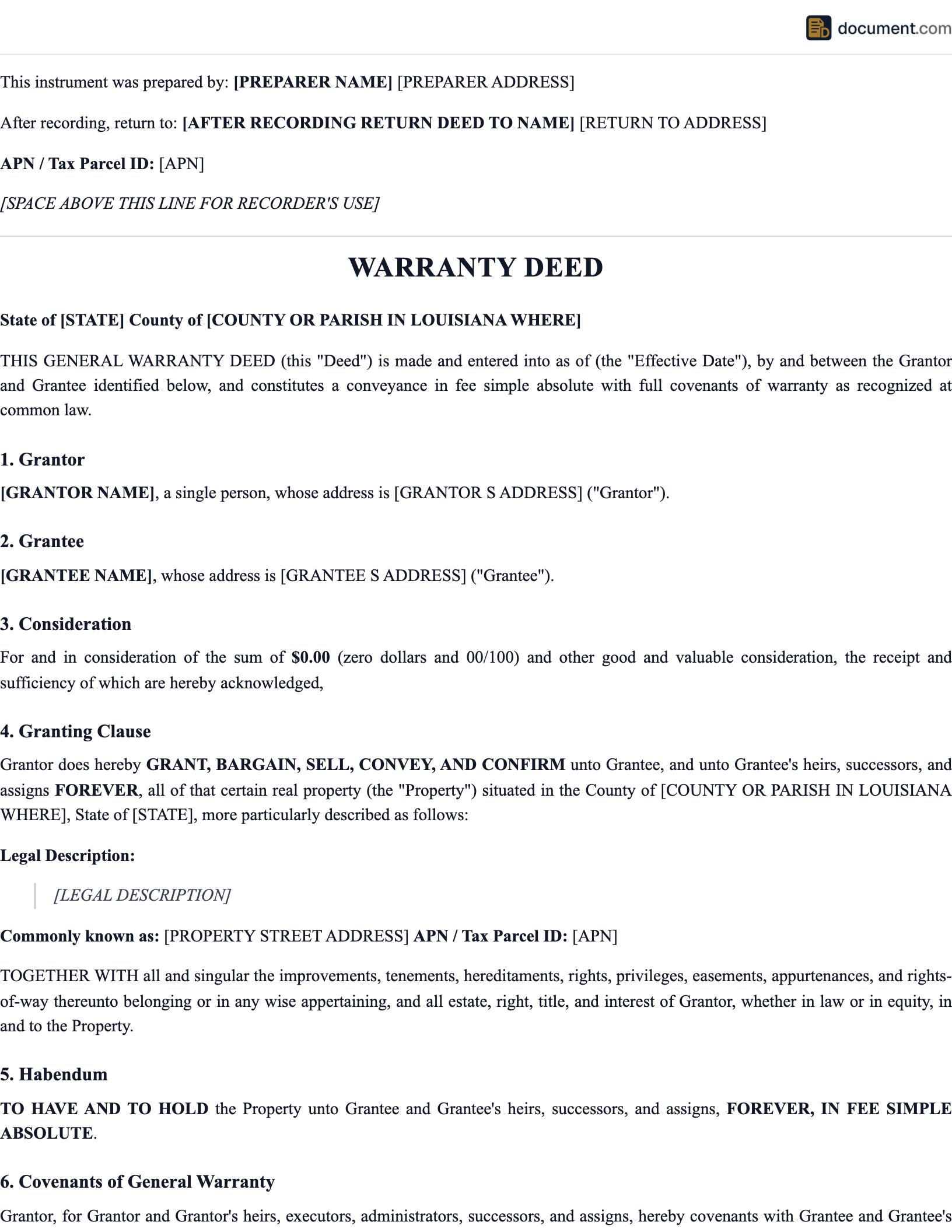



Oregon Warranty Deed Overview
Oregon warranty deeds are filed with the County Clerk in the county where the property is located. The statutory form is established under ORS 93.850, and when a grantor uses the phrase "conveys and warrants," Oregon law automatically attaches a general warranty of title against encumbrances created by the grantor. One notable requirement that sets Oregon apart is ORS 93.030, which mandates that every deed state the actual consideration paid, or clearly indicate that the transfer is a gift.
Oregon is also one of the very few states where not only the state itself, but also every city and county, is legally prohibited from imposing a real estate transfer tax. ORS 306.815 extends this ban to local governments, making Oregon's approach to transfer taxes unique in the country. This simplifies closing cost calculations considerably compared to states like Pennsylvania or New Jersey, where state and local transfer taxes stack on top of each other.
$56
Recording fee
Varies by county
Transfer tax
Required
Notarization
0
Witnesses required
Oregon Requirements
Oregon's County Clerk offices handle all deed recordings. Each county has its own fee schedule, but all are subject to the same statewide statutory requirements for deed validity. Recording fees tend to be higher in Oregon than in many other states, partly due to the county's role as the sole recording office for all land documents.
Oregon Specific Note
Oregon has no state or local real estate transfer tax. ORS 306.815 prohibits both state and local governments from levying transfer taxes on deeds, making Oregon one of the most transfer-tax-friendly states in the country. However, Oregon does require that every deed state the actual consideration paid or include a clear statement that the transfer is a gift under ORS 93.030. Omitting this can cause the County Clerk to reject the deed for recording. Recording fees start around $56 for the first page.
Document Requirements
- Notarization: Must be notarized by an Oregon notary public or authorized notary
- Witnesses: Oregon requires 0 additional witness(es)
- Legal Description: Complete legal description as it appears on the current deed of record
- Parcel Number: Assessor's parcel number or tax ID
- Return Address: Mailing address for returning the recorded document
- Formatting: Standard formatting with adequate margins, black ink, minimum 10-point font
How to File in Oregon
Oregon's filing process runs through each county's clerk office. Before you prepare the deed, retrieve the current recorded deed from the County Clerk's index to confirm the exact legal description and the names in which title is held.
Prepare the Document
Complete grantor and grantee names using their full legal names. Copy the legal description word-for-word from the current deed of record. Include the actual consideration amount or a proper gift statement as required by ORS 93.030. Use "conveys and warrants" as the granting language to invoke the ORS 93.850 statutory warranty.
Get the Document Notarized
The grantor must sign in front of an Oregon notary public. The notary will complete the acknowledgment certificate including the date, their commission expiration, and their official seal or stamp. Oregon does not require any witnesses beyond the notary for deed validity.
File With the County Clerk
Bring the original notarized deed to the County Clerk's office in the county where the property is located. Many Oregon counties also accept e-recording through approved vendors. Call ahead or check the county website to confirm current filing options and whether a cover sheet or additional forms are required.
Pay the Recording Fee
Oregon has no transfer tax at the state or local level, so your only payment at recording is the County Clerk's filing fee. Fees start around $56 for the first page and increase per additional page. Confirm the exact amount with your county before filing, as each county sets its own fee schedule.
Receive the Recorded Document
After recording, the County Clerk stamps the deed with a document number and returns it to the address listed on the deed. The deed is also indexed under the grantor and grantee names in the county's official real property records. Retain the recorded copy as your proof of ownership.
Oregon Fees & Costs
Typical costs for filing in Oregon. Actual fees may vary by county.
| Fee / Tax | Amount |
|---|---|
| Recording Fee | $56 |
| Transfer Tax | Varies by county |
| Notarization | $5 - $25 per signature |
| Certified Copy | $1 - $10 per page |
| Attorney Review (optional) | $150 - $500 |
Oregon Tax Implications
Oregon imposes no real estate transfer tax at any level of government. ORS 306.815 bars the state, counties, and municipalities from taxing deed transfers, which is a genuinely unusual protection compared to most other states. Sellers in Oregon avoid the thousands of dollars in transfer taxes that are routine in states like Pennsylvania or New York, and buyers do not need to factor any local transfer tax into their closing cost estimates.
Federal tax obligations still apply regardless of state policy. If the deed conveys property as a gift, the grantor may have reporting requirements under the federal gift tax rules if the value of the transferred interest exceeds the annual exclusion. Gift recipients typically inherit the grantor's original cost basis in the property, which affects capital gains calculations if the recipient later sells. Sellers in a standard transaction should consult a tax advisor about capital gains on any appreciated real property.
Oregon's property tax system is shaped in part by Measure 50, which limits how assessed values can increase annually for most properties. A deed transfer does not automatically trigger a full reassessment to market value. However, new construction and major improvements can prompt reassessment. Buyers who intend to substantially remodel or develop a property after purchase should speak with the county assessor's office about potential property tax implications before closing.
Sample Oregon Warranty Deed
Preview of our Oregon-specific template. Your document will include all fields required for recording in any Oregon county.
WARRANTY DEED (GENERAL WARRANTY DEED)
STATE OF OREGON
Legal Document
PARTY INFORMATION
Name: [Full Legal Name]
Address: [Oregon Address]
County: [County]
PROPERTY DESCRIPTION
County: [County] State: Oregon
Legal Description: [Per Recorded Plat]
Parcel No.: [APN]
Oregon Warranty Deed FAQ
Common questions about filing in Oregon, including requirements, fees, and tax implications.
Official Oregon Resources
Official state resources for verifying requirements and finding your local recording office.
Related Documents
Depending on your situation, you may need additional documents alongside this one. Below are commonly related documents that are frequently used together in real estate transactions.
Important Considerations
The consideration requirement in ORS 93.030 is easy to overlook but important. Oregon deeds must state the actual amount paid or include a statement that the transfer is a gift. This is not just administrative formality. County Clerks can reject deeds that fail to include it, and omitting the consideration can raise questions about the validity of the conveyance in a future title search. Make sure this is addressed before the deed is signed and notarized.
Oregon's land use system is among the most regulated in the country. Many rural and agricultural properties in Oregon are subject to farm and forest zone restrictions that limit how the land can be developed or subdivided. Before purchasing rural Oregon property, verify the zoning designation and any land use conditions that run with the land. These restrictions are recorded separately from the deed but are binding on subsequent owners regardless of notice.
Water rights in Oregon are a separate property interest that does not automatically transfer with a deed to the surface land. Oregon follows the prior appropriation doctrine, and water rights must be specifically transferred and reported to the Oregon Water Resources Department. If the property you are acquiring has irrigation rights or other certificated water rights, ensure those are included in the transaction documents and properly transferred in addition to the warranty deed.
Oregon-Specific Attorney Tip
Oregon real estate attorneys regularly deal with issues around land use restrictions, water rights, and the consideration disclosure requirement that catch out-of-state buyers and sellers off guard. If your transaction involves rural land, agricultural property, or any conveyance where the consideration is not a standard cash sale, a licensed Oregon real estate attorney can help structure the deed properly before recording.
Related Documents
Depending on your situation, you may need additional documents alongside this one. Below are commonly related documents that are frequently used together in real estate transactions.
Create your Oregon Warranty Deed in under 5 minutes.
Answer a few questions and download a Oregon-compliant document, ready for the state agency.