



Oklahoma Warranty Deed Overview
Oklahoma warranty deeds are recorded with the County Clerk in the county where the property sits. Title is governed by 16 O.S. Section 41, which creates the statutory warranty deed and specifies what warranties attach by operation of law when a grantor uses conveyancing language like "grant, bargain, sell and convey." The grantor is warranting title against all persons and entities, including anyone who may have acquired a claim through the grantor's own acts.
One aspect of Oklahoma real property law that surprises many first-time buyers is the prevalence of severed mineral estates. Oklahoma's oil and gas history means that surface rights and mineral rights are frequently held by different owners, and a warranty deed transfers only what the grantor actually owns. Additionally, Oklahoma has no state transfer tax on real estate, which puts it among a small number of states where only the recording fee applies at closing.
$18
Recording fee
$0.75 per $500
Transfer tax
Required
Notarization
0
Witnesses required
Oklahoma Requirements
The County Clerk's office handles all deed recordings in Oklahoma. Every Oklahoma county has its own office and while the statutory requirements are consistent statewide, individual counties may have local preferences around formatting, paper size, and payment methods. Calling ahead before you make the trip to file is always a good idea.
Oklahoma Specific Note
Oklahoma has no state real estate transfer tax. The documentary stamp tax was repealed, so the only charge at recording is the County Clerk's fee (around $18 for the first page). If the property has homestead status, both spouses must sign the deed even if only one holds title. Deeds conveying homestead property signed by only one spouse are voidable under Oklahoma law. Also confirm whether any prior mineral reservations affect the title before preparing the deed.
Document Requirements
- Notarization: Must be notarized by an Oklahoma notary public or authorized notary
- Witnesses: Oklahoma requires 0 additional witness(es)
- Legal Description: Complete legal description as it appears on the current deed of record
- Parcel Number: Assessor's parcel number or tax ID
- Return Address: Mailing address for returning the recorded document
- Formatting: Standard formatting with adequate margins, black ink, minimum 10-point font
How to File in Oklahoma
Oklahoma's recording process is handled county by county. Before you prepare the deed, pull the current vesting deed from the County Clerk's records to confirm the exact legal description and verify whether any mineral reservations or spousal interests appear in the chain of title.
Prepare the Document
Fill in all grantor and grantee names exactly as they appear in official records. Copy the legal description verbatim from the current deed of record at the County Clerk's office. If the property is homestead, include signature lines for both spouses even if only one holds title.
Get the Document Notarized
The grantor (and spouse, if homestead property) must sign in the physical presence of a notary public. The notary completes the acknowledgment block with the date, their commission number, and expiration date. Oklahoma does not require additional witnesses beyond the notary.
Take the Deed to the County Clerk
Bring the original notarized deed to the County Clerk's office in the county where the property sits. Most Oklahoma County Clerks accept walk-in filings during regular business hours. Some counties also accept filings by mail or through approved e-recording vendors.
Pay the Recording Fee
Oklahoma has no transfer tax on real estate, so you only pay the County Clerk's recording fee. The base fee is typically around $18 for the first page, with additional charges for each subsequent page. Confirm the exact amount with your county's office before filing.
Obtain the Stamped, Recorded Copy
After recording, the County Clerk stamps the deed with a book and page or document number and returns the original to the address specified on the document. Keep this recorded copy in a secure location. It is your proof of ownership and will be needed for any future sale or refinance.
Oklahoma Fees & Costs
Typical costs for filing in Oklahoma. Actual fees may vary by county.
| Fee / Tax | Amount |
|---|---|
| Recording Fee | $18 |
| Transfer Tax | $0.75 per $500 |
| Notarization | $5 - $25 per signature |
| Certified Copy | $1 - $10 per page |
| Attorney Review (optional) | $150 - $500 |
Oklahoma Tax Implications
Oklahoma stands out among states because it does not impose a real estate transfer tax. The documentary stamp tax that once applied to deed transfers was repealed by the legislature, and there is currently no state or county-level transfer tax collected at recording. This means a $500,000 property sale in Oklahoma avoids the several-thousand-dollar transfer tax that would apply in states like Pennsylvania or New York.
Federal tax considerations still apply. If a deed is a gift rather than an arm's-length sale, the grantor may have gift tax reporting obligations under IRS rules if the value of the transferred interest exceeds the annual exclusion amount. The recipient of a gift deed typically takes the grantor's original cost basis, which can have capital gains implications when the property is eventually sold. Sellers in a standard sale should account for any capital gains on appreciated property under federal law.
Oklahoma's county assessors reassess property values periodically, and a transfer of title can trigger a review of the assessed value used for property tax purposes. Oklahoma also has a homestead exemption that can reduce assessed value for owner-occupied primary residences. If you are purchasing a property and intend to live there, apply for the homestead exemption with the county assessor's office after the deed is recorded. The exemption does not transfer automatically with the deed.
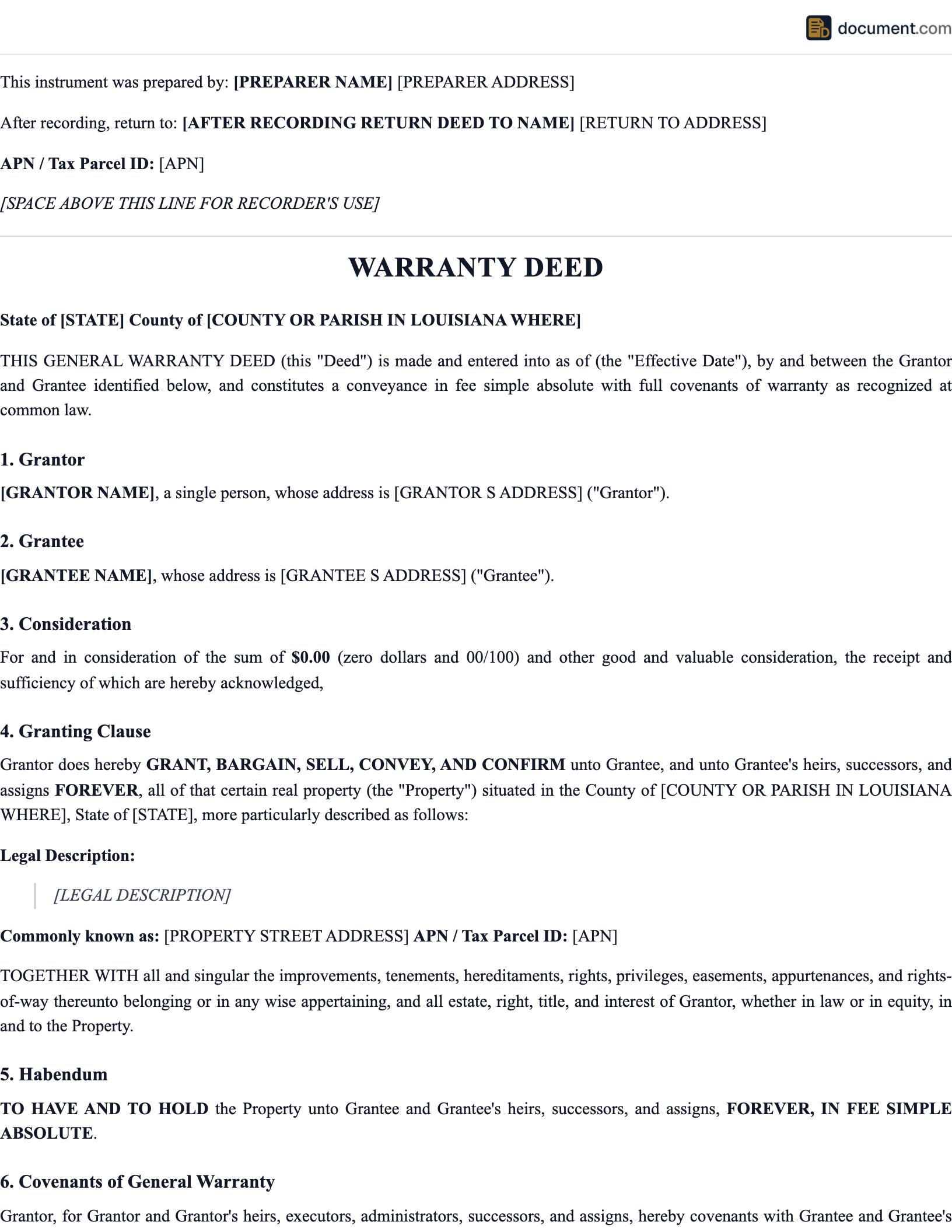
Sample Oklahoma Warranty Deed
Preview of our Oklahoma-specific template. Your document will include all fields required for recording in any Oklahoma county.
WARRANTY DEED (GENERAL WARRANTY DEED)
STATE OF OKLAHOMA
Legal Document
PARTY INFORMATION
Name: [Full Legal Name]
Address: [Oklahoma Address]
County: [County]
PROPERTY DESCRIPTION
County: [County] State: Oklahoma
Legal Description: [Per Recorded Plat]
Parcel No.: [APN]
Oklahoma Warranty Deed FAQ
Common questions about filing in Oklahoma, including requirements, fees, and tax implications.
Official Oklahoma Resources
Official state resources for verifying requirements and finding your local recording office.
Related Documents
Depending on your situation, you may need additional documents alongside this one. Below are commonly related documents that are frequently used together in real estate transactions.
Important Considerations
Mineral rights are the single biggest trap in Oklahoma real estate. Because Oklahoma has such a deep history of oil and gas production, countless properties have had their mineral estates severed from the surface over the past century. A warranty deed in Oklahoma conveys only what the grantor actually owns. If the grantor never acquired the minerals, or previously reserved them, they will not pass to the grantee regardless of how the deed is worded. Before preparing your deed, order a thorough title search that goes back far enough to identify any mineral severances or reservations in the chain of title.
Homestead protection in Oklahoma is meaningful and the joinder requirement has teeth. Courts have voided transfers of homestead property where the non-titled spouse was not included on the deed. Even if the parties have a valid reason for excluding one spouse, confirm with an Oklahoma real estate attorney whether the joinder requirement applies before closing. Situations involving divorce proceedings, separation, or estate transfers where homestead is involved require careful handling.
Oklahoma's county recording system means that practices around fees, turnaround times, and accepted filing methods vary from Tulsa County to Cimarron County. High-volume urban counties like Oklahoma County and Tulsa County typically have faster processing and more robust e-recording options. Smaller rural counties may require in-person filing and payment by check. The County Clerk's website or a quick phone call will tell you exactly what to expect before you make the trip.
Oklahoma-Specific Attorney Tip
Oklahoma real estate attorneys frequently encounter deed problems related to mineral severances and homestead joinder that could have been caught with a proper title search beforehand. If your property is in a historically active oil and gas region, or if any party in the transaction is married, consulting an Oklahoma licensed real estate attorney before recording is worthwhile. Many offer flat-fee deed preparation and review services.
Related Documents
Depending on your situation, you may need additional documents alongside this one. Below are commonly related documents that are frequently used together in real estate transactions.
Create your Oklahoma Warranty Deed in under 5 minutes.
Answer a few questions and download a Oklahoma-compliant document, ready for the state agency.