



Ohio Warranty Deed Overview
Ohio uses a two-step recording process that distinguishes it from most states. Before a warranty deed can be filed with the County Recorder, it must first go through the County Auditor. The Auditor applies the conveyance fee, endorses the deed, and updates ownership records. Only after receiving the Auditor's stamp will the County Recorder accept the document for recording. This sequence is mandatory under Ohio law and is not negotiable regardless of how straightforward the transaction appears.
Ohio Revised Code Section 5302.06 provides the statutory warranty deed form, and the implied covenants that attach to it are comprehensive: good title, right to convey, freedom from encumbrances except those stated, and a duty to defend the title. The conveyance fee is set at the county level and ranges from $1 to $4 per $1,000 of consideration depending on the county. Cuyahoga County charges more than most. Notarization is required; witnesses are not. Our Ohio template follows the ORC 5302.06 form and is structured to move cleanly through the Auditor's review process.
$28
Recording fee
$1 per $1,000
Transfer tax
Required
Notarization
0
Witnesses required
Ohio Requirements
The Auditor step is the most important Ohio-specific requirement to plan for. It adds time and requires either a physical visit to the Auditor's office or coordination through a title company or closing attorney who handles it as part of the closing service. The Auditor's endorsement is visible on the face of the recorded deed and is part of the official public record. Without it, the deed is not a valid recorded instrument in Ohio.
Ohio Specific Note
Ohio requires every warranty deed to pass through the County Auditor before it can be recorded with the County Recorder. The Auditor applies the conveyance fee (typically $1 per $1,000, but higher in some counties like Cuyahoga), endorses the deed, and updates property ownership records. Do not take the deed directly to the Recorder's office without first completing the Auditor step. Manufactured homes may be titled as personal property rather than real estate, requiring a different transfer process.
Document Requirements
- Notarization: Must be notarized by an Ohio notary public or authorized notary
- Witnesses: Ohio requires 0 additional witness(es)
- Legal Description: Complete legal description as it appears on the current deed of record
- Parcel Number: Assessor's parcel number or tax ID
- Return Address: Mailing address for returning the recorded document
- Formatting: Standard formatting with adequate margins, black ink, minimum 10-point font
How to File in Ohio
Ohio's filing process has one additional step compared to most states: the County Auditor's endorsement. Plan for this step and account for it in your closing timeline. Most title companies in Ohio handle both the Auditor and Recorder steps as part of their standard closing service, but if you are filing independently, understand the sequence before you show up at the courthouse.
Prepare the Deed Using the ORC 5302.06 Form
Complete the warranty deed with the grantor and grantee's full legal names and addresses, the property's complete legal description from the existing deed or a current survey, the Permanent Parcel Number (PPN), and the consideration amount. Ohio's statutory form under ORC 5302.06 implies the full general warranty covenants. Include the preparer's name and a return address for the recorded document.
Grantor Signs Before a Notary
The grantor executes the deed before an Ohio notary public under ORC 5301.01. No witnesses are required. The notary must include their commission expiration date. Ohio permits remote online notarization under ORC Chapter 147 through approved platforms, which is useful for out-of-state grantors or situations where in-person signing is not practical.
Present the Deed to the County Auditor
This is Ohio's distinctive step. Before recording, take the signed and notarized deed to the County Auditor's office in the county where the property is located. The Auditor reviews the transfer, computes the conveyance fee (typically $1 per $1,000 of consideration, but higher in some counties), collects payment, and stamps the deed with their endorsement. The Auditor also updates the county's property ownership records at this step.
Record With the County Recorder
After the Auditor endorsement, take the stamped deed to the County Recorder's office in the same county. Pay the recording fee, which starts around $28 for the first page. The Recorder indexes the deed and stamps it with the document number and recording date. Many Ohio counties now accept e-recordings, particularly for title companies submitting through approved platforms like Simplifile.
Receive the Recorded Deed and Update Records
After recording, the County Recorder returns the deed to the address listed on the instrument. Confirm that property tax bills will be sent to the new owner by verifying the Auditor's records were updated correctly during the endorsement step. Notify your mortgage servicer, property insurer, and any HOA of the ownership change.
Ohio Fees & Costs
Typical costs for filing in Ohio. Actual fees may vary by county.
| Fee / Tax | Amount |
|---|---|
| Recording Fee | $28 |
| Transfer Tax | $1 per $1,000 |
| Notarization | $5 - $25 per signature |
| Certified Copy | $1 - $10 per page |
| Attorney Review (optional) | $150 - $500 |
Ohio Tax Implications
Ohio's primary deed transfer tax is the conveyance fee, collected by the County Auditor under ORC 319.54. The standard rate is $1 per $1,000 of consideration, but certain counties have enacted a higher rate through local option. Cuyahoga County charges $4 per $1,000. Summit County charges $3 per $1,000. On a $400,000 Cuyahoga County sale, the conveyance fee alone is $1,600. Check the rate for your specific county before closing because the variation is meaningful on higher-value transactions.
Ohio also allows counties to charge an additional real property conveyance fee through a voter-approved levy under ORC 322.02. Some counties have passed these measures to fund local services, adding another dollar or two per $1,000 on top of the base rate. Ask the County Auditor's office for the current total conveyance fee rate before closing.
For sellers, Ohio's capital gains treatment follows federal rules at the state level with Ohio's own income tax applied to the gain. Ohio uses a graduated income tax schedule, and capital gains are taxed as ordinary income. If you owned the property as a primary residence for at least two of the previous five years, the federal exclusion ($250,000 for single filers, $500,000 for married filing jointly) reduces the taxable gain, but Ohio's income tax still applies to any taxable portion. Property tax in Ohio is calculated based on assessed value, which is set at 35% of the appraised value by county auditors. A deed transfer does not automatically trigger a new appraisal, but the Auditor may flag properties that have sold at significantly different values from the current assessment.
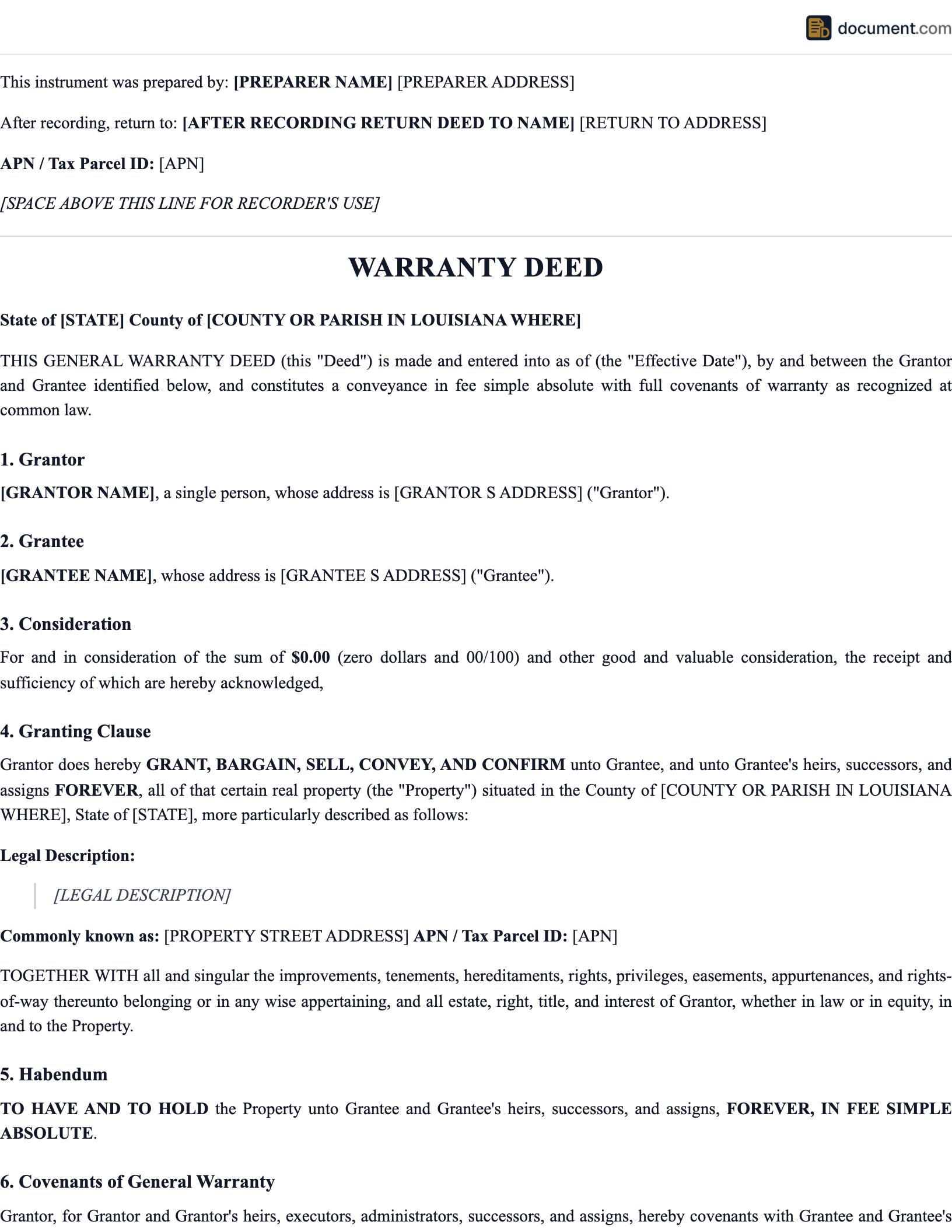
Sample Ohio Warranty Deed
Preview of our Ohio-specific template. Your document will include all fields required for recording in any Ohio county.
WARRANTY DEED (GENERAL WARRANTY DEED)
STATE OF OHIO
Legal Document
PARTY INFORMATION
Name: [Full Legal Name]
Address: [Ohio Address]
County: [County]
PROPERTY DESCRIPTION
County: [County] State: Ohio
Legal Description: [Per Recorded Plat]
Parcel No.: [APN]
Ohio Warranty Deed FAQ
Common questions about filing in Ohio, including requirements, fees, and tax implications.
Official Ohio Resources
Official state resources for verifying requirements and finding your local recording office.
Important Considerations
The Auditor step is the most common source of confusion and delay for people unfamiliar with Ohio deed recording. If you take a deed directly to the County Recorder without first going through the Auditor, the Recorder's office will turn you away. The Auditor and Recorder offices are often in the same building or courthouse complex, which makes the two-step process faster in practice than it sounds, but you must do them in order and you must pay the conveyance fee at the Auditor's window before the Recorder will accept the document.
If the property includes or may include a manufactured home, verify the home's title status before preparing a warranty deed. Ohio treats manufactured homes as either personal property (BMV title) or real property (converted to real estate through a recorded affidavit). A warranty deed can only convey a manufactured home that has been properly converted to real property. Conveying a manufactured home that is still titled as a motor vehicle requires a certificate of title transfer through the BMV, not a deed.
Ohio's conveyance fee rate varies by county and can be significantly higher in Northeast Ohio counties like Cuyahoga and Summit. For a high-value transaction in Cuyahoga County at $4 per $1,000, the conveyance fee on a $1 million transfer is $4,000. Calculate the total conveyance fee using the specific rate for your county before finalizing the purchase agreement, so there are no surprises at closing.
Ohio's Two-Step Recording Process
Ohio is one of only a few states that routes every deed through the County Auditor before recording. In practice, most Ohio closings are handled by title companies that manage both steps as part of their service. If you are filing independently, budget time to visit both offices, which are often in the same courthouse building. Confirm the current conveyance fee rate at the Auditor's office for your county, particularly if you are in Cuyahoga, Summit, or another county that has adopted a higher local-option rate.
Related Documents
Depending on your situation, you may need additional documents alongside this one. Below are commonly related documents that are frequently used together in real estate transactions.
Important Considerations
The Auditor step is the most common source of confusion for people unfamiliar with Ohio deed recording. If you take a deed directly to the County Recorder without first going through the Auditor, the Recorder's office will turn you away. The Auditor and Recorder offices are often in the same courthouse building, which makes the two-step process faster in practice than it sounds, but you must do them in order and pay the conveyance fee at the Auditor's window before the Recorder will accept the document.
If the property includes a manufactured home, verify the home's title status before preparing a warranty deed. Ohio treats manufactured homes as either personal property (BMV title) or real property (converted through a recorded affidavit). A warranty deed can only convey a manufactured home that has been properly converted to real property. A manufactured home still titled as a motor vehicle requires a certificate of title transfer through the BMV, not a deed.
Ohio's conveyance fee rate varies significantly by county. For a high-value transaction in Cuyahoga County at $4 per $1,000, the conveyance fee on a $1 million transfer is $4,000. Calculate the total conveyance fee using the specific rate for your county before finalizing the purchase agreement, so there are no surprises at closing.
Ohio's Two-Step Recording Process
Ohio is one of only a few states that routes every deed through the County Auditor before recording with the County Recorder. In practice, most Ohio closings are handled by title companies that manage both steps as part of their service. If you are filing independently, budget time to visit both offices. Confirm the current conveyance fee rate with the Auditor's office for your county before closing, particularly in Cuyahoga, Summit, or other counties with higher local-option rates.
Related Documents
Depending on your situation, you may need additional documents alongside this one. Below are commonly related documents that are frequently used together in real estate transactions.
Create your Ohio Warranty Deed in under 5 minutes.
Answer a few questions and download a Ohio-compliant document, ready for the state agency.