



North Dakota Warranty Deed Overview
North Dakota has one of the more straightforward warranty deed recording systems in the country. Deeds are recorded with the County Recorder in the county where the property is located, there is no state transfer tax, and recording fees are low. What makes North Dakota transactions more nuanced than they appear on the surface is the state's unique opt-in community property system and its significant oil and gas economy, which has created extensive mineral severance activity across western counties.
The state does not require an attorney to prepare or supervise a warranty deed transaction, which gives parties more flexibility than states like North Carolina. However, properties in the Bakken formation counties or properties held by married couples who have executed community property agreements require careful attention to who signs as grantor and what interests are being conveyed. The recording fee structure is simple: there is no transfer tax, and the base recording fee is among the lowest in the Midwest.
$10
Recording fee
None
Transfer tax
Required
Notarization
0
Witnesses required
North Dakota Requirements
North Dakota's recording requirements are among the least burdensome in the country. Notarization is required; witnesses are not. The deed must contain a complete legal description that precisely identifies the property. On agricultural parcels and Bakken-area properties, that description should clearly state whether mineral rights are included or excluded. If a couple has opted into North Dakota's community property system, both spouses must sign as grantors.
North Dakota Specific Note
North Dakota has no state real estate transfer tax. Recording fees are low, starting around $10. If the transaction involves property in an oil-producing county, confirm whether mineral rights are part of the conveyance and address this in the deed. If the grantors are married and have a community property agreement in place under NDCC Chapter 47-02, both spouses must sign as grantors. Remote online notarization is permitted under North Dakota law.
Document Requirements
- Notarization: Must be notarized by a North Dakota notary public or authorized notary
- Witnesses: North Dakota requires 0 additional witness(es)
- Legal Description: Complete legal description as it appears on the current deed of record
- Parcel Number: Assessor's parcel number or tax ID
- Return Address: Mailing address for returning the recorded document
- Formatting: Standard formatting with adequate margins, black ink, minimum 10-point font
How to File in North Dakota
Recording a warranty deed in North Dakota is a clean, low-friction process. There are no state tax forms to accompany the deed and no transfer tax to calculate. The entire process from preparation through recording can often be completed in a single business day in counties that accept walk-in filings or e-recordings.
Prepare the Deed
Complete all required fields: grantor and grantee full legal names and addresses, complete legal description from the existing deed of record, consideration amount, and warranty covenants. If mineral rights are a factor, state explicitly whether they are included or excluded. If the grantors are married with a community property agreement, both spouses must be listed as grantors.
Get the Deed Notarized
The grantor signs before a North Dakota notary public. No witnesses are required beyond the notary. The notary completes the acknowledgment certificate and includes their commission expiration date and seal. North Dakota permits remote online notarization, so out-of-state grantors can acknowledge the deed through an approved RON platform without traveling.
Submit to the County Recorder
Take the notarized deed to the County Recorder in the county where the property sits. Some North Dakota counties accept e-recordings; contact the recorder's office to confirm. There are no additional state-level forms required alongside the deed, which simplifies the submission compared to states with mandatory transfer tax returns.
Pay the Recording Fee
North Dakota has no transfer tax, so you pay only the County Recorder's recording fee. Fees are set at the county level and are modest, starting around $10 for the first page. Confirm the current fee schedule with the recorder before arriving. Payment methods vary by county.
Receive and Store the Recorded Deed
After recording, the County Recorder stamps the deed with the document number and recording date and returns it to the address listed on the instrument. Store the recorded original in a secure location. Notify the county tax director's office if the ownership change requires updating property tax records, and inform your insurance company of the new ownership.
North Dakota Fees & Costs
Typical costs for filing in North Dakota. Actual fees may vary by county.
| Fee / Tax | Amount |
|---|---|
| Recording Fee | $10 |
| Transfer Tax | None |
| Notarization | $5 - $25 per signature |
| Certified Copy | $1 - $10 per page |
| Attorney Review (optional) | $150 - $500 |
North Dakota Tax Implications
North Dakota imposes no state real estate transfer tax, and it is also notable for having no state individual income tax. That combination means a North Dakota resident selling appreciated property owes federal capital gains tax but no state income tax on the gain, which is a meaningful difference from states like California or New York where combined federal and state tax on long-term capital gains can exceed 35%. This is worth factoring into your net proceeds calculation if you are comparing a North Dakota sale to properties in other states.
For gift transfers, federal gift tax rules still apply. If the value of the property transferred as a gift exceeds the annual gift tax exclusion, the grantor must file IRS Form 709. The recipient takes the grantor's original cost basis rather than the fair market value at the time of the gift. This carryover basis can result in a large taxable capital gain when the property is eventually sold, particularly on North Dakota farmland that has appreciated significantly over the past two decades.
Property tax in North Dakota is administered by the county tax director and is based on assessed value. North Dakota's agricultural land assessment rules are separate from residential and commercial rules, and farmland is assessed using a capitalized income formula rather than market value. If you are conveying agricultural property, confirm with the county director whether any agricultural exemptions or special assessment programs will continue to apply after the transfer. Some programs require a reapplication by the new owner.
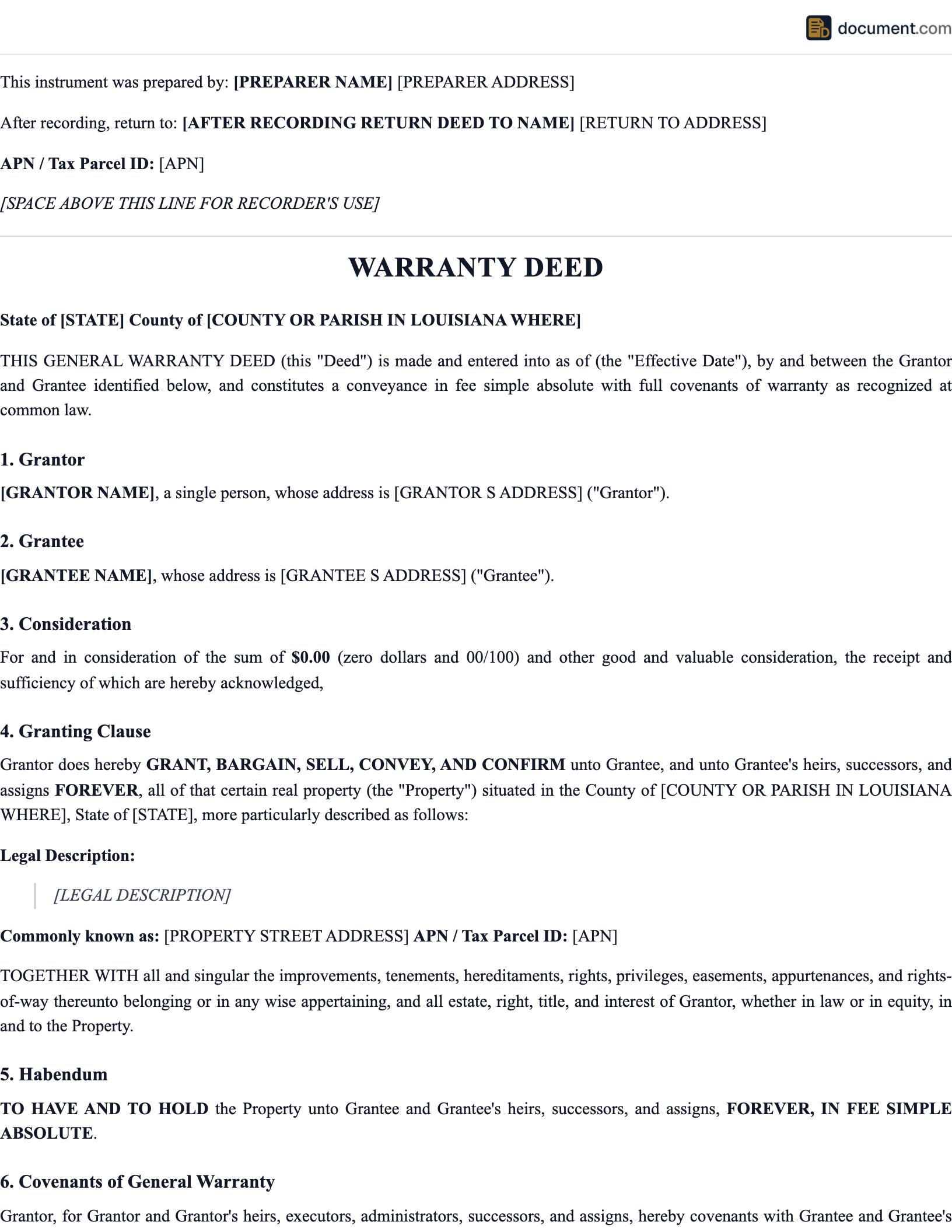
Sample North Dakota Warranty Deed
Preview of our North Dakota-specific template. Your document will include all fields required for recording in any North Dakota county.
WARRANTY DEED (GENERAL WARRANTY DEED)
STATE OF NORTH DAKOTA
Legal Document
PARTY INFORMATION
Name: [Full Legal Name]
Address: [North Dakota Address]
County: [County]
PROPERTY DESCRIPTION
County: [County] State: North Dakota
Legal Description: [Per Recorded Plat]
Parcel No.: [APN]
North Dakota Warranty Deed FAQ
Common questions about filing in North Dakota, including requirements, fees, and tax implications.
Official North Dakota Resources
Official state resources for verifying requirements and finding your local recording office.
Important Considerations
North Dakota's opt-in community property system is easy to overlook and easy to cause problems with. Most North Dakota married couples own property under the default rules, which treat individually titled property as separate and jointly titled property under whatever tenancy form is stated in the deed. But if a couple has executed a community property agreement under NDCC Chapter 47-02, those default rules are overridden. A grantor who does not know their spouse executed such an agreement could sign a deed and have it challenged later. Before closing on a purchase from a married seller in North Dakota, confirm whether a community property agreement is on file with the county recorder.
Mineral rights in western North Dakota are a serious title consideration. The Bakken shale play has generated enormous activity in Williams, McKenzie, Mountrail, and Dunn Counties, among others. A property that appears straightforward on the surface record may have dozens of recorded mineral leases, overriding royalty assignments, and partial mineral conveyances affecting the subsurface estate. If you are buying in an oil and gas county, a surface-only title search is not enough. Request a mineral title report and ensure the deed clearly states whether minerals are included in the conveyance.
Agricultural land conveyances in North Dakota can also involve federal conservation program restrictions, particularly CRP (Conservation Reserve Program) contracts. A buyer who purchases farmland subject to an active CRP contract assumes the obligations of that contract. Violating CRP terms can result in significant repayment obligations to the USDA. Disclose and address any existing CRP enrollment in the purchase agreement and note it in the deed or a separate agreement if necessary.
Practical Advice for North Dakota Transactions
North Dakota's low-fee, no-transfer-tax recording environment makes the administrative side of a deed transfer simple. The complexity in North Dakota deals typically lives in the substance: mineral rights, community property agreements, agricultural program restrictions, and farmland ownership rules that limit who can hold agricultural land under North Dakota law. For any transaction involving agricultural property or oil and gas county parcels, working with a North Dakota title company or real estate attorney who knows the local recording history is worth the cost.
Related Documents
Depending on your situation, you may need additional documents alongside this one. Below are commonly related documents that are frequently used together in real estate transactions.
Important Considerations
North Dakota's opt-in community property system is easy to overlook. Most North Dakota married couples own property under default rules, treating individually titled property as separate. But if a couple has a community property agreement under NDCC Chapter 47-02, both spouses must sign as grantors on any deed conveying community property. Before purchasing from a married seller in North Dakota, confirm whether a community property agreement exists in the county recorder's records.
Mineral rights in western North Dakota require serious attention. The Bakken shale play has generated extensive mineral severance activity in Williams, McKenzie, Mountrail, and Dunn Counties. A property that appears simple on the surface record may have dozens of recorded mineral leases and partial conveyances. If you are buying in an oil and gas county, a surface-only title search is not adequate. Request a mineral title report and ensure the deed addresses whether minerals are included in the conveyance.
Agricultural land conveyances may involve CRP (Conservation Reserve Program) contracts with federal obligations. A buyer who purchases farmland subject to an active CRP contract assumes the seller's obligations. Violating CRP terms can result in significant repayment liability to the USDA. Confirm CRP enrollment status and address it in the purchase agreement before closing.
Practical Advice for North Dakota Transactions
North Dakota's low-fee, no-transfer-tax recording environment makes the administrative side of deed recording simple. The complexity in North Dakota deals typically lives in the substance: mineral rights, community property agreements, agricultural program restrictions, and farmland ownership rules. For transactions involving agricultural property or oil and gas county parcels, working with a North Dakota title company or real estate attorney who knows the local recording history is worth the cost.
Related Documents
Depending on your situation, you may need additional documents alongside this one. Below are commonly related documents that are frequently used together in real estate transactions.
Create your North Dakota Warranty Deed in under 5 minutes.
Answer a few questions and download a North Dakota-compliant document, ready for the state agency.