



North Carolina Warranty Deed Overview
North Carolina records warranty deeds through its 100 county Registers of Deeds, not through a state-level office. The state imposes an excise tax on deed transfers at $1 per $500 of consideration, which the seller pays before the deed can be recorded. North Carolina is also one of a small number of states that requires a licensed attorney to supervise deed preparation and real estate closings; the North Carolina State Bar has issued formal opinions making clear that deed preparation is the practice of law and cannot be handled by non-lawyers for compensation.
North Carolina previously required two witnesses for a valid deed acknowledgment, but that requirement was abolished. Today only notarization is required, governed by NC General Statutes Section 47-38. Acknowledgment before a North Carolina notary public is the standard. The notary must include their commission expiration date. Without a complete and proper notarial certificate, the Register of Deeds will refuse to record the document regardless of how otherwise complete it is.
$26
Recording fee
$1 per $500
Transfer tax
Required
Notarization
0
Witnesses required
North Carolina Requirements
North Carolina recording requirements have a few particulars worth knowing. The excise tax must be paid before recording and is calculated on stated consideration at $1 per $500, rounded up. If consideration is not stated (as in a gift or family conveyance), the deed must include a statement describing the exemption basis. Many counties also require a tax certification from the county tax collector confirming no delinquent taxes before they will record a deed. This varies by county, so ask the Register of Deeds in advance.
North Carolina Specific Note
North Carolina requires a licensed attorney to supervise all real estate closings and deed preparation. The excise tax (revenue stamps) at $1 per $500 of consideration must be paid by the seller before recording. The old two-witness requirement for acknowledgments has been abolished; only notarization is now required under NC GS 47-38. Include the Parcel Identification Number (PIN) on the deed. Some counties require tax certification before recording.
Document Requirements
- Notarization: Must be notarized by a North Carolina notary public or authorized notary
- Witnesses: North Carolina requires 0 additional witness(es)
- Legal Description: Complete legal description as it appears on the current deed of record
- Parcel Number: Assessor's parcel number or tax ID
- Return Address: Mailing address for returning the recorded document
- Formatting: Standard formatting with adequate margins, black ink, minimum 10-point font
How to File in North Carolina
Recording a warranty deed in North Carolina requires an attorney's involvement in the preparation step. The process otherwise moves efficiently, particularly in larger counties that have adopted e-recording. Expect the following sequence at a typical residential closing:
Attorney Prepares the Deed
A licensed North Carolina attorney prepares the warranty deed. Include full grantor and grantee names, the Parcel Identification Number (PIN), the complete legal description from the current deed of record, and the consideration amount. The preparation of this document is the practice of law in North Carolina and must be handled or supervised by a licensed NC attorney.
Grantor Signs and Notary Acknowledges
The grantor signs the deed before a North Carolina notary public. No witnesses are required beyond the notary. The notary must complete the acknowledgment certificate and include their commission expiration date. A deficient acknowledgment will result in the Register of Deeds rejecting the document.
Pay the Excise Tax
Before the deed can be recorded, the grantor (seller) pays the excise tax at $1 per $500 of consideration. Revenue stamps or the tax amount are noted on the deed. Exempt transfers must include language identifying the exemption. Some counties also require a tax certification from the county tax collector confirming no delinquent property taxes before they will record.
Record With the Register of Deeds
Submit the signed, notarized deed to the Register of Deeds in the county where the property is located. Recording fees start around $26 for the first page. Many North Carolina counties now accept e-recordings through approved platforms. The recording date establishes priority and provides constructive notice to all subsequent purchasers and lienholders.
Receive the Recorded Deed
After recording, the Register of Deeds returns the stamped original to the return address listed on the instrument. Keep the recorded original in a safe place. Notify the county tax office of the ownership change to ensure property tax bills go to the correct party. Inform your property insurer and any mortgage servicer of the transfer as well.
North Carolina Fees & Costs
Typical costs for filing in North Carolina. Actual fees may vary by county.
| Fee / Tax | Amount |
|---|---|
| Recording Fee | $26 |
| Transfer Tax | $1 per $500 |
| Notarization | $5 - $25 per signature |
| Certified Copy | $1 - $10 per page |
| Attorney Review (optional) | $150 - $500 |
North Carolina Tax Implications
North Carolina's primary deed-related tax is the excise tax, collected at the state level and remitted through the recording process at $1 per $500 of consideration, which the seller pays. The tax is straightforward to calculate, and the revenue goes into the state's general fund. Some transfers are exempt, including transfers between spouses and certain trust and estate conveyances, but the exemption must be recited in the deed itself. Failing to note the exemption will result in the Register of Deeds expecting payment regardless.
For gift transfers, the federal gift tax rules still apply when the value exceeds the annual exclusion amount. The recipient takes the grantor's cost basis, which becomes relevant when the property is eventually sold. North Carolina also imposes its own individual income tax, and capital gains on property sales are taxed as ordinary income at the state level. If you are selling appreciated property, factor in both the federal capital gains rate and the North Carolina income tax rate when calculating after-tax proceeds.
Property tax in North Carolina is administered at the county level and is based on assessed value, which counties are required to update at least every eight years under state law. Most active markets reappraise more frequently. A deed transfer does not by itself trigger a full property reappraisal, but the new owner should verify the assessed value shortly after closing and appeal it if the assessment appears out of line with market value. Some counties complete informal review requests quickly, and the potential savings on annual tax bills make the effort worthwhile.
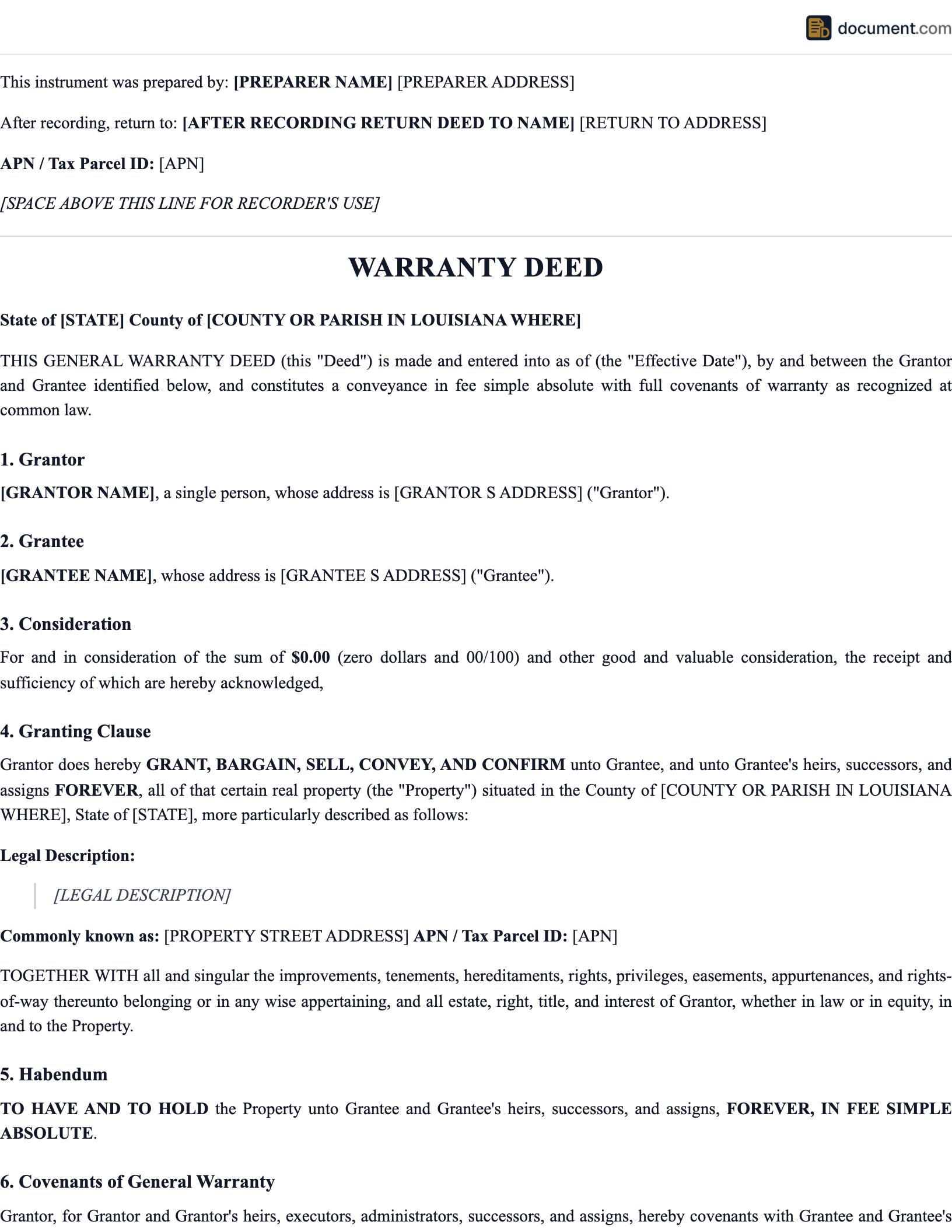
Sample North Carolina Warranty Deed
Preview of our North Carolina-specific template. Your document will include all fields required for recording in any North Carolina county.
WARRANTY DEED (GENERAL WARRANTY DEED)
STATE OF NORTH CAROLINA
Legal Document
PARTY INFORMATION
Name: [Full Legal Name]
Address: [North Carolina Address]
County: [County]
PROPERTY DESCRIPTION
County: [County] State: North Carolina
Legal Description: [Per Recorded Plat]
Parcel No.: [APN]
North Carolina Warranty Deed FAQ
Common questions about filing in North Carolina, including requirements, fees, and tax implications.
Official North Carolina Resources
Official state resources for verifying requirements and finding your local recording office.
Important Considerations
The most important North Carolina-specific rule for most people to know is that deed preparation requires attorney involvement. This is not a formality. The North Carolina State Bar treats unauthorized deed preparation as the unauthorized practice of law and has pursued cases against individuals and services that prepared deeds for compensation without a license. If you are conducting a family transfer or other straightforward conveyance, an NC attorney can typically review and prepare a deed for a flat fee that is far less than the cost of a title dispute later.
Before submitting any deed for recording, confirm with the Register of Deeds whether your county requires a tax certification from the county tax collector. This is not universally required across all 100 counties, but it is common in many of them, and arriving at the Register of Deeds without the certification when the office requires it will delay your recording. Call ahead or check the county's website.
If the property you are conveying was ever located within a North Carolina DOT corridor map area before the Map Act's repeal in 2016, review the title history carefully. Some properties in Piedmont corridors along planned I-285, I-485 extensions, and other routes had development restrictions attached to them for years. Although the Map Act itself is gone, the historical encumbrances and related compensation claims may have generated recorded instruments that affect the title chain.
Attorney Requirement in North Carolina
North Carolina is one of a handful of states where attorney involvement in deed preparation is not merely recommended but legally required. The North Carolina State Bar considers deed preparation for compensation to be the practice of law. Budget for an attorney at closing. In most residential transactions, one attorney handles the closing for the buyer's benefit and charges $600 to $1,200 in typical markets. For commercial or complex ownership structure transactions, fees are higher and multiple attorneys may be involved.
Related Documents
Depending on your situation, you may need additional documents alongside this one. Below are commonly related documents that are frequently used together in real estate transactions.
Important Considerations
Before proceeding with your document, there are several important factors to consider. Each real estate transaction is unique, and understanding the specific requirements and implications of your situation will help ensure a smooth and legally compliant process.
Real estate laws and regulations are subject to change, and local requirements may differ from state-level rules. It is always advisable to verify current requirements with your local recording office before submitting any documents for recording.
If your transaction involves complex circumstances such as multiple parties, commercial properties, trusts, estates, or interstate elements, consulting with a licensed real estate attorney is strongly recommended. An attorney can provide guidance specific to your situation and help you avoid potential legal issues.
Keep copies of all documents related to your real estate transaction in a safe place. Recorded documents become part of the public record, but having your own copies ensures you can reference the terms and conditions at any time. Keep the recorded original in a secure location and maintain digital backups. Notify the county tax office of the new ownership so property tax bills reach the correct party going forward.
Attorney Requirement in North Carolina
North Carolina law requires a licensed attorney to supervise all real estate closings and deed preparation. This is not a recommendation; it is a legal requirement enforced by the State Bar. Budget for attorney fees as part of your closing costs. Most residential transactions in North Carolina involve a single closing attorney who represents the lender's and buyer's interests, with fees typically in the $600 to $1,200 range for standard transactions.
Related Documents
Depending on your situation, you may need additional documents alongside this one. Below are commonly related documents that are frequently used together in real estate transactions.
Create your North Carolina Warranty Deed in under 5 minutes.
Answer a few questions and download a North Carolina-compliant document, ready for the state agency.