



New York Warranty Deed Overview
New York has one of the more layered deed recording processes in the country. Every warranty deed must be accompanied by a completed RP-5217 Real Property Transfer Report before the county clerk will accept it for recording. In New York City, the Department of Finance administers an additional municipal recording system through ACRIS, and sellers owe a separate NYC Real Property Transfer Tax on top of the state RPTT. Closings in New York are conducted by attorneys, not escrow officers, which shapes the whole dynamic of how deeds get prepared and reviewed.
The state transfer tax runs $2 per $500 of consideration (0.4%). On residential sales over $1 million anywhere in New York State, the buyer pays an additional 1% mansion tax. Within the five boroughs, the seller also owes the NYC transfer tax, which ranges from 1% to 2.625% depending on property type and value. Recording fees start around $40 but increase with page count and additional instruments. Understanding the full tax stack before closing is essential, especially on high-value Manhattan and Brooklyn transactions where the combined transfer taxes can represent a meaningful line item.
$40
Recording fee
$2 per $500
Transfer tax
Required
Notarization
0
Witnesses required
New York Requirements
New York recording requirements go beyond notarization. The RP-5217 form is mandatory and must be completed accurately. County clerks are not permitted to record a deed without it. In New York City, the ACRIS e-recording system has its own submission requirements, and the Department of Finance must clear the NYC transfer tax before the clerk will stamp the deed. Outside the city, county-specific formatting requirements (margin sizes, font minimums, cover page requirements) vary and should be verified with each clerk's office.
New York Specific Note
Every deed filed in New York must be accompanied by a completed RP-5217 Real Property Transfer Report. In New York City, the NYC Real Property Transfer Tax must be paid through the Department of Finance before recording. The mansion tax (1% on residential sales over $1 million) is paid by the buyer and is due at closing. Attorneys handle deed preparation and closing in New York by established custom.
Document Requirements
- Notarization: Must be notarized by a New York notary public or authorized notary
- Witnesses: New York requires 0 additional witness(es)
- Legal Description: Complete legal description as it appears on the current deed of record
- Parcel Number: Assessor's parcel number or tax ID
- Return Address: Mailing address for returning the recorded document
- Formatting: Standard formatting with adequate margins, black ink, minimum 10-point font
How to File in New York
New York deed recording involves more steps than most states due to the mandatory RP-5217 requirement, the attorney-closing custom, and the separate NYC tax clearance process if your property is in the five boroughs. Plan for these steps and their timing before closing day.
Prepare the Deed and RP-5217
The grantor's attorney prepares the warranty deed. Include the full legal description using the tax map designation (section, block, and lot), not just a street address. Complete the RP-5217 Real Property Transfer Report simultaneously. In NYC, prepare the ACRIS submission package through the Department of Finance portal.
Get the Deed Notarized at Closing
The grantor signs before a New York notary public at the closing. No additional witnesses are required. The notary must be commissioned in New York. Out-of-state notaries can acknowledge New York deeds only if they hold a New York certificate of authentication, which is why using a local NY notary at the closing table is standard practice.
Pay State and NYC Transfer Taxes
The state RPTT ($2 per $500) is typically paid by the seller at closing through the attorney. If the property is in New York City, the seller's attorney clears the NYC RPTT through the Department of Finance before recording. The mansion tax (1% of the purchase price on residential transfers over $1 million) is collected from the buyer at closing.
Record With the County Clerk
Submit the notarized deed, completed RP-5217, and recording fee to the County Clerk. In NYC, submission goes through ACRIS. Many upstate counties now accept e-recordings through Simplifile or similar platforms. Recording fees start around $40 but increase with additional pages and instruments.
Receive the Recorded Deed
After recording, the clerk stamps the deed with the liber (book) and page reference and mails or electronically returns it to the submitting attorney or title company. The recorded deed should be delivered to the new owner. Notify the property insurer and mortgage servicer of the ownership change promptly.
New York Fees & Costs
Typical costs for filing in New York. Actual fees may vary by county.
| Fee / Tax | Amount |
|---|---|
| Recording Fee | $40 |
| Transfer Tax | $2 per $500 |
| Notarization | $5 - $25 per signature |
| Certified Copy | $1 - $10 per page |
| Attorney Review (optional) | $150 - $500 |
New York Tax Implications
New York imposes multiple transfer taxes that stack on top of each other in ways that surprise buyers and sellers who are accustomed to simpler states. The base New York State Real Property Transfer Tax is $2 per $500 of consideration (0.4%), paid by the seller. On any residential sale over $1 million statewide, the buyer additionally owes the mansion tax at 1% of the full purchase price. That tax is not marginal, it applies to the entire price once the threshold is crossed.
In New York City, the seller also owes the NYC Real Property Transfer Tax separately from the state tax. The NYC rate is 1% on transfers of $500,000 or less, and 1.425% on residential transfers above $500,000. For commercial properties or mixed-use buildings, the NYC RPTT runs 1.425% on transfers up to $500,000 and 2.625% above that level. In practice, the total tax burden on a high-value Manhattan sale can reach 3% or more on the combined state and city taxes before accounting for the mansion tax on the buyer's side.
Gift transfers are subject to the same recording requirements and transfer taxes unless a specific exemption applies. Transfers between spouses are exempt from the state RPTT. Certain family transfers and estate conveyances may also qualify for exemptions, but these require careful documentation. Basis carries over to the recipient in a gift transfer, which creates deferred capital gains exposure. New York also imposes its own state income tax on capital gains, so residents selling appreciated property face both federal and New York State capital gains taxes on the profit.
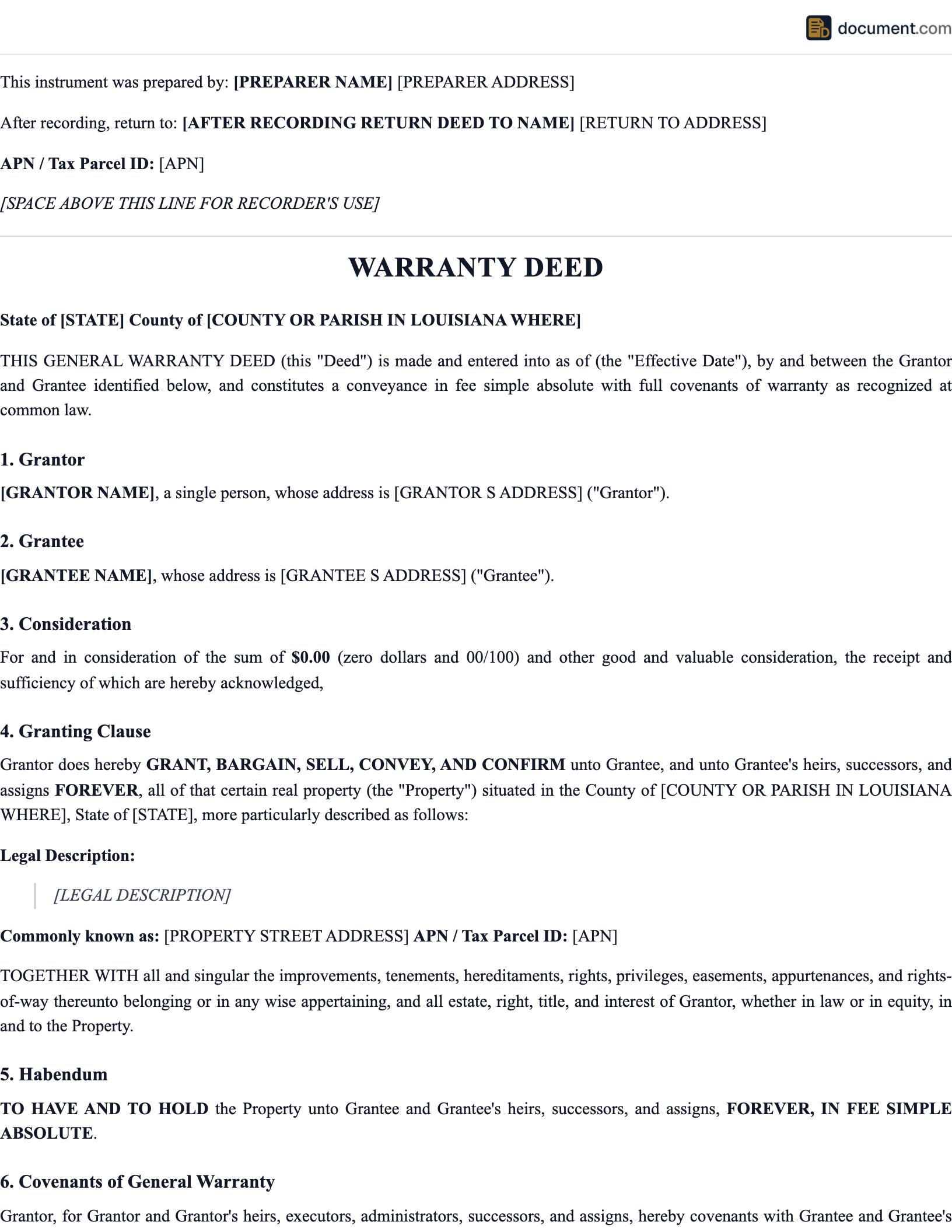
Sample New York Warranty Deed
Preview of our New York-specific template. Your document will include all fields required for recording in any New York county.
WARRANTY DEED (GENERAL WARRANTY DEED)
STATE OF NEW YORK
Legal Document
PARTY INFORMATION
Name: [Full Legal Name]
Address: [New York Address]
County: [County]
PROPERTY DESCRIPTION
County: [County] State: New York
Legal Description: [Per Recorded Plat]
Parcel No.: [APN]
New York Warranty Deed FAQ
Common questions about filing in New York, including requirements, fees, and tax implications.
Official New York Resources
Official state resources for verifying requirements and finding your local recording office.
Important Considerations
New York is an attorney-closing state as a matter of entrenched custom. Both the buyer and the seller retain separate legal counsel. The grantor's attorney prepares the deed. Even if you are conducting a straightforward family transfer with no lender involved, having an attorney review the deed and the RP-5217 before recording is standard practice and provides protection that is hard to replicate through any other means.
The RP-5217 form cannot be skipped or submitted after the fact. County clerks will turn away deeds presented without it. In New York City, the ACRIS system requires the deed package to be prepared and submitted through the online portal, and the NYC transfer tax must be cleared by the Department of Finance before the clerk will accept the recording. If you are recording outside the city, verify whether the relevant county clerk accepts e-recordings through Simplifile or a similar service or requires a physical submission.
The mansion tax applies once the residential purchase price crosses $1 million and applies to the entire amount, not just the portion above the threshold. On a $1.1 million purchase, the buyer owes $11,000 in mansion tax alone. This is a predictable cost, but buyers who are not expecting it can find it disruptive to their closing budget. Confirm all applicable taxes with your attorney well before the closing date so funds can be arranged in advance.
Attorney Role in New York Real Estate
Unlike states where real estate agents or escrow officers handle closings, New York closings are conducted by licensed attorneys who represent the buyer and seller as separate clients. The grantor's attorney is responsible for deed preparation, RP-5217 completion, transfer tax payment, and recording. Budget $1,500 to $4,000 per side for residential attorney fees, more for commercial transactions or complex ownership structures involving trusts, LLCs, or estate situations.
Related Documents
Depending on your situation, you may need additional documents alongside this one. Below are commonly related documents that are frequently used together in real estate transactions.
Important Considerations
Before proceeding with your document, there are several important factors to consider. Each real estate transaction is unique, and understanding the specific requirements and implications of your situation will help ensure a smooth and legally compliant process.
Real estate laws and regulations are subject to change, and local requirements may differ from state-level rules. It is always advisable to verify current requirements with your local recording office before submitting any documents for recording.
If your transaction involves complex circumstances such as multiple parties, commercial properties, trusts, estates, or interstate elements, consulting with a licensed real estate attorney is strongly recommended. An attorney can provide guidance specific to your situation and help you avoid potential legal issues.
Keep copies of all documents related to your real estate transaction in a safe place. Recorded documents become part of the public record, but having your own copies ensures you can reference the terms and conditions at any time. Digital copies stored securely are also recommended as a backup.
Professional Recommendation
While our templates are designed to be comprehensive and legally compliant, we recommend having your completed document reviewed by a licensed attorney before recording, especially for high-value transactions or complex situations. Many attorneys offer flat-fee document review services that provide peace of mind at a reasonable cost.
Related Documents
Depending on your situation, you may need additional documents alongside this one. Below are commonly related documents that are frequently used together in real estate transactions.
Create your New York Warranty Deed in under 5 minutes.
Answer a few questions and download a New York-compliant document, ready for the state agency.