



New Jersey Warranty Deed Overview
New Jersey warranty deeds are recorded with the County Clerk in the county where the property sits. New Jersey's Realty Transfer Fee (RTF) is a seller-side tax calculated on a sliding scale based on consideration. The RTF rate increases with the purchase price, and properties over $1 million also trigger a separate 1% "mansion tax" paid by the buyer. The combined tax burden at higher price points is substantial and should be budgeted carefully.
New Jersey has no community property law. Title is generally held by whoever is named on the deed, and spouses may hold property as joint tenants or tenants by the entirety. Senior citizens, blind persons, and disabled persons selling their primary residence may qualify for a reduced RTF rate. The deed must be acknowledged before a notary public and accompanied by the RTF calculation or exemption claim at the time of recording.
$35
Recording fee
Varies by value
Transfer tax
Required
Notarization
0
Witnesses required
New Jersey Requirements
The County Clerk reviews each deed for completeness. Missing acknowledgments, RTF calculation errors, and absent preparer identification lines are the most common reasons deeds are rejected at the counter. Many County Clerks' offices provide a checklist, and checking it before presenting the document saves a second trip.
New Jersey Specific Note
New Jersey's Realty Transfer Fee is calculated on a sliding scale and paid by the seller. Residential properties over $1 million also trigger a separate 1% mansion tax paid by the buyer. Senior citizens, blind persons, and disabled persons selling their primary residence may qualify for a reduced RTF rate on properties up to $1 million. The RTF amount or a claimed exemption must be stated on the deed or on an accompanying form at the time of recording. Farmland assessed under the Farmland Assessment Act has a separate RTF calculation based on the Director's Ratio.
Document Requirements
- Notarization: Must be notarized by a New Jersey notary public or authorized notary
- Witnesses: New Jersey requires 0 additional witness(es)
- Legal Description: Complete legal description as it appears on the current deed of record
- Parcel Number: Assessor's parcel number or tax ID
- Return Address: Mailing address for returning the recorded document
- Formatting: Standard formatting with adequate margins, black ink, minimum 10-point font
How to File in New Jersey
New Jersey closings typically involve a real estate attorney on each side, in part because of the RTF calculation complexity and in part because the state has a strong attorney-closing tradition. The steps below reflect a standard New Jersey deed recording process.
Prepare the Document
Complete the deed with grantor and grantee names and addresses, the full legal description from the existing deed or tax map, the block and lot numbers, and the actual consideration. Include the preparer's name and address. The RTF amount or a claimed exemption must be noted on the deed or on an accompanying form.
Calculate the RTF
Determine the Realty Transfer Fee owed based on the sliding scale for the consideration amount. If the seller qualifies for the senior citizen, blind, or disabled exemption, prepare the supporting documentation. If the property exceeds $1 million and is residential, calculate the buyer's 1% mansion tax as well.
Get the Deed Notarized
The grantor acknowledges the deed before a New Jersey notary public. No witnesses are required. The notary's certificate of acknowledgment must be complete and clearly legible. If the grantor is signing in a representative capacity, the acknowledgment should reflect that capacity.
File With the County Clerk
Submit the notarized deed to the County Clerk in the county where the property is located. Pay the recording fee and the RTF. Most New Jersey County Clerks accept in-person and mail-in filings; many also accept e-recording through approved vendor networks.
Notify the Municipal Tax Assessor
Property taxes in New Jersey are administered at the municipal level. After recording, notify the municipal tax assessor of the ownership change so that property tax bills are directed to the new owner. The assessor's office also updates the property card, which reflects the current owner and assessed value.
New Jersey Fees & Costs
Typical costs for filing in New Jersey. Actual fees may vary by county.
| Fee / Tax | Amount |
|---|---|
| Recording Fee | $35 |
| Transfer Tax | Varies by value |
| Notarization | $5 - $25 per signature |
| Certified Copy | $1 - $10 per page |
| Attorney Review (optional) | $150 - $500 |
New Jersey Tax Implications
New Jersey has one of the more complex real estate tax structures in the country. The Realty Transfer Fee is a seller-paid tax calculated on a sliding scale. For consideration up to $150,000, the rate is $2.00 per $500. For amounts between $150,001 and $200,000, the rate is $3.35 per $500. For amounts over $200,000, the rate continues to increase. Sellers should calculate the RTF precisely before closing rather than estimating it, because underpayment can delay recording.
The mansion tax adds a buyer-paid 1% fee on residential property transfers over $1 million. For a $1.2 million purchase, the buyer pays $12,000 in mansion tax. This applies to the full consideration, not just the amount above $1 million. There is no mansion tax on commercial or industrial property transfers; it is specific to residential real estate.
New Jersey also has a state income tax and an estate tax structure that affects how property transfers are planned. Capital gains from real estate sales are subject to New Jersey's income tax. Non-residents selling New Jersey property must comply with the New Jersey Non-Resident Seller Withholding requirement under N.J.S.A. 54A:8-9, which requires estimated income tax to be withheld at closing and remitted to the Division of Taxation. This applies even when the gain is modest or zero.
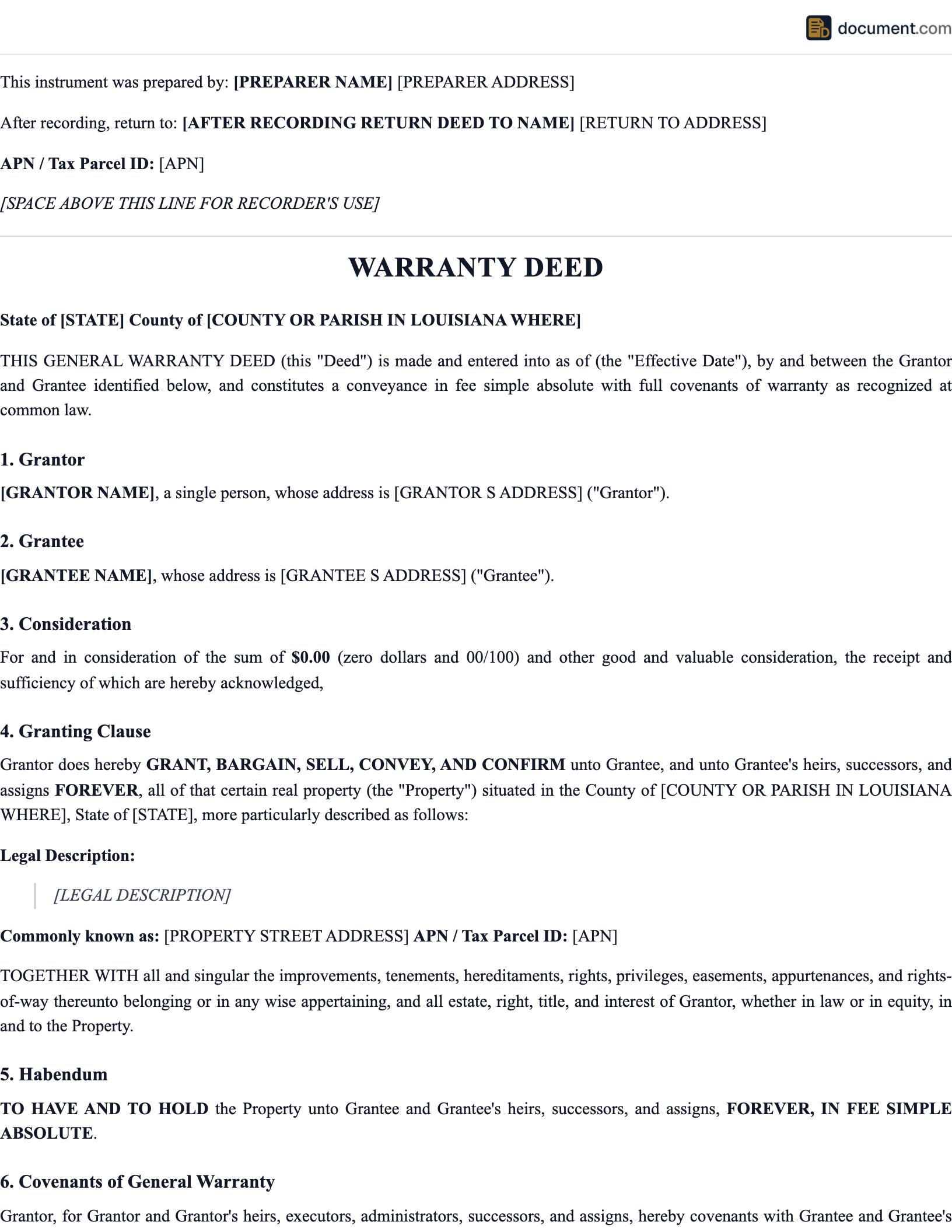
Sample New Jersey Warranty Deed
Preview of our New Jersey-specific template. Your document will include all fields required for recording in any New Jersey county.
WARRANTY DEED (GENERAL WARRANTY DEED)
STATE OF NEW JERSEY
Legal Document
PARTY INFORMATION
Name: [Full Legal Name]
Address: [New Jersey Address]
County: [County]
PROPERTY DESCRIPTION
County: [County] State: New Jersey
Legal Description: [Per Recorded Plat]
Parcel No.: [APN]
New Jersey Warranty Deed FAQ
Common questions about filing in New Jersey, including requirements, fees, and tax implications.
Official New Jersey Resources
Official state resources for verifying requirements and finding your local recording office.
Important Considerations
The Realty Transfer Fee and mansion tax calculations should be confirmed before closing, not at the County Clerk's counter. Errors in the RTF amount can delay recording. For properties near the $1 million threshold, confirm whether the consideration is above or below the mansion tax trigger, since the 1% buyer tax applies to the full amount, not just the excess.
New Jersey's non-resident withholding requirement catches many sellers off guard. If the grantor is not a New Jersey resident, the buyer's attorney or title company must withhold estimated income tax from the sale proceeds and remit it to the Division of Taxation at closing, unless a waiver has been obtained in advance. This is a statutory obligation that cannot be waived by agreement between the parties.
New Jersey farmland assessed under the Farmland Assessment Act carries rollback taxes if the land is converted to non-agricultural use within a set number of years. A buyer of farmland should confirm whether rollback taxes are a risk and obtain a rollback tax search from the municipal assessor before closing.
Keep the original recorded deed returned from the County Clerk. The instrument number and book and page assigned at recording are the standard references for future title work on this property.
New Jersey Attorney Note
New Jersey's RTF sliding scale, mansion tax, non-resident withholding rules, and attorney-closing tradition make attorney involvement the norm in the state's real estate transactions. A New Jersey real estate attorney can calculate the RTF, prepare the deed and associated documents, coordinate withholding compliance, and ensure recording is completed correctly at the County Clerk's office.
Related Documents
Depending on your situation, you may need additional documents alongside this one. Below are commonly related documents that are frequently used together in real estate transactions.
Important Considerations
New Jersey's RTF is one of the highest real estate transfer taxes in the region. Sellers of high-value properties should budget for it well in advance. The sliding scale means the marginal rate increases as the sale price rises, and for properties above $1 million the combined seller RTF and buyer mansion tax represent a material additional cost at closing.
Non-resident sellers have an additional compliance obligation. New Jersey requires estimated income tax withholding on the gain from the sale of New Jersey real property by non-residents. If the seller lives in another state, the buyer's attorney or closing agent must withhold and remit this amount to the state unless the seller has obtained a withholding waiver in advance. This should be coordinated with counsel before the closing date.
New Jersey's extensive environmental regulations affect many properties, particularly older industrial sites, properties near wetlands, and properties in flood hazard areas. A buyer should obtain an environmental assessment appropriate to the property type before closing on any commercial or industrial transfer.
Keep the original deed stamped and returned from the County Clerk in a secure location. The book and page or instrument number assigned at recording is the reference for all future title work on this property.
New Jersey Attorney Note
New Jersey's attorney-closing tradition, RTF complexity, non-resident withholding rules, and dense regulatory environment make attorney involvement practical for nearly all deed transactions. A New Jersey real estate attorney handles the RTF calculation, deed preparation, withholding compliance, and recording coordination in a single closing engagement.
Related Documents
Depending on your situation, you may need additional documents alongside this one. Below are commonly related documents that are frequently used together in real estate transactions.
Create your New Jersey Warranty Deed in under 5 minutes.
Answer a few questions and download a New Jersey-compliant document, ready for the state agency.