



New Hampshire Warranty Deed Overview
New Hampshire warranty deeds are recorded with the County Registry of Deeds in the county where the property is located. New Hampshire imposes a Real Estate Transfer Tax (RETT) at $1.50 per $100 of consideration, split equally between buyer and seller at $0.75 per $100 each. At $15 per $1,000 of purchase price combined, this makes New Hampshire's transfer tax one of the steeper ones in New England.
The state has no general income tax and no sales tax, which affects the overall tax picture for sellers of appreciated property. New Hampshire does not impose a state capital gains tax, so sellers pay federal capital gains but nothing additional at the state level. Deeds must be acknowledged before a notary public under RSA 477, and the NH DRA Form CD-57 must accompany the deed at recording for all taxable transfers.
$26
Recording fee
$7.50 per $1,000
Transfer tax
Required
Notarization
0
Witnesses required
New Hampshire Requirements
The County Registry of Deeds reviews each deed for completeness. Deeds missing the acknowledgment, return address, or consideration amount will be returned unfiled. For taxable transfers, the NH DRA Form CD-57 is a required companion document and must be submitted with the deed.
New Hampshire Specific Note
New Hampshire's Real Estate Transfer Tax is $1.50 per $100 of consideration, split equally so each party pays $0.75 per $100. Both parties must complete NH DRA Form CD-57 at closing. This form is required by the NH Department of Revenue Administration and must accompany the deed when presented for recording. Transfers between spouses, gifts, or certain other conveyances may qualify for RETT exemptions, which should be claimed on the form with supporting documentation.
Document Requirements
- Notarization: Must be notarized by a New Hampshire notary public or authorized notary
- Witnesses: New Hampshire requires 0 additional witness(es)
- Legal Description: Complete legal description as it appears on the current deed of record
- Parcel Number: Assessor's parcel number or tax ID
- Return Address: Mailing address for returning the recorded document
- Formatting: Standard formatting with adequate margins, black ink, minimum 10-point font
How to File in New Hampshire
New Hampshire requires an extra step compared to most states because of the Real Estate Transfer Tax form. Budget time to complete Form CD-57 before the closing appointment, and confirm whether the transfer qualifies for any exemption from the tax.
Prepare the Document
Complete the deed with the full legal description from the existing recorded deed, grantor and grantee names and addresses, the municipality and county where the property is located, the actual consideration paid, and a return address. Pull the legal description from the Registry of Deeds directly if there is any question about the accuracy of the description on hand.
Complete Form CD-57
Both buyer and seller must complete the NH Department of Revenue Administration's Real Estate Transfer Tax Declaration of Consideration (Form CD-57). This form must accompany the deed when it is submitted for recording. Prepare it in advance and have it signed at closing alongside the deed.
Get the Deed Notarized
The grantor acknowledges the deed before a New Hampshire notary public or justice of the peace. No witnesses beyond the notary are required. The notary's seal and signature must appear on the acknowledgment certificate.
File With the County Registry of Deeds
Submit the notarized deed and completed Form CD-57 to the County Registry of Deeds. Pay the recording fee and the transfer tax. Most registries accept in-person filing and many accept e-recording through approved vendors.
Notify the Municipality
Property taxes in New Hampshire are assessed and collected at the town or city level. After recording, notify the municipal assessor's office of the ownership change so that property tax bills are directed to the new owner. Towns update their tax records annually, so prompt notification prevents misdirected bills.
New Hampshire Fees & Costs
Typical costs for filing in New Hampshire. Actual fees may vary by county.
| Fee / Tax | Amount |
|---|---|
| Recording Fee | $26 |
| Transfer Tax | $7.50 per $1,000 |
| Notarization | $5 - $25 per signature |
| Certified Copy | $1 - $10 per page |
| Attorney Review (optional) | $150 - $500 |
New Hampshire Tax Implications
New Hampshire's Real Estate Transfer Tax is the most significant tax in a typical deed transaction. At $1.50 per $100 combined (split $0.75 per $100 between buyer and seller), it is among the highest rates in New England. For a $500,000 home, the combined RETT is $7,500, with the buyer and seller each paying $3,750. The tax applies to the full consideration, and underreporting consideration to reduce the tax is a violation of state law.
Certain transfers are exempt from the RETT, including transfers between spouses incident to a divorce, transfers to or from a trust where the beneficial ownership does not change, and transfers for nominal or no consideration when there is no underlying sale. These exemptions must be claimed on Form CD-57 with supporting documentation. The Registry of Deeds reviews the form at recording, and the DRA may audit claimed exemptions.
New Hampshire has no general income tax, so sellers of appreciated real estate pay federal capital gains but nothing to the state. Property taxes are administered at the town or city level and can vary significantly across the state's 234 municipalities. A new owner should confirm the property's current assessed value and tax rate with the town assessing office, since assessment practices differ from town to town.
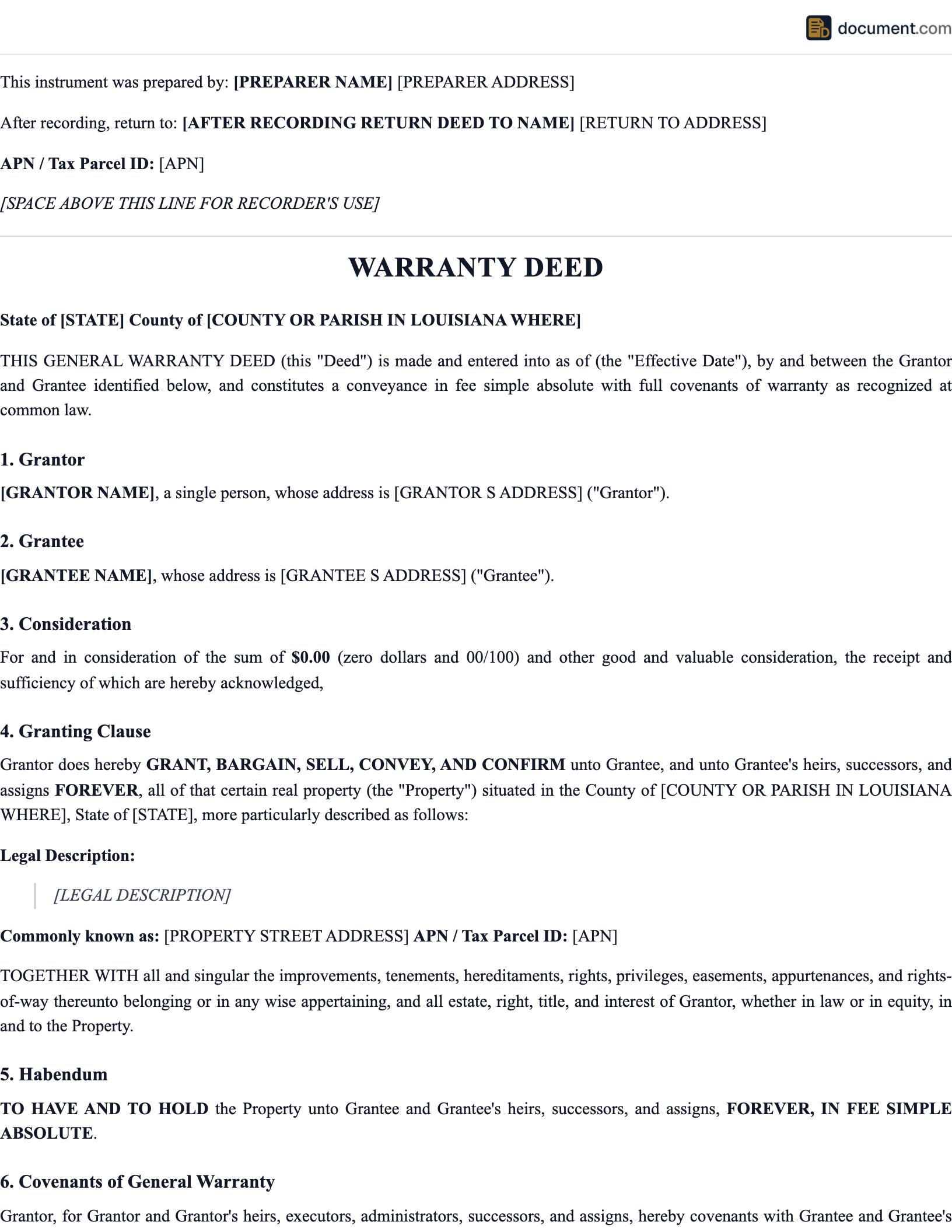
Sample New Hampshire Warranty Deed
Preview of our New Hampshire-specific template. Your document will include all fields required for recording in any New Hampshire county.
WARRANTY DEED (GENERAL WARRANTY DEED)
STATE OF NEW HAMPSHIRE
Legal Document
PARTY INFORMATION
Name: [Full Legal Name]
Address: [New Hampshire Address]
County: [County]
PROPERTY DESCRIPTION
County: [County] State: New Hampshire
Legal Description: [Per Recorded Plat]
Parcel No.: [APN]
New Hampshire Warranty Deed FAQ
Common questions about filing in New Hampshire, including requirements, fees, and tax implications.
Official New Hampshire Resources
Official state resources for verifying requirements and finding your local recording office.
Important Considerations
The Form CD-57 requirement is the most common point of confusion for parties new to New Hampshire closings. The form is not optional and must accompany the deed when presented to the County Registry of Deeds. Both buyer and seller signatures are required. If either party is missing, the Registry will not record the deed.
New Hampshire's property tax system is town-level, not county-level. Tax rates, assessment practices, and appeal procedures all vary by municipality. Buyers purchasing in a new town should request the current tax card from the town assessing office before closing to understand both the current assessed value and the applicable tax rate.
New Hampshire has a growing number of properties held in trusts for estate planning purposes. When a trustee signs a warranty deed, the deed must identify the trust and confirm the trustee's authority to convey. An attorney certificate or a certified copy of the trust's relevant provisions may be required by the Registry or by a title company.
Keep the original recorded deed returned from the County Registry. The book and page reference assigned at recording is the standard citation for this document in all future title work on the property.
New Hampshire Attorney Note
New Hampshire's transfer tax structure and the Form CD-57 requirement add procedural steps that trip up out-of-state parties. A New Hampshire real estate attorney can prepare both the deed and the CD-57, advise on RETT exemptions, and ensure the closing documents are in order before the parties execute.
Related Documents
Depending on your situation, you may need additional documents alongside this one. Below are commonly related documents that are frequently used together in real estate transactions.
Important Considerations
The RETT exemption for transfers between spouses is one of the most frequently used in New Hampshire. Transfers made between spouses as part of a divorce settlement or estate plan are typically exempt, but the exemption must be properly claimed on Form CD-57 at recording. Failing to file the form results in the deed being held at the Registry.
New Hampshire's town-by-town property tax system means that buyers moving from one municipality to another within the state may encounter dramatically different tax rates. A buyer comparing two similar properties in adjacent towns should confirm the tax rate per $1,000 of assessed value in each town before making a decision.
New Hampshire has significant shorefront property, much of which is subject to state wetland rules, shoreland protection laws, and sometimes federal floodplain regulations. Buyers of lakefront, riverfront, or coastal property should have a clear picture of what activities are permitted on the land before closing.
Keep the original recorded deed from the County Registry. The book and page number assigned at recording is the standard reference for this document in future title examinations.
New Hampshire Attorney Note
New Hampshire closings almost universally involve an attorney, in part because of the RETT form requirement and in part because of the state's attorney-supervised closing practice. A New Hampshire real estate attorney coordinates the Form CD-57, reviews title, and ensures that recording occurs correctly at the County Registry of Deeds.
Related Documents
Depending on your situation, you may need additional documents alongside this one. Below are commonly related documents that are frequently used together in real estate transactions.
Create your New Hampshire Warranty Deed in under 5 minutes.
Answer a few questions and download a New Hampshire-compliant document, ready for the state agency.