



Nevada Warranty Deed Overview
Nevada warranty deeds are recorded with the County Recorder in the county where the property sits. Nevada's real property transfer tax is $1.95 per $500 of consideration at the state baseline, but Clark County (Las Vegas) charges $2.55 per $500 and Washoe County (Reno) charges $2.05 per $500 due to additional county-level components. The deed must be acknowledged before a notary, and no additional witnesses are required.
Nevada is a community property state with no state income tax. The combination matters for real estate planning: both spouses must sign when conveying community property, and sellers benefit from the absence of a state capital gains tax layer on top of the federal tax when appreciated property is sold. Nevada's recording system is well-established, particularly in Clark and Washoe counties where the vast majority of state real estate activity occurs.
$15
Recording fee
$1.95 per $500
Transfer tax
Required
Notarization
0
Witnesses required
Nevada Requirements
The County Recorder reviews each deed for completeness before accepting it for recording. Deeds missing the acknowledgment, the return address, or the consideration amount may be rejected. Clark County and Washoe County both offer e-recording through their approved vendor networks, which is the fastest option for parties who cannot appear in person.
Nevada Specific Note
Nevada's real property transfer tax rate varies by county. The statewide baseline is $1.95 per $500, but Clark County (Las Vegas area) charges $2.55 per $500 and Washoe County (Reno area) charges $2.05 per $500. Confirm the exact rate with the County Recorder before closing. Nevada is a community property state, so both spouses must execute the deed when conveying community property assets.
Document Requirements
- Notarization: Must be notarized by a Nevada notary public or authorized notary
- Witnesses: Nevada requires 0 additional witness(es)
- Legal Description: Complete legal description as it appears on the current deed of record
- Parcel Number: Assessor's parcel number or tax ID
- Return Address: Mailing address for returning the recorded document
- Formatting: Standard formatting with adequate margins, black ink, minimum 10-point font
How to File in Nevada
Nevada's county-level recording system means each county has its own fee schedule and procedures. Clark and Washoe counties handle the bulk of the state's volume and have the most developed recording infrastructure, including online status tracking for e-recorded documents.
Prepare the Document
Complete the deed with the full legal description from the existing recorded deed, grantor and grantee names, mailing addresses, and the actual consideration paid. Include the assessor's parcel number and a return address. If the property is community property, both spouses must be named as grantors.
Get the Document Notarized
The grantor signs in front of a Nevada notary public, who completes the acknowledgment. No witnesses are required beyond the notary. If both spouses are signing as co-grantors, both acknowledgments must be separately completed.
File With the County Recorder
Present the notarized deed to the County Recorder in the county where the property sits. Clark County and Washoe County have active e-recording programs. For counties without e-recording, in-person or mail-in recording is available.
Pay Transfer Tax and Recording Fee
Pay the real property transfer tax based on the county rate and the recording fee. The transfer tax is typically paid at closing in a coordinated transaction. The County Recorder will stamp the deed with the recording date and instrument number.
Update the County Assessor
After recording, the County Assessor's office should be notified of the ownership change to redirect property tax bills. In Clark and Washoe counties, the assessor typically receives notice through the recorder's indexing system, but confirming directly avoids any delay in updating the tax roll.
Nevada Fees & Costs
Typical costs for filing in Nevada. Actual fees may vary by county.
| Fee / Tax | Amount |
|---|---|
| Recording Fee | $15 |
| Transfer Tax | $1.95 per $500 |
| Notarization | $5 - $25 per signature |
| Certified Copy | $1 - $10 per page |
| Attorney Review (optional) | $150 - $500 |
Nevada Tax Implications
Nevada levies a real property transfer tax, but it imposes no state income tax. For sellers of appreciated property, this is material: Nevada sellers pay the federal capital gains tax but owe nothing to the state on the gain. That is a meaningful advantage compared to California, Oregon, or other neighboring states with income taxes that can push the combined capital gains rate well above 30 percent for high earners.
The real property transfer tax is calculated on the consideration stated in the deed. The statewide rate is $1.95 per $500, but Clark County charges $2.55 per $500 and Washoe County charges $2.05 per $500 due to county supplements. For a $500,000 residential sale in Las Vegas, the transfer tax runs approximately $2,550. In Reno, it would be approximately $2,050. The tax is typically a seller cost negotiated in the purchase contract.
Nevada's property tax system caps annual increases in assessed value, which creates divergence between taxable assessed value and market value over time. A new owner will receive a property tax bill based on the assessor's current assessed value for the parcel, which may be reset toward market value following a sale. Buyers should review the current assessed value before closing so the post-transfer tax bill is not a surprise.
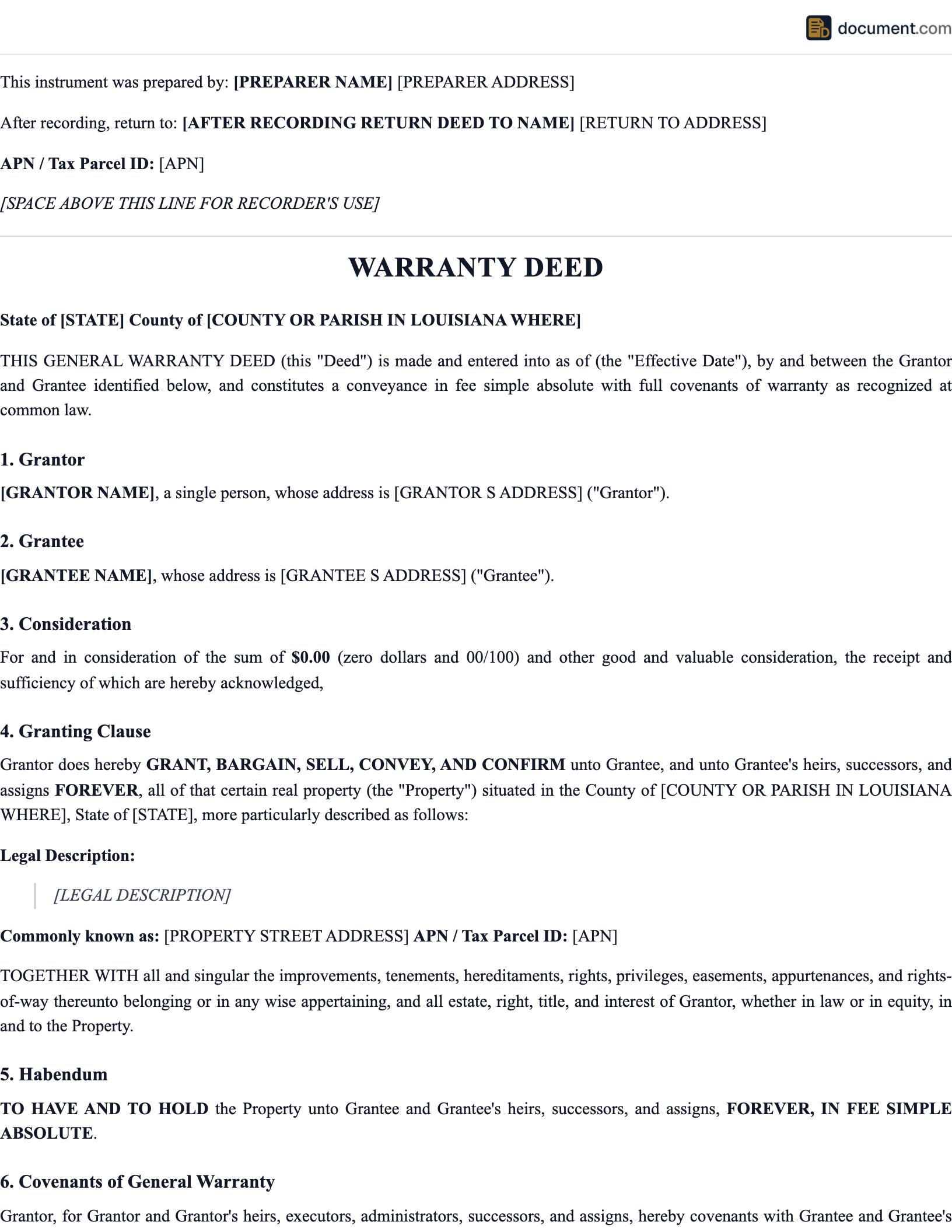
Sample Nevada Warranty Deed
Preview of our Nevada-specific template. Your document will include all fields required for recording in any Nevada county.
WARRANTY DEED (GENERAL WARRANTY DEED)
STATE OF NEVADA
Legal Document
PARTY INFORMATION
Name: [Full Legal Name]
Address: [Nevada Address]
County: [County]
PROPERTY DESCRIPTION
County: [County] State: Nevada
Legal Description: [Per Recorded Plat]
Parcel No.: [APN]
Nevada Warranty Deed FAQ
Common questions about filing in Nevada, including requirements, fees, and tax implications.
Official Nevada Resources
Official state resources for verifying requirements and finding your local recording office.
Important Considerations
Nevada's community property rules are one of the most common sources of title complications in the state. A married person who owns property in their name alone may still hold it as community property if it was acquired with marital funds during the marriage. Title companies typically require the non-titled spouse to sign a spousal consent or join the deed to clear this issue. Confirm the property's character before the deed is prepared.
Clark County's high transaction volume means the recorder processes thousands of documents daily. E-recording is the most reliable method for time-sensitive transactions where confirmed recording is needed quickly. Documents submitted by mail may take longer to process during peak periods.
Nevada's resort and gaming properties often carry CC&Rs, shared amenity easements, and hotel condominium operating agreements that run with the land. A buyer should review the complete title report, not just the deed chain, to understand all recorded encumbrances that will survive the transfer.
Keep the original stamped deed returned from the County Recorder. The instrument number assigned at recording is the reference used in all future title searches for this property.
Nevada Attorney Note
Nevada real estate transactions involving resort properties, gaming-adjacent assets, shared facilities, or complex ownership structures benefit from attorney review. A Nevada real estate attorney can also advise on whether holding title in an LLC or trust makes sense given Nevada's favorable asset protection statutes.
Related Documents
Depending on your situation, you may need additional documents alongside this one. Below are commonly related documents that are frequently used together in real estate transactions.
Important Considerations
The transfer tax rate in Nevada depends on where the property is located, not just the state baseline. If you are recording in Clark County or Washoe County, expect to pay more than the statewide $1.95 per $500 rate. Verify the current county rate with the recorder before closing, since these rates can be adjusted by county ordinance.
Community property considerations arise frequently in Nevada because of the state's large transplant population. People who move to Nevada from non-community-property states and then purchase property in Nevada acquire that property as Nevada community property if they are married and use marital funds. Both spouses must sign the deed to convey it.
Nevada is one of the strongest asset protection states in the country. Holding real property in a properly structured Nevada LLC can provide liability protection not available through individual ownership. An attorney can advise whether a holding structure is appropriate given the type and value of the property.
Keep the original stamped deed returned from the County Recorder. The instrument number assigned at recording is the reference point for future title work on the property.
Nevada Attorney Note
Nevada's favorable LLC and trust statutes make it worth discussing ownership structure with an attorney before recording a new deed, particularly for investment properties or high-value residential real estate. A Nevada-licensed attorney can also help navigate community property questions that arise in spousal transfers or divorces.
Related Documents
Depending on your situation, you may need additional documents alongside this one. Below are commonly related documents that are frequently used together in real estate transactions.
Create your Nevada Warranty Deed in under 5 minutes.
Answer a few questions and download a Nevada-compliant document, ready for the state agency.