



Nebraska Warranty Deed Overview
Nebraska warranty deeds are recorded with the Register of Deeds in the county where the property sits. Nebraska eliminated its documentary stamp tax back in 1967, so there is no state transfer tax to calculate or pay at closing. You owe only the recording fee, which is charged on a per-page basis.
Nebraska has a statutory warranty deed form under Neb. Rev. Stat. 76-218. When a deed uses the language prescribed by the statute, it carries all standard warranty covenants by operation of law, including the covenant of seisin, the right to convey, freedom from undisclosed encumbrances, and the general warranty of title. The deed must be acknowledged before a notary public and no witnesses are required beyond the notary.
$10
Recording fee
$2.25 per $1,000
Transfer tax
Required
Notarization
0
Witnesses required
Nebraska Requirements
The Register of Deeds reviews each submitted deed for completeness. Documents without a proper notarial acknowledgment, a return address, or a preparer identification line will not be accepted. Nebraska also requires that the first page of the deed include the name and address of the person who prepared it.
Nebraska Specific Note
Nebraska has no real estate transfer tax. The documentary stamp tax was repealed in 1967 and was never replaced. Recording fees are charged per page by each county's Register of Deeds. Nebraska's statutory warranty deed form under Neb. Rev. Stat. 76-218 automatically incorporates all standard warranty covenants when used correctly, so you do not need to list each covenant individually in the deed.
Document Requirements
- Notarization: Must be notarized by a Nebraska notary public or authorized notary
- Witnesses: Nebraska requires 0 additional witness(es)
- Legal Description: Complete legal description as it appears on the current deed of record
- Parcel Number: Assessor's parcel number or tax ID
- Return Address: Mailing address for returning the recorded document
- Formatting: Standard formatting with adequate margins, black ink, minimum 10-point font
How to File in Nebraska
Nebraska's recording process is among the more straightforward in the Midwest. There is no transfer tax form to file, no state clearance required, and the Register of Deeds typically records deeds the same day they are presented.
Prepare the Document
Complete the deed using Nebraska's statutory form or an equivalent. Include the full legal description from the existing recorded deed, grantee mailing address, consideration amount, and the preparer's name and address. This last item is required by Nebraska statute and is a common reason deeds get rejected at the counter.
Get the Document Notarized
The grantor signs in front of a Nebraska notary public, who completes the acknowledgment certificate. No additional witnesses are required. If the grantor is acting as a trustee or corporate officer, the acknowledgment should reflect that capacity.
File With the Register of Deeds
Present the original notarized deed to the Register of Deeds in the county where the property is located. Nebraska has no central state recording office. Mail-in recording is accepted by most counties, and e-recording is available in many metro-area counties including Douglas and Lancaster.
Pay the Recording Fee
Nebraska charges a per-page recording fee with no transfer tax. There is no separate documentary stamp or state tax form. The Register of Deeds will stamp the deed with a book and page or instrument number and return the original to the return address shown on the document.
Update the County Assessor
After the deed is recorded, notify the county assessor's office so property tax bills are sent to the new owner. Nebraska uses a deed return system in many counties where the assessor is automatically notified of transfers, but confirming directly with the assessor avoids misdirected tax notices.
Nebraska Fees & Costs
Typical costs for filing in Nebraska. Actual fees may vary by county.
| Fee / Tax | Amount |
|---|---|
| Recording Fee | $10 |
| Transfer Tax | $2.25 per $1,000 |
| Notarization | $5 - $25 per signature |
| Certified Copy | $1 - $10 per page |
| Attorney Review (optional) | $150 - $500 |
Nebraska Tax Implications
Nebraska has no real estate transfer tax. The documentary stamp tax was abolished by the legislature in 1967 and has not been revived. At the state and county levels, a deed recording triggers no tax obligation beyond the per-page recording fee.
Nebraska does have a state income tax, and federal capital gains rules apply to any future sale. A buyer who receives property as a gift takes a carryover basis from the donor. When the property is later sold at a higher value, the gain is measured from that original basis. For transfers between family members involving land that has been held for generations, this can mean a substantial taxable gain on eventual disposition. A stepped-up basis at death through inheritance avoids this issue, so the choice between gifting and bequeathing has real tax consequences.
Nebraska's property tax system is administered at the county level. The county assessor values property annually based on comparable sales. A new deed does not automatically trigger reassessment in the way some states' systems do, but the assessor will note the new ownership and may use the sale price as a data point in the next assessment cycle, particularly for residential and agricultural transfers at or near market value.
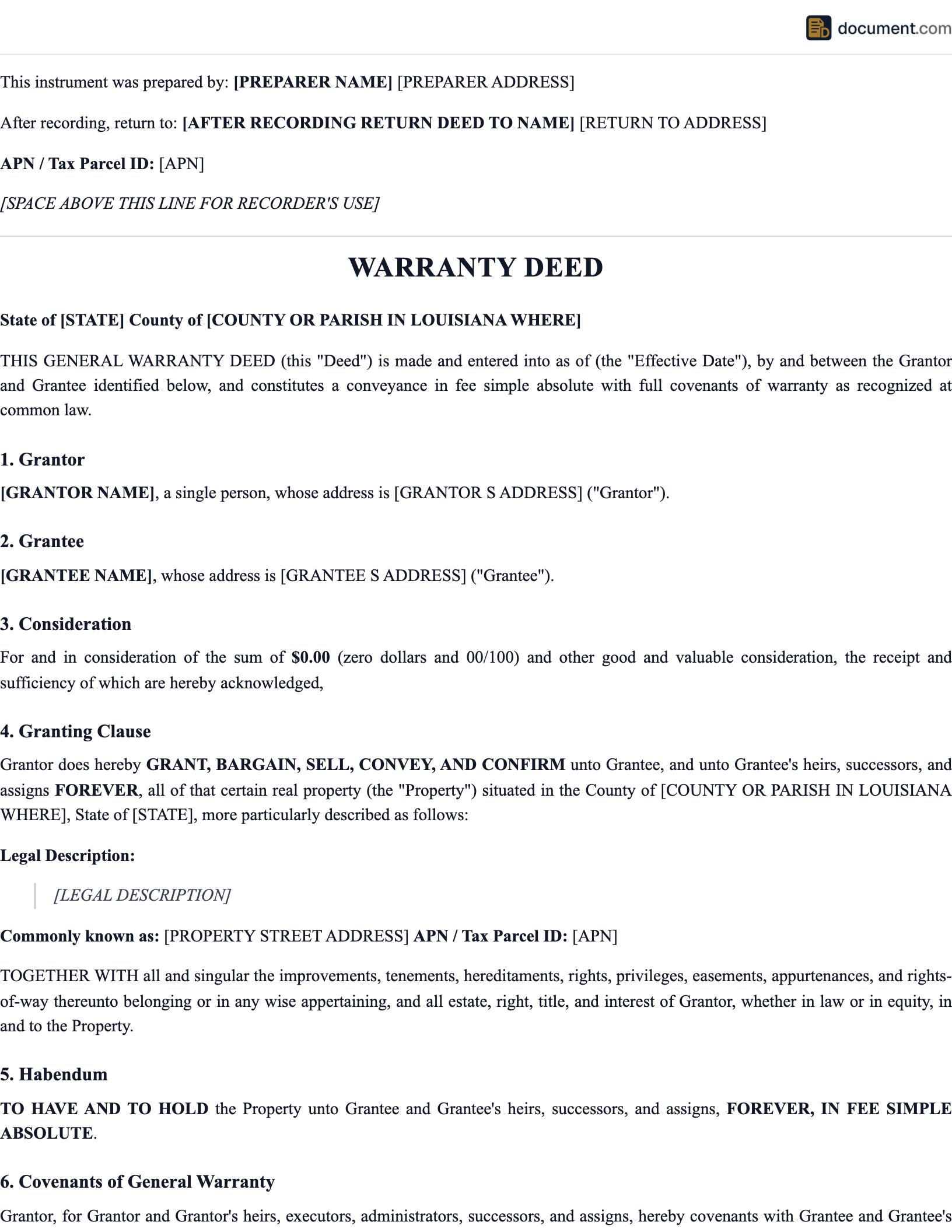
Sample Nebraska Warranty Deed
Preview of our Nebraska-specific template. Your document will include all fields required for recording in any Nebraska county.
WARRANTY DEED (GENERAL WARRANTY DEED)
STATE OF NEBRASKA
Legal Document
PARTY INFORMATION
Name: [Full Legal Name]
Address: [Nebraska Address]
County: [County]
PROPERTY DESCRIPTION
County: [County] State: Nebraska
Legal Description: [Per Recorded Plat]
Parcel No.: [APN]
Nebraska Warranty Deed FAQ
Common questions about filing in Nebraska, including requirements, fees, and tax implications.
Official Nebraska Resources
Official state resources for verifying requirements and finding your local recording office.
Important Considerations
One practical point specific to Nebraska: the deed must include the preparer's name and address on the face of the document. This is a statutory requirement under Nebraska law, and the Register of Deeds will reject a deed that is missing this information. It's a quick fix, but a frustrating one to discover at the counter.
Nebraska's statutory warranty deed form is worth using precisely because it is efficient. By using the language prescribed by Neb. Rev. Stat. 76-218, all standard covenants attach automatically without having to enumerate each one. This reduces the chance of missing a material warranty and keeps the document compact.
For agricultural land in Nebraska's vast farming counties, check whether the property is subject to any recorded lease. A warranty deed conveys the fee interest, but an existing farm lease may give a tenant the right to remain for the balance of the lease term. Buyers of farmland should confirm lease status before closing.
Keep the original returned deed in a secure location. The Register of Deeds stamps the document with the recording date and instrument number. That stamped original is your proof of a complete, timely conveyance.
Nebraska Note
Nebraska's relatively simple deed recording process makes it one of the easier states to navigate without an attorney for straightforward residential transactions. For commercial property, agricultural land with existing leases, or family transfers involving trusts or LLCs, consulting a Nebraska real estate attorney is a practical step that can prevent problems that are difficult to unwind after recording.
Related Documents
Depending on your situation, you may need additional documents alongside this one. Below are commonly related documents that are frequently used together in real estate transactions.
Important Considerations
Nebraska's no-transfer-tax environment is a real benefit, but it does not reduce the importance of a clean title. A warranty deed puts the grantor on the hook for any title defects that surface after closing, including old liens, easements that were never disclosed, or prior conveyances that did not transfer title correctly. Grantors should be confident in the state of their title before executing a warranty deed.
The statutory form language in Neb. Rev. Stat. 76-218 simplifies the document, but it does not substitute for a correct legal description. Using an inaccurate or incomplete legal description is one of the most common causes of deed disputes. Always pull the description from the most recently recorded deed or from the county assessor's parcel records, not from memory or an old abstract.
Nebraska farmland transactions frequently involve grain storage agreements, drainage tile ownership questions, and center-pivot irrigation systems that may or may not be considered fixtures conveyed with the real property. These issues should be addressed in the purchase agreement and, where appropriate, in the deed itself.
Keep the original stamped deed returned from the Register of Deeds in a secure location. The instrument number assigned at recording is the key reference for any future title search involving this property.
Nebraska Note
Nebraska's straightforward recording process works well for residential transactions. For complex transfers involving multiple parcels, agricultural leases, irrigation rights, or corporate or trust ownership, a Nebraska-licensed real estate attorney can ensure that the deed and any ancillary documents are correctly prepared and that all parties' interests are accurately reflected.
Related Documents
Depending on your situation, you may need additional documents alongside this one. Below are commonly related documents that are frequently used together in real estate transactions.
Create your Nebraska Warranty Deed in under 5 minutes.
Answer a few questions and download a Nebraska-compliant document, ready for the state agency.