



Missouri Warranty Deed Overview
Missouri is a pleasantly uncomplicated state for deed recording in many respects. Warranty deeds are filed with the Recorder of Deeds in the county where the property is located, there is no state transfer tax, and the statutory warranty deed form under RSMo 442.430 gives practitioners a reliable baseline. The main procedural wrinkle unique to Missouri is the spousal signature requirement for homestead conveyances: both spouses must sign a deed conveying the family homestead even if only one holds title.
Recording fees start around $24 for a standard deed, with additional per-page fees. The City of St. Louis has its own Recorder of Deeds separate from St. Louis County, which is worth confirming before filing if your property is in the metro area. Notarization is required under RSMo 442.130, and Missouri allows remote online notarization for parties who cannot appear in person. Our Missouri template is drafted to meet the requirements of RSMo Chapter 442 and includes the acknowledgment language accepted by Missouri recording offices.
$24
Recording fee
None
Transfer tax
Required
Notarization
0
Witnesses required
Missouri Requirements
Missouri deed requirements under RSMo Chapter 442 are relatively straightforward compared to many neighboring states. The main traps are the homestead spousal signature requirement and the St. Louis City versus St. Louis County filing distinction. Beyond those, Missouri deed practice follows standard Midwestern norms.
Missouri Specific Note
Missouri has no state real estate transfer tax. Both spouses must sign a deed conveying the family homestead under RSMo 442.030, even if title is held in only one name. St. Louis City and St. Louis County are separate jurisdictions with separate Recorders of Deeds; confirm which office governs your property before filing. The legal description must match the description in the existing deed exactly, and the grantor's acknowledgment must include the notary's commission expiration date.
Document Requirements
- Notarization: Must be notarized by a Missouri notary public or authorized notary
- Witnesses: Missouri requires 0 additional witness(es)
- Legal Description: Complete legal description as it appears on the current deed of record
- Parcel Number: Assessor's parcel number or tax ID
- Return Address: Mailing address for returning the recorded document
- Formatting: Standard formatting with adequate margins, black ink, minimum 10-point font
How to File in Missouri
Missouri deed recording is one of the more straightforward processes in the region, with no transfer tax, no witness requirement, and a well-established statutory form. The main things to get right are the homestead spousal signature requirement and which Recorder's office has jurisdiction for your property, particularly in the St. Louis area where the city and county are separate filing jurisdictions.
Prepare the Document
Fill in the grantor and grantee names, addresses, the consideration amount, and the complete legal description from the existing deed. Missouri practitioners copy the legal description verbatim from the prior deed rather than paraphrasing it. Determine whether the property is the grantor's homestead; if it is, both spouses must be named as grantors and both must sign regardless of how title is currently held.
Get the Document Notarized
All grantors sign before a Missouri notary public. The acknowledgment under RSMo Chapter 442 must include the notary's commission expiration date. No witnesses are required beyond the notary. Missouri permits remote online notarization under RSMo 486.1200, which is useful for out-of-state sellers who cannot travel to a notary in person.
File With the Recorder of Deeds
Take the original notarized deed to the Recorder of Deeds in the county where the property is located. If the property is in the City of St. Louis (not St. Louis County), file with the City of St. Louis Recorder of Deeds, not the St. Louis County Recorder in Clayton. Many Missouri counties accept e-recording through approved platforms.
Pay the Recording Fee
Missouri charges recording fees but no state transfer tax. Fees start around $24 for a standard deed, with additional per-page charges. There is no deed excise or transfer stamp required. The Recorder's office will return the recorded deed (or a certified copy) after processing.
Update the County Assessor
After recording, notify the county assessor of the change in ownership. Missouri does not require a formal property transfer affidavit like Michigan, but the assessor needs to update ownership records so property tax bills go to the right party. If the new owner will use the property as their primary residence, they may qualify for homestead exemptions from certain property taxes; check with the local assessor for filing requirements and deadlines.
Missouri Fees & Costs
Typical costs for filing in Missouri. Actual fees may vary by county.
| Fee / Tax | Amount |
|---|---|
| Recording Fee | $24 |
| Transfer Tax | None |
| Notarization | $5 - $25 per signature |
| Certified Copy | $1 - $10 per page |
| Attorney Review (optional) | $150 - $500 |
Missouri Tax Implications
Missouri has no state real estate transfer tax and no county-level transfer tax either. The Missouri Constitution expressly prohibits such a tax. This distinguishes Missouri from neighboring states like Kansas and Illinois, and it makes deed recording straightforwardly cheap from a government tax perspective. The only fees at recording are the Recorder's fees, which vary slightly by county.
Federal income tax consequences are the primary tax consideration in Missouri property transfers. On a sale, the federal capital gains rate applies to taxable gain after any applicable exclusion under IRC Section 121. Sellers who have used the property as their primary residence for two of the preceding five years can exclude up to $250,000 of gain ($500,000 for married couples filing jointly). Gain above that threshold is taxed at the federal long-term capital gains rate if the property was held more than one year. Missouri also has a state income tax, and capital gains realized by Missouri residents are subject to it in addition to the federal tax.
Missouri property taxes are assessed at the county level, with residential property assessed at 19% of true value and commercial property at 32%. After a sale, the assessor typically updates the assessed value based on the sale price at the next reassessment cycle. Missouri reassesses real property every two years (odd years in most counties), so a buyer who closes in an even year may not see the full reassessment effect until the following year. There is no immediate uncapping mechanism like Michigan's Proposal A; Missouri assessments adjust through the regular cycle.
Sample Missouri Warranty Deed
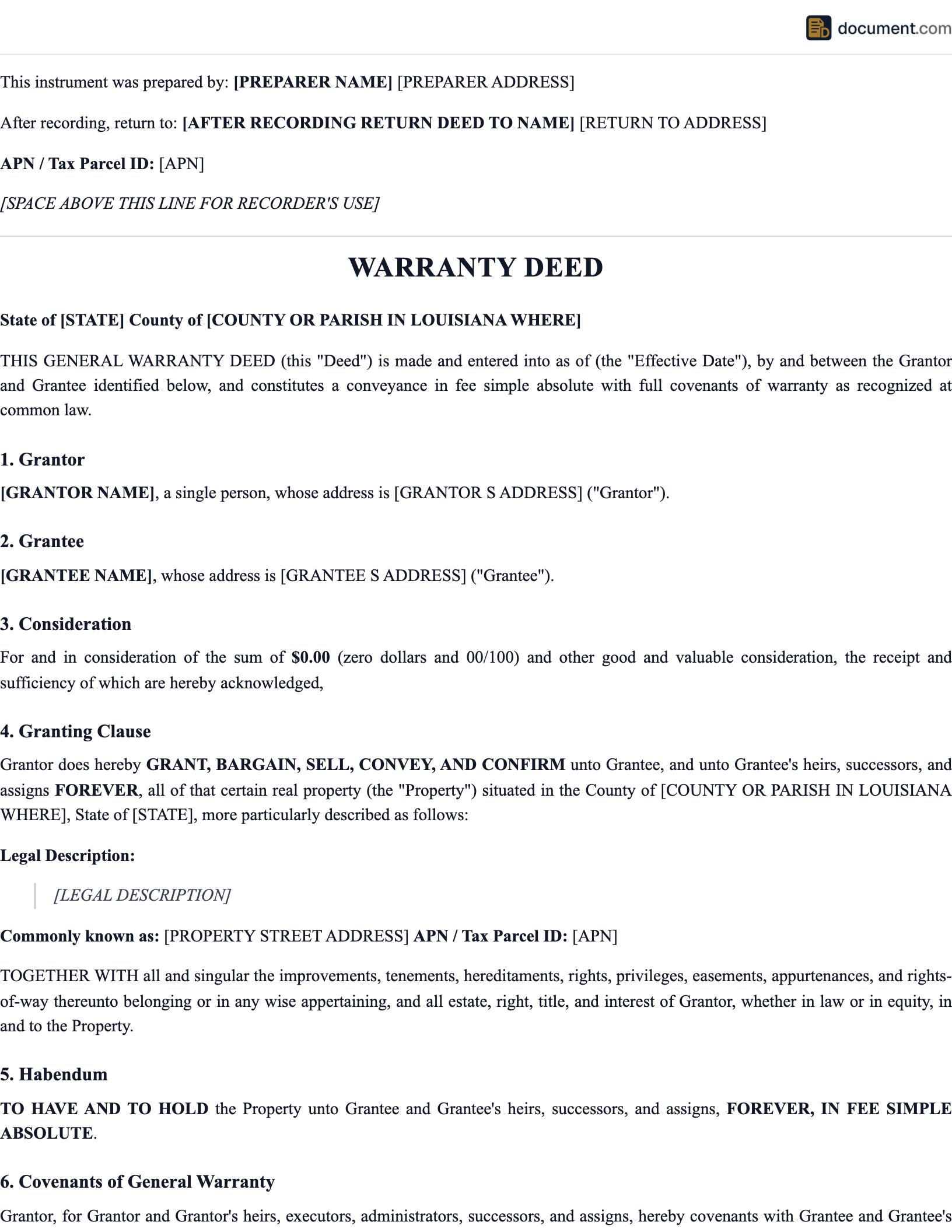
Preview of our Missouri-specific template. Your document will include all fields required for recording in any Missouri county.
WARRANTY DEED (GENERAL WARRANTY DEED)
STATE OF MISSOURI
Legal Document
PARTY INFORMATION
Name: [Full Legal Name]
Address: [Missouri Address]
County: [County]
PROPERTY DESCRIPTION
County: [County] State: Missouri
Legal Description: [Per Recorded Plat]
Parcel No.: [APN]
Missouri Warranty Deed FAQ
Common questions about filing in Missouri, including requirements, fees, and tax implications.
Official Missouri Resources
Official state resources for verifying requirements and finding your local recording office.
Important Considerations
The homestead spousal signature requirement under RSMo 442.030 is the most frequently overlooked issue in Missouri residential deed drafting. When a married person wants to convey the family home, both spouses must sign even if the deed of record shows only one spouse's name. A deed signed by only the title-holding spouse that purports to convey the homestead is voidable by the non-signing spouse. Lenders and title companies have long known this and require both signatures as a standard condition. If you are preparing a deed and the property is the grantor's home, build in time to get both spousal signatures.
Missouri's recording act is a race-notice statute like Mississippi's. A subsequent purchaser who records first and takes without notice of a prior unrecorded transfer defeats that prior interest. Practically speaking, this means you should record the deed promptly after closing rather than waiting days or weeks. Title companies routinely handle same-day or next-day recording as part of their closing services precisely to eliminate this risk.
Missouri also has a relatively easy mechanism for transferring property outside of probate through a Transfer on Death Deed (TODD) under RSMo 461.025. A TODD designates a beneficiary to receive the property automatically at the owner's death without going through probate. It has no effect during the owner's lifetime and can be revoked at any time before death. For families who want to avoid probate on real property without the complexity of a trust, the TODD is a straightforward option worth knowing about.
Missouri Practice Note
Missouri real estate closings are handled by a mix of title companies and attorneys depending on the region and the complexity of the transaction. In the Kansas City and St. Louis metro areas, title companies conduct most residential closings. In rural Missouri, attorneys are more commonly involved. Missouri does not require an attorney to conduct a closing, but for any transaction involving an estate, a trust, a business entity, or a property with known title issues, attorney involvement is advisable. The Missouri Bar's lawyer search tool can help you find real estate practitioners by county.
Related Documents
Depending on your situation, you may need additional documents alongside this one. Below are commonly related documents that are frequently used together in real estate transactions.
Additional Missouri Considerations
Missouri's Transfer on Death Deed statute (RSMo 461.025) is one of the more practical estate planning tools for property owners who want to avoid probate without creating a revocable trust. A TODD names a beneficiary who takes title automatically at the owner's death, with no probate proceeding required. The deed has no effect during the owner's lifetime; the owner can sell, mortgage, or revoke the TODD at any time without the beneficiary's consent. For simple estates involving a single Missouri property, the TODD is often sufficient to accomplish the goal.
Missouri's race-notice recording statute protects subsequent purchasers who record without notice of a prior unrecorded interest. The practical takeaway is that gaps between closing and recording create title risk. A seller who transfers the same property twice (which does happen in fraud cases and errors) can create competing claims. Title companies handle this by recording at the earliest opportunity after closing disbursement, typically the same day or the next business day.
Agricultural and rural Missouri properties carry additional considerations around mineral rights, drainage districts, and tax liens. Drainage district assessments in particular are a feature of Missouri real property law that buyers of agricultural land in the lowland counties should investigate. These assessments can constitute liens on the property and may not appear in a standard title search without a specific drainage district inquiry.
Missouri Deed Language Note
Missouri's statutory warranty deed uses 'grant, bargain and sell' language under RSMo 442.430, which by statute implies certain covenants of title limited to the grantor's own acts. A full general warranty deed uses broader language warranting the title against all claims from all sources. Make sure the warranty language in your deed matches the level of protection you intend to provide (or receive). Title companies and attorneys in Missouri are familiar with both forms and can help ensure the deed says what the parties intend.
Related Documents
Depending on your situation, you may need additional documents alongside this one. Below are commonly related documents that are frequently used together in real estate transactions.
Create your Missouri Warranty Deed in under 5 minutes.
Answer a few questions and download a Missouri-compliant document, ready for the state agency.