



Mississippi Warranty Deed Overview
In Mississippi, real property documents are filed with the Chancery Clerk, an elected county official who handles land records alongside probate and chancery court functions. This is distinct from most states, where a county recorder or register of deeds handles only real property filings. The Chancery Clerk system gives Mississippi land records a distinct character: the same office that records your deed may also handle the probate of the prior owner's estate, which can be useful when tracing a title chain.
Mississippi does not impose a state real estate transfer tax, which makes it one of the least expensive states for deed recording from a tax perspective. Recording fees start around $25 for a standard deed. Notarization is required, and the acknowledgment must comply with Mississippi Code Section 89-3-1. Dower rights were abolished in Mississippi, so a spouse's signature is not technically required by statute, but lenders and title companies routinely require it for marital homestead property. Our Mississippi template follows the warranty deed form recognized under Mississippi Code and includes the acknowledgment language required by the Chancery Clerk.
$25
Recording fee
None
Transfer tax
Required
Notarization
0
Witnesses required
Mississippi Requirements
The Chancery Clerk's office in each Mississippi county has its own procedures, and practices can vary more than in states with standardized county recorder offices. Some offices have adopted e-recording; others still operate primarily in person. Calling ahead to confirm current fees, accepted payment methods, and any local formatting preferences is worthwhile before making the trip.
Mississippi Specific Note
Mississippi records deeds at the Chancery Clerk's office, not a county recorder. There is no state real estate transfer tax. Recording fees are set by statute and start around $25, but individual Chancery Clerks may have additional local charges. Although dower and curtesy rights were abolished in Mississippi, lenders and title companies typically require both spouses to sign when the property is a marital homestead. The acknowledgment must comply with Mississippi Code Section 89-3-1, and the deed must contain a proper legal description sufficient to locate and identify the property on the ground.
Document Requirements
- Notarization: Must be notarized by a Mississippi notary public or authorized notary
- Witnesses: Mississippi requires 0 additional witness(es)
- Legal Description: Complete legal description as it appears on the current deed of record
- Parcel Number: Assessor's parcel number or tax ID
- Return Address: Mailing address for returning the recorded document
- Formatting: Standard formatting with adequate margins, black ink, minimum 10-point font
How to File in Mississippi
Filing in Mississippi involves preparing the document, getting it notarized, and recording it. Follow these steps for a smooth process.
Prepare the Document
Gather the grantor and grantee names and addresses, the consideration amount, and the full legal description from the existing deed or the Chancery Clerk's records. Include the source of title (the prior instrument through which the grantor acquired the property) to support the chain of title. If both spouses are grantors on marital homestead property, both should sign even though dower rights no longer exist in Mississippi.
Get the Document Notarized
The grantor signs before a Mississippi notary public or two disinterested witnesses who are not parties to the deed. Notarization under Mississippi Code Section 89-3-1 is the standard approach used in virtually all closings. Confirm the notary's commission is current, and make sure the acknowledgment block is fully completed with the county and state of notarization.
File With the Chancery Clerk
Take the original notarized deed to the Chancery Clerk's office in the county where the property is located. Mississippi does not have a separate register of deeds or county recorder; all deed recording goes through the Chancery Clerk. Call ahead to confirm hours, accepted payment methods, and whether the office accepts e-recording through an approved vendor.
Pay the Recording Fee
Mississippi charges a recording fee set by statute (typically around $25 for a standard deed) but imposes no state real estate transfer tax. The Clerk will stamp and return a certified copy or the original after recording, depending on local practice. Keep the recorded deed in a secure location.
Notify the County Tax Assessor
After recording, notify the county tax assessor of the ownership change so that future property tax bills are directed to the correct party. Mississippi property taxes are assessed annually by county tax assessors, and it can take a billing cycle or two for ownership changes to fully propagate through the system. Keep copies of the recorded deed in case you need to follow up with the assessor.
Mississippi Fees & Costs
Typical costs for filing in Mississippi. Actual fees may vary by county.
| Fee / Tax | Amount |
|---|---|
| Recording Fee | $25 |
| Transfer Tax | None |
| Notarization | $5 - $25 per signature |
| Certified Copy | $1 - $10 per page |
| Attorney Review (optional) | $150 - $500 |
Mississippi Tax Implications
Mississippi does not impose a state-level real estate transfer tax, which is a meaningful distinction from states like Massachusetts or Tennessee. The only government fees at recording are the Chancery Clerk's recording fees, which are set by state statute. This makes Mississippi one of the more affordable states for deed recording from a tax standpoint, and it applies equally to arms-length sales and intra-family transfers.
Federal tax considerations still apply regardless of Mississippi's lack of a transfer tax. Sellers who have held the property as their primary residence for at least two of the five years prior to sale may exclude up to $250,000 of capital gain from federal income tax ($500,000 for married couples filing jointly) under IRC Section 121. Sellers who do not qualify for that exclusion owe federal capital gains tax on the full gain. Mississippi has its own income tax, and capital gains are subject to it, so residents also owe state income tax on taxable gains from real property sales.
Gift transfers of Mississippi real property require federal Form 709 filing if the fair market value exceeds the annual gift tax exclusion. The recipient takes the donor's carryover basis, which preserves any embedded capital gain for future recognition. One common planning mistake in Mississippi involves families transferring appreciated farmland as a gift rather than waiting for it to pass through a decedent's estate with a stepped-up basis. That basis step-up at death can eliminate decades of embedded gain and significantly reduce the tax cost of an eventual sale by the next generation.
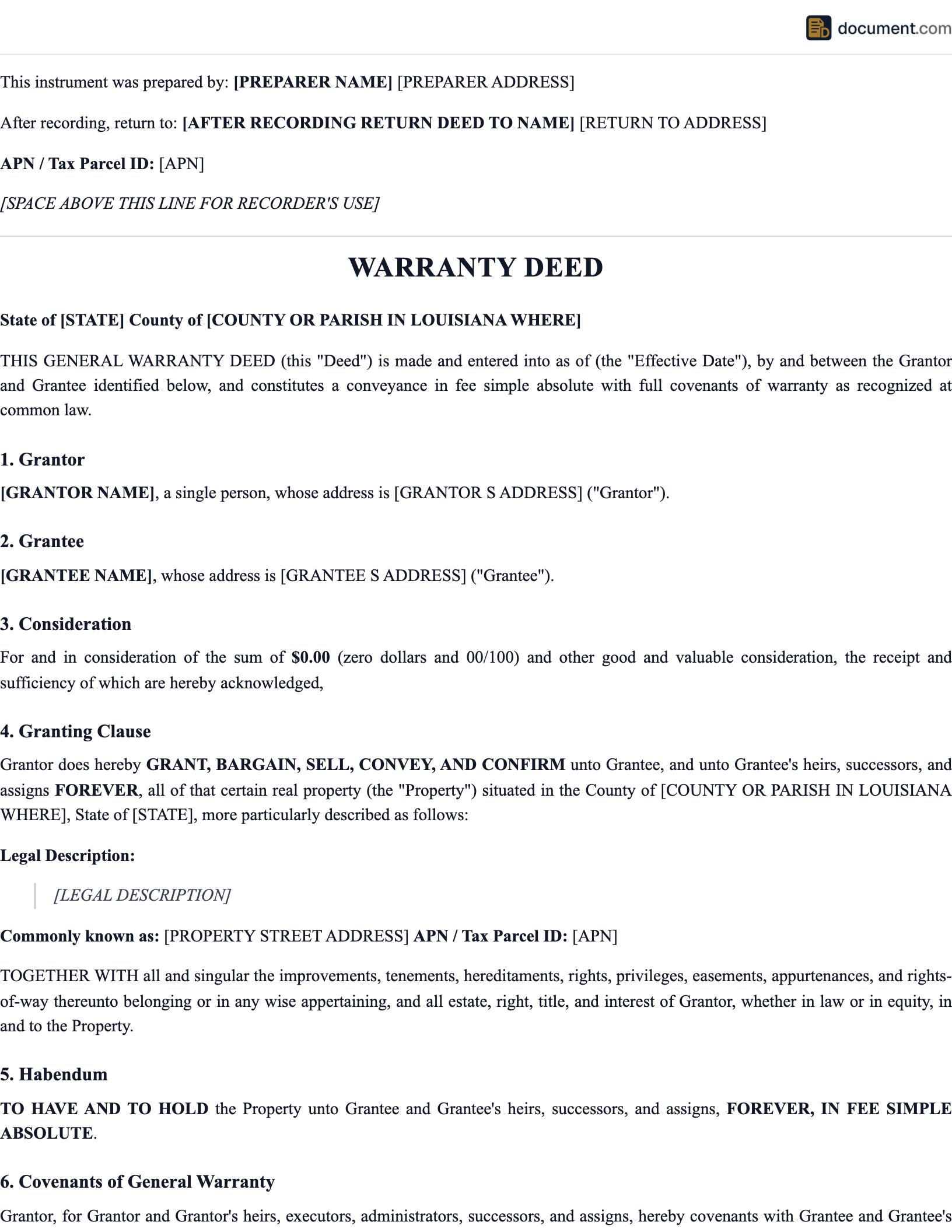
Sample Mississippi Warranty Deed
Preview of our Mississippi-specific template. Your document will include all fields required for recording in any Mississippi county.
WARRANTY DEED (GENERAL WARRANTY DEED)
STATE OF MISSISSIPPI
Legal Document
PARTY INFORMATION
Name: [Full Legal Name]
Address: [Mississippi Address]
County: [County]
PROPERTY DESCRIPTION
County: [County] State: Mississippi
Legal Description: [Per Recorded Plat]
Parcel No.: [APN]
Mississippi Warranty Deed FAQ
Common questions about filing in Mississippi, including requirements, fees, and tax implications.
Official Mississippi Resources
Official state resources for verifying requirements and finding your local recording office.
Important Considerations
Heirship issues are a significant and recurring problem in Mississippi real property titles, particularly in rural areas and for properties that have been in families for generations. When a property owner dies without a will, Mississippi intestacy law distributes the property to the heirs. If no probate proceeding is filed and no formal deed is recorded from the estate to the heirs, the property title becomes clouded. Future purchasers may need to obtain an affidavit of heirship or pursue a quiet title action to establish a clear chain. This issue affects a material percentage of rural Mississippi parcels.
Mineral rights and timber rights are frequently severed from surface rights in Mississippi deeds, particularly in the southern part of the state. A property can appear clean on a surface title search while someone else entirely owns the mineral estate below. Buyers of rural Mississippi land should conduct a separate mineral title search in addition to the standard surface search. If you are buying property in a county with historical oil and gas activity, this is not optional due diligence.
Mississippi does not have a statutory redemption period after a tax sale in the same form as some states, but tax lien issues and delinquent tax situations do arise and can affect title. Buyers should confirm that property taxes are current before closing and that no outstanding tax sales or tax certificates cloud the title. The Chancery Clerk's land records and the county tax collector's records are both worth searching.
Mississippi Practice Note
Mississippi real estate closings frequently involve real estate attorneys, particularly for residential purchases with lender financing and for commercial transactions. Unlike states where title companies dominate, Mississippi attorneys play a significant role in the closing process, reviewing title, preparing deeds, and conducting closings. The Mississippi Bar's Lawyer Referral Service can connect you with real estate attorneys in any county. For rural properties with complicated histories, an attorney experienced in Mississippi title examination is genuinely worth the cost.
Related Documents
Depending on your situation, you may need additional documents alongside this one. Below are commonly related documents that are frequently used together in real estate transactions.
Additional Mississippi Considerations
The Chancery Clerk system means that Mississippi land records are intertwined with probate records in a way that does not exist in most other states. If a prior owner died, the probate file at the same Chancery Clerk's office may contain deeds, orders of distribution, and other instruments that are part of the title chain. A thorough title search in Mississippi includes a probate search for deceased prior owners, not just a search of the deed index.
Mississippi's recording act is a race-notice statute. To be protected against prior unrecorded conveyances, a subsequent purchaser must both record first and take without notice of the prior conveyance. This means that delaying recording after closing carries real risk: a seller who conveys the same property twice (fraudulently or negligently) can create a genuine priority dispute. Record the deed promptly after closing.
Family land trusts and heir property situations are common throughout Mississippi, particularly in the Delta and along the Gulf Coast. Heir property (land owned by multiple family members as tenants in common with no formal legal agreement) is notoriously difficult to sell or mortgage because every co-owner must participate. Federal and state programs exist to help families in heir property situations obtain clear title, but the process takes time and legal assistance.
Mississippi Closing Customs
Real estate attorneys are central to Mississippi closings, particularly on the buyer's side when lender financing is involved. Title companies operate in Mississippi as well, but the attorney involvement in drafting and certifying title is more pronounced here than in states like Minnesota or Texas. When purchasing rural property with a complicated history, retain an attorney who regularly handles title examination in that specific county, since local land records practice can vary significantly even across county lines.
Related Documents
Depending on your situation, you may need additional documents alongside this one. Below are commonly related documents that are frequently used together in real estate transactions.
Create your Mississippi Warranty Deed in under 5 minutes.
Answer a few questions and download a Mississippi-compliant document, ready for the state agency.