



Minnesota Warranty Deed Overview
Minnesota's property recording system is one of the more nuanced in the Midwest because the state runs two parallel systems side by side. Abstract property is recorded with the County Recorder, while Torrens registered property goes to the Registrar of Titles. In most Minnesota counties, both offices share a building, but they operate under different statutory schemes with different forms and procedures. Identifying which system applies to your property before preparing the deed is the first thing a competent practitioner does.
Minnesota refers to its transfer tax as the deed tax, set at 0.33% of the net consideration with a $5 Conservation Fee tacked on. Recording fees vary by county but run around $46 for the first page. Minnesota also has a well disclosure requirement under MN Stat. 103I.235: any deed conveying property that has a well must include or attach a well disclosure certificate, or the recording office will reject the document. Our Minnesota template is drafted to comply with MN Stat. 507.0943, which governs deed formatting requirements in the state.
$46
Recording fee
$1.65 per $500
Transfer tax
Required
Notarization
0
Witnesses required
Minnesota Requirements
Minnesota imposes several requirements that are specific to the state and that practitioners in other states may not anticipate. Beyond the standard notarization and legal description rules, the drafter's name and address must appear on the deed under MN Stat. 507.0943. The well disclosure requirement applies to most residential and rural property transfers. And the abstract versus Torrens distinction means the filing destination varies by property.
Minnesota Specific Note
Minnesota's deed tax is 0.33% of the net consideration plus a mandatory $5 Conservation Fee on every deed. If the property has a well, a well disclosure certificate under MN Stat. 103I.235 must accompany the deed or the recording office will reject it. Determine whether your property is abstract or Torrens before filing: abstract deeds go to the County Recorder, Torrens deeds go to the Registrar of Titles. The drafter's name and address are also required on the face of the deed under MN Stat. 507.0943.
Document Requirements
- Notarization: Must be notarized by a Minnesota notary public or authorized notary
- Witnesses: Minnesota requires 0 additional witness(es)
- Legal Description: Complete legal description as it appears on the current deed of record
- Parcel Number: Assessor's parcel number or tax ID
- Return Address: Mailing address for returning the recorded document
- Formatting: Standard formatting with adequate margins, black ink, minimum 10-point font
How to File in Minnesota
Filing in Minnesota involves preparing the document, getting it notarized, and recording it. Follow these steps for a smooth process.
Prepare the Document
Identify whether the property is abstract or Torrens (check the current deed or county records). Pull the exact legal description. Include the drafter's name and address on the deed as required by MN Stat. 507.0943. If the property has a well, prepare a well disclosure certificate under MN Stat. 103I.235 to attach at filing.
Get the Document Notarized
The grantor signs before a Minnesota notary public. The acknowledgment must meet the requirements of MN Stat. 358.42. No additional witnesses are required. Remote online notarization is permitted under MN Stat. Chapter 358A for parties who cannot appear in person.
File With the Correct Office
Abstract property goes to the County Recorder; Torrens property goes to the Registrar of Titles. Both offices are typically in the same county government center. Many Minnesota counties offer e-recording through approved services. Bring the well disclosure certificate if required.
Pay the Deed Tax and Fees
Pay the deed tax (0.33% of net consideration, minimum $1.65) plus the $5 Conservation Fee, plus the recording fee (typically around $46 per document). If the transfer qualifies for a deed tax exemption, bring a completed exemption certificate citing the applicable statutory basis.
Notify the County Assessor
After recording, notify the county assessor of the ownership change. Minnesota does not require a separate property transfer affidavit like Michigan, but the assessor needs to update ownership records to send future property tax statements to the correct party. Update any homestead classification if the grantee will occupy the property as their primary residence.
Minnesota Fees & Costs
Typical costs for filing in Minnesota. Actual fees may vary by county.
| Fee / Tax | Amount |
|---|---|
| Recording Fee | $46 |
| Transfer Tax | $1.65 per $500 |
| Notarization | $5 - $25 per signature |
| Certified Copy | $1 - $10 per page |
| Attorney Review (optional) | $150 - $500 |
Minnesota Tax Implications
Minnesota's deed tax is 0.33% of the net consideration, with a $5 Conservation Fee added on top of every deed. By comparison, states like Massachusetts and New York impose substantially higher transfer taxes, so Minnesota is relatively transfer-tax-friendly. Certain transfers are exempt from the deed tax, including transfers between spouses, transfers correcting a prior instrument without conveying any additional interest, and transfers pursuant to a divorce decree or legal separation. Claiming an exemption requires a written statement on the deed identifying the specific statutory exemption, not just a general claim of exemption.
Minnesota imposes its own income tax on capital gains, and that tax applies to gains realized on Minnesota real property regardless of where the seller lives. A nonresident who sells Minnesota property owes Minnesota income tax on the gain attributable to the Minnesota source. The state requires withholding on nonresident seller transactions under certain circumstances. If you are a nonresident selling Minnesota real property, confirm your withholding obligations with a Minnesota tax professional before closing.
Property tax classifications in Minnesota matter to buyers in a way they do not in many other states. Minnesota classifies property (residential homestead, agricultural, commercial, etc.) and applies different mill rates to each class. A buyer who intends to use the property as their primary residence should file a homestead application with the county assessor promptly after closing to qualify for the lower homestead classification and the related property tax reduction. Missing the filing deadline pushes the classification change to the following tax year.
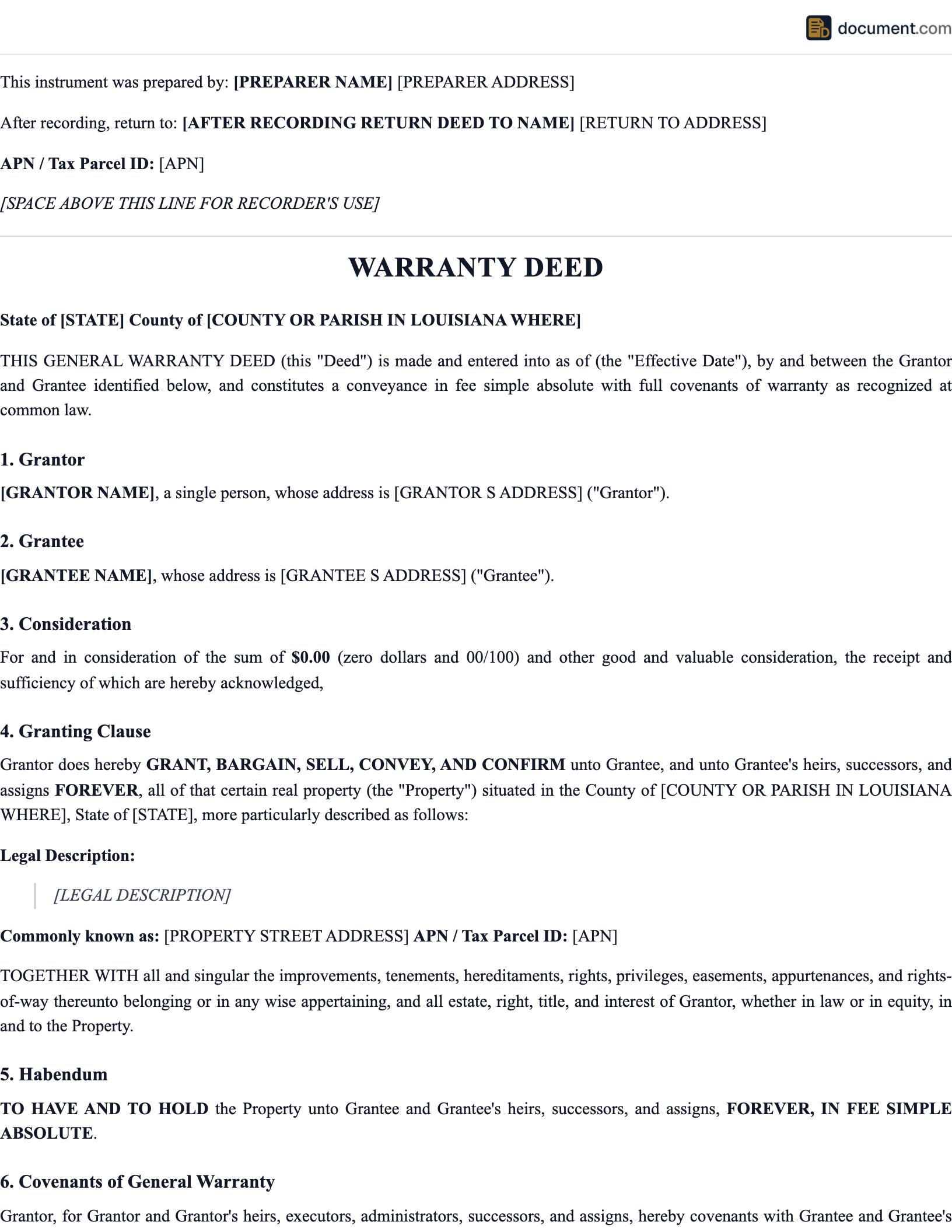
Sample Minnesota Warranty Deed
Preview of our Minnesota-specific template. Your document will include all fields required for recording in any Minnesota county.
WARRANTY DEED (GENERAL WARRANTY DEED)
STATE OF MINNESOTA
Legal Document
PARTY INFORMATION
Name: [Full Legal Name]
Address: [Minnesota Address]
County: [County]
PROPERTY DESCRIPTION
County: [County] State: Minnesota
Legal Description: [Per Recorded Plat]
Parcel No.: [APN]
Minnesota Warranty Deed FAQ
Common questions about filing in Minnesota, including requirements, fees, and tax implications.
Official Minnesota Resources
Official state resources for verifying requirements and finding your local recording office.
Important Considerations
The abstract versus Torrens distinction is the most Minnesota-specific issue in real estate here, and it affects everything from how you search title to which filing office accepts your deed. Hennepin and Ramsey counties (Minneapolis and St. Paul) have significant concentrations of Torrens property because the metro area went through mass registration early in the twentieth century. Greater Minnesota is predominantly abstract property, though registered parcels exist throughout the state. Always confirm before preparing the deed.
Well disclosures trip up out-of-state practitioners and first-time sellers frequently. If there is any well on the property, or if there has ever been a well that was sealed or abandoned, the disclosure requirement applies. Sellers who are unaware of an old well may discover the issue during a title search or buyer inspection. Disclosing a sealed well is not a deal-killer, but failing to disclose a known well creates seller liability.
Agricultural land in Minnesota can carry restrictions related to the Agricultural Land Preservation Program or be subject to a first right of purchase by adjoining landowners in certain contexts. Buyers of rural Minnesota land should verify whether any such restrictions or rights attach to the parcel before closing.
Minnesota Practice Note
Minnesota title closings are predominantly conducted by title companies rather than attorneys, which is different from states like Massachusetts or Iowa. Title companies in Minnesota are licensed by the Department of Commerce and follow established closing customs. Attorneys are involved more frequently in complex transactions, Torrens registrations, or disputes about title. The Minnesota State Bar Association's Real Property Law Section publishes resources on title standards that practitioners rely on for resolving title issues.
Related Documents
Depending on your situation, you may need additional documents alongside this one. Below are commonly related documents that are frequently used together in real estate transactions.
Additional Minnesota Considerations
Hennepin County and Ramsey County, the two most populous counties in Minnesota, have online property search systems through their respective assessor and recorder websites that can tell you quickly whether a parcel is abstract or Torrens land. For greater Minnesota counties, the county auditor or recorder's office can typically confirm the property's recording status with a quick phone call or online lookup. Do not guess: the filing office for an abstract deed and a Torrens deed are legally distinct, and filing in the wrong one has no effect on the title.
Sellers transferring property in Minnesota should be aware that the deed tax is typically allocated to the seller as a closing cost by convention, but the parties can agree to split it or assign it to the buyer in the purchase agreement. The $5 Conservation Fee cannot be waived by agreement. Both are collected at the recording counter.
Marital property considerations in Minnesota follow equitable distribution principles under the Minnesota Marital Property Act. A deed conveying property that is marital property generally requires both spouses to sign if it involves the homestead, even if title is held in only one name. Practitioners often add both spouses as grantors on homestead conveyances to eliminate any ambiguity about the other spouse's interest.
Minnesota Title Closing Practice
Unlike Massachusetts or Iowa, Minnesota closings are overwhelmingly handled by licensed title companies rather than attorneys. The title company will typically prepare the deed on behalf of the seller, handle the deed tax payment, and coordinate recording. That said, attorneys remain common in commercial transactions, Torrens registrations, and any deal involving a significant title defect or dispute. The Minnesota Land Title Association is a good resource for finding licensed closing agents and understanding state-specific closing customs.
Related Documents
Depending on your situation, you may need additional documents alongside this one. Below are commonly related documents that are frequently used together in real estate transactions.
Create your Minnesota Warranty Deed in under 5 minutes.
Answer a few questions and download a Minnesota-compliant document, ready for the state agency.