



Michigan Warranty Deed Overview
Michigan warranty deeds are filed with the Register of Deeds in the county where the property is located. The state charges both a state-level and a county-level real estate transfer tax, which together add meaningful closing costs. But the tax question is often secondary to the uncapping issue: when a Michigan property transfers, Proposal A's taxable value cap resets, and buyers frequently see their first annual property tax bill run significantly higher than what the seller was paying.
The Property Transfer Affidavit (Form 2766) must be filed with the local city or township assessor within 45 days of recording the deed. This is the grantor's responsibility to disclose, but it falls on the grantee to actually file. The penalty for missing the deadline is $5 per day up to $200, but the more serious consequence is a delayed reassessment that can affect property tax records for years. Our Michigan template meets the recording requirements under MCL 565 and includes all fields the Register of Deeds expects at filing.
$15
Recording fee
$3.75 per $500
Transfer tax
Required
Notarization
0
Witnesses required
Michigan Requirements
Michigan deeds must meet the statutory requirements of MCL 565.201 to be accepted for recording. Beyond the standard notarization and legal description requirements, Michigan imposes a parcel identification number requirement and has specific margin standards. Deeds that do not meet the formatting standards may be rejected or flagged by the Register of Deeds.
Michigan Specific Note
Michigan imposes a state real estate transfer tax of $3.75 per $500 of consideration, plus a county transfer tax (typically $0.55 per $500). The Property Transfer Affidavit (Form 2766) must be filed with the local assessor within 45 days of the deed transfer or the grantee faces penalties of $5 per day up to $200. Michigan also allows a principal residence exemption from the uncapping rules if the transferee will occupy the property as their primary home. File the PRE affidavit with the assessor at the same time as the PTA.
Document Requirements
- Notarization: Must be notarized by a Michigan notary public or authorized notary
- Witnesses: Michigan requires 0 additional witness(es)
- Legal Description: Complete legal description as it appears on the current deed of record
- Parcel Number: Assessor's parcel number or tax ID
- Return Address: Mailing address for returning the recorded document
- Formatting: Standard formatting with adequate margins, black ink, minimum 10-point font
How to File in Michigan
Filing in Michigan involves preparing the document, getting it notarized, and recording it. Follow these steps for a smooth process.
Prepare the Document
Fill in the grantor and grantee names, addresses, consideration amount, and the complete legal description from the existing deed or the county Register of Deeds. Include the parcel identification number (PIN), which Michigan requires on the deed itself. Verify name spelling matches exactly how it appears on the current deed to avoid chain of title issues.
Get the Document Notarized
The grantor signs before a Michigan notary public. The acknowledgment must follow the statutory form under MCL 565.8. No witnesses are required. Michigan permits remote online notarization for grantors who cannot appear in person, which is useful for out-of-state sellers.
Record With the County Register of Deeds
Take the original notarized deed to the Register of Deeds in the county where the property is located. Many Michigan counties accept e-recording through approved vendors. Wayne, Oakland, and Macomb counties have high-volume offices with robust e-recording capabilities.
Pay Transfer Taxes and Recording Fees
Pay the state transfer tax ($3.75 per $500) and county transfer tax (typically $0.55 per $500), plus the recording fee ($15 for the first page, $3 per additional page). Exemption affidavits must accompany any deed claiming a transfer tax exemption.
File the Property Transfer Affidavit
Within 45 days of recording, the grantee must file Form 2766 (Property Transfer Affidavit) with the local city or township assessor where the property is located. If the grantee will occupy the property as a principal residence, also file the Principal Residence Exemption (PRE) affidavit with the assessor to potentially limit the uncapping effect.
Michigan Fees & Costs
Typical costs for filing in Michigan. Actual fees may vary by county.
| Fee / Tax | Amount |
|---|---|
| Recording Fee | $15 |
| Transfer Tax | $3.75 per $500 |
| Notarization | $5 - $25 per signature |
| Certified Copy | $1 - $10 per page |
| Attorney Review (optional) | $150 - $500 |
Michigan Tax Implications
Michigan's real estate transfer tax operates on two levels simultaneously. The state charges $3.75 per $500 of consideration, and the county adds between $0.55 and $0.75 per $500 on top. The combined rate on a $300,000 purchase works out to roughly $2,580 in transfer taxes, which is a meaningful closing cost. Certain transfers avoid the tax entirely: transfers between spouses, transfers to a child or parent where the property will be used as the transferee's principal residence, and corrective deeds that do not reflect a change in ownership are among the most common exemptions. Claiming an exemption requires filing a notarized exemption affidavit with the deed at recording.
The property tax implications of a Michigan transfer frequently matter more in the long run than the one-time transfer tax. Michigan's Proposal A (1994) limits annual taxable value increases to 5% or the inflation rate for existing owners. That cap disappears upon a transfer, and the taxable value resets to the state equalized value, which tracks market value. Buyers who purchase at current market prices in a neighborhood where sellers have owned for 20 or 30 years may see property taxes nearly double in the first year. The Principal Residence Exemption does not prevent the uncapping; it provides a separate 18-mill reduction in the millage rate for owner-occupants.
At the federal level, gift transfers of Michigan real property exceeding the annual exclusion trigger Form 709 gift tax reporting. The recipient takes a carryover basis equal to the donor's adjusted basis, preserving embedded capital gains that will be recognized if the property is later sold. Inherited Michigan real estate receives a stepped-up basis to fair market value at the date of death, which is a significant planning distinction for families considering lifetime transfers versus testamentary transfers of appreciated property.
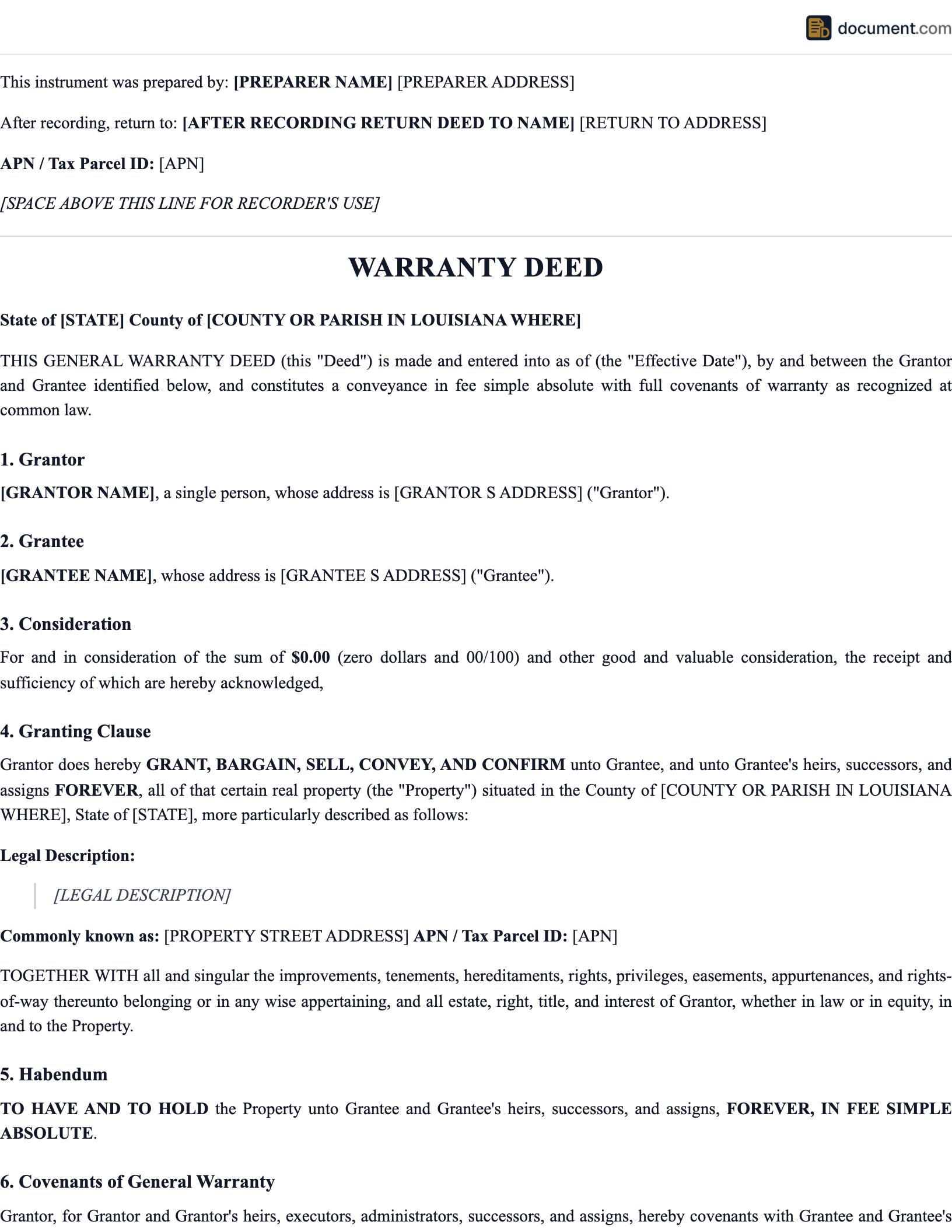
Sample Michigan Warranty Deed
Preview of our Michigan-specific template. Your document will include all fields required for recording in any Michigan county.
WARRANTY DEED (GENERAL WARRANTY DEED)
STATE OF MICHIGAN
Legal Document
PARTY INFORMATION
Name: [Full Legal Name]
Address: [Michigan Address]
County: [County]
PROPERTY DESCRIPTION
County: [County] State: Michigan
Legal Description: [Per Recorded Plat]
Parcel No.: [APN]
Michigan Warranty Deed FAQ
Common questions about filing in Michigan, including requirements, fees, and tax implications.
Official Michigan Resources
Official state resources for verifying requirements and finding your local recording office.
Important Considerations
The 45-day Property Transfer Affidavit deadline is the single most commonly missed post-closing obligation in Michigan real estate. Unlike the deed recording, which happens at the closing table, the PTA filing requires a separate trip (or mailing) to the local assessor's office after recording. Buyers who use a title company should ask whether the company files the PTA on their behalf as part of the service, because some do and some do not. Either way, verify it was filed and keep a copy.
Michigan also permits a special form of deed called a 'covenant deed,' which provides a limited warranty covering only claims arising during the grantor's period of ownership. This is distinct from a full warranty deed, which covers the entire chain of title going back. In practice, sellers who acquired property through foreclosure or a tax sale often use covenant deeds because they cannot honestly warrant against pre-existing defects. Buyers purchasing a covenant deed should take title insurance seriously; the seller is explicitly not warranting against problems that predate their ownership.
Riparian rights and mineral interests add complexity to some Michigan deed transactions, particularly in rural northern Michigan or lakefront properties. If the existing deed contains reservations of mineral rights or language about water access, those terms carry forward. A deed that fails to properly address an existing reservation may leave the grantee with less than they bargained for.
Michigan Practice Note
Michigan has a robust title insurance market, and most lenders require a lender's policy. The Michigan Department of Insurance and Financial Services (DIFS) regulates title insurance rates filed by title insurers. Owner's policies are separately priced from lender's policies, and purchasing both simultaneously at closing is almost always cheaper than buying the owner's policy at a later date. For properties in counties with older industrial use, brownfield designation, or environmental liens, a title search alone may not surface all encumbrances.
Related Documents
Depending on your situation, you may need additional documents alongside this one. Below are commonly related documents that are frequently used together in real estate transactions.
Additional Michigan Considerations
Michigan's recording act is a race-notice statute, meaning a subsequent purchaser who records first and takes without notice of a prior unrecorded conveyance takes priority over that earlier interest. The practical implication for buyers is that recording should happen promptly after closing, not days or weeks later. Title companies handling Michigan closings typically record the deed on the day of closing or the following business day to eliminate this risk entirely.
Michigan also has a robust Lady Bird Deed (Enhanced Life Estate Deed) statute that allows property owners to convey property to a beneficiary at death while retaining full control, including the ability to sell or mortgage the property, during their lifetime. Unlike a traditional life estate deed, the Lady Bird Deed does not require the future beneficiary's consent to any transaction during the owner's lifetime. This makes it a popular estate planning tool in Michigan for families who want to avoid probate without creating a trust.
For commercial and industrial Michigan properties, environmental lien issues can affect the title. The Michigan Department of Environment, Great Lakes, and Energy (EGLE) can place liens on contaminated properties under the Natural Resources and Environmental Protection Act. A standard title search covers recorded liens, but environmental due diligence for commercial properties often requires a separate Phase I environmental site assessment. Buyers of industrial or agricultural Michigan land should investigate this independently.
Michigan PTA Reminder
The Property Transfer Affidavit (Form 2766) is the most commonly missed post-closing obligation in Michigan. The 45-day deadline runs from the date of the deed transfer, not the recording date. Both the state and the Michigan Association of Realtors have published guidance on PTA requirements, and the Michigan Treasury website provides the current version of Form 2766 for download. Grantees should file the PTA and, if applicable, the Principal Residence Exemption affidavit with the local assessor as soon as possible after recording.
Related Documents
Depending on your situation, you may need additional documents alongside this one. Below are commonly related documents that are frequently used together in real estate transactions.
Create your Michigan Warranty Deed in under 5 minutes.
Answer a few questions and download a Michigan-compliant document, ready for the state agency.