



Massachusetts Warranty Deed Overview
Massachusetts warranty deeds are recorded at the Registry of Deeds for the county where the property sits. The state has 21 registry districts, and in counties like Middlesex and Bristol, property falls into one of multiple sub-districts based on its location. Before filing, you also need to confirm whether your property is ordinary recorded land or registered land held under a Land Court Certificate of Title, because those follow completely different procedures.
The deed excise tax runs $4.56 per $1,000 of consideration, making Massachusetts one of the higher-tax states in the region. Recording fees start at $75 for the first page and $10 per additional page. Massachusetts closings are handled almost exclusively by attorneys as a matter of professional custom, and lenders routinely require attorney certification of title as a condition of funding. Our template follows the warranty covenant language expected by Massachusetts registries and includes the acknowledgment block formatted for MA notaries.
$75
Recording fee
$2.28 per $500
Transfer tax
Required
Notarization
0
Witnesses required
Massachusetts Requirements
Massachusetts registries are strict about formatting and documentation. A deed that is returned for defects needs to be re-executed and re-acknowledged, which can delay closing or upset a title chain. The requirements below reflect what the registry expects at the counter; they are not aspirational suggestions.
Massachusetts Specific Note
Massachusetts imposes a deed excise tax of $4.56 per $1,000 of consideration (approximately $2.28 per $500). If you are transferring registered land, the deed must go to the Land Court registration district, not the standard Registry of Deeds. The grantor's complete mailing address must appear on the deed per MGL Chapter 183, Section 6C, and the grantor's acknowledgment must include the notary's commission expiration date. Deeds missing that date are routinely rejected at the registry counter.
Document Requirements
- Notarization: Must be notarized by a Massachusetts notary public or authorized notary
- Witnesses: Massachusetts requires 0 additional witness(es)
- Legal Description: Complete legal description as it appears on the current deed of record
- Parcel Number: Assessor's parcel number or tax ID
- Return Address: Mailing address for returning the recorded document
- Formatting: Standard formatting with adequate margins, black ink, minimum 10-point font
How to File in Massachusetts
Filing in Massachusetts involves preparing the document, getting it notarized, and recording it. Follow these steps for a smooth process.
Prepare the Document
Confirm the property is recorded land or registered land (check the current deed or the Land Court website). Pull the exact legal description from the existing deed or Certificate of Title, and include the grantor's full mailing address as required by MGL Chapter 183, Section 6C.
Get the Document Notarized
The grantor signs before a Massachusetts notary public or other officer authorized under MGL Chapter 222. The acknowledgment block must state the notary's commission expiration date. No additional witnesses are required beyond the notary, but many practitioners add a witness line as a precaution against future challenges.
File With the Correct Registry
Bring the original notarized deed to the Registry of Deeds for the county and district where the property is located. If the property is registered land, file instead with the Land Court registration office. Each district has its own recording counter, and some accept e-recording through approved vendor platforms.
Pay Fees and Excise Tax
Pay the base recording fee ($75 for the first page, $10 per additional page) plus the deed excise tax at $4.56 per $1,000 of consideration. Bring a check or cash; some registries also accept credit cards. Exempt transfers still require a completed excise tax form noting the exemption reason.
Notify the Local Assessor
After recording, notify the town or city assessor's office of the ownership change so property tax bills are directed to the new owner. Also update any homestead exemptions if applicable. Most Massachusetts registries return the recorded deed by mail within a few weeks.
Massachusetts Fees & Costs
Typical costs for filing in Massachusetts. Actual fees may vary by county.
| Fee / Tax | Amount |
|---|---|
| Recording Fee | $75 |
| Transfer Tax | $2.28 per $500 |
| Notarization | $5 - $25 per signature |
| Certified Copy | $1 - $10 per page |
| Attorney Review (optional) | $150 - $500 |
Massachusetts Tax Implications
Massachusetts charges a deed excise tax of $4.56 per $1,000 of consideration, one of the higher rates in New England. The tax is paid at the Registry of Deeds at the time of recording and is typically a seller-side closing cost by convention, though parties can allocate it differently in the purchase and sale agreement. Certain transfers are exempt: conveyances between spouses or parents and children without actual payment, corrections of prior instruments, and transfers from a deceased person's estate where no money changes hands are the most common exemptions. Exempt deeds still require a completed registry excise certificate noting the applicable exemption.
Gift transfers of real property trigger federal gift tax reporting on IRS Form 709 if the fair market value of the gift exceeds the annual exclusion amount. When a property is gifted, the recipient generally takes the donor's carryover basis, which means a low-basis property gifted to a child will carry a large embedded capital gain when the child eventually sells. Receiving the same property through a decedent's estate, by contrast, produces a stepped-up basis to fair market value at the date of death, potentially eliminating that gain entirely.
Massachusetts does not have a separate property transfer tax beyond the deed excise, but property tax implications remain. Most Massachusetts cities and towns do not automatically reassess property upon transfer the way some states do, but the local assessor will update ownership records and may flag the sale price for comparison with the current assessed value. If a significant gap exists, an informal revaluation or abatement inquiry could follow. Sellers who have lived in the property as their principal residence for two of the preceding five years may exclude up to $250,000 (or $500,000 for married couples) of capital gain from federal income tax under IRC Section 121.
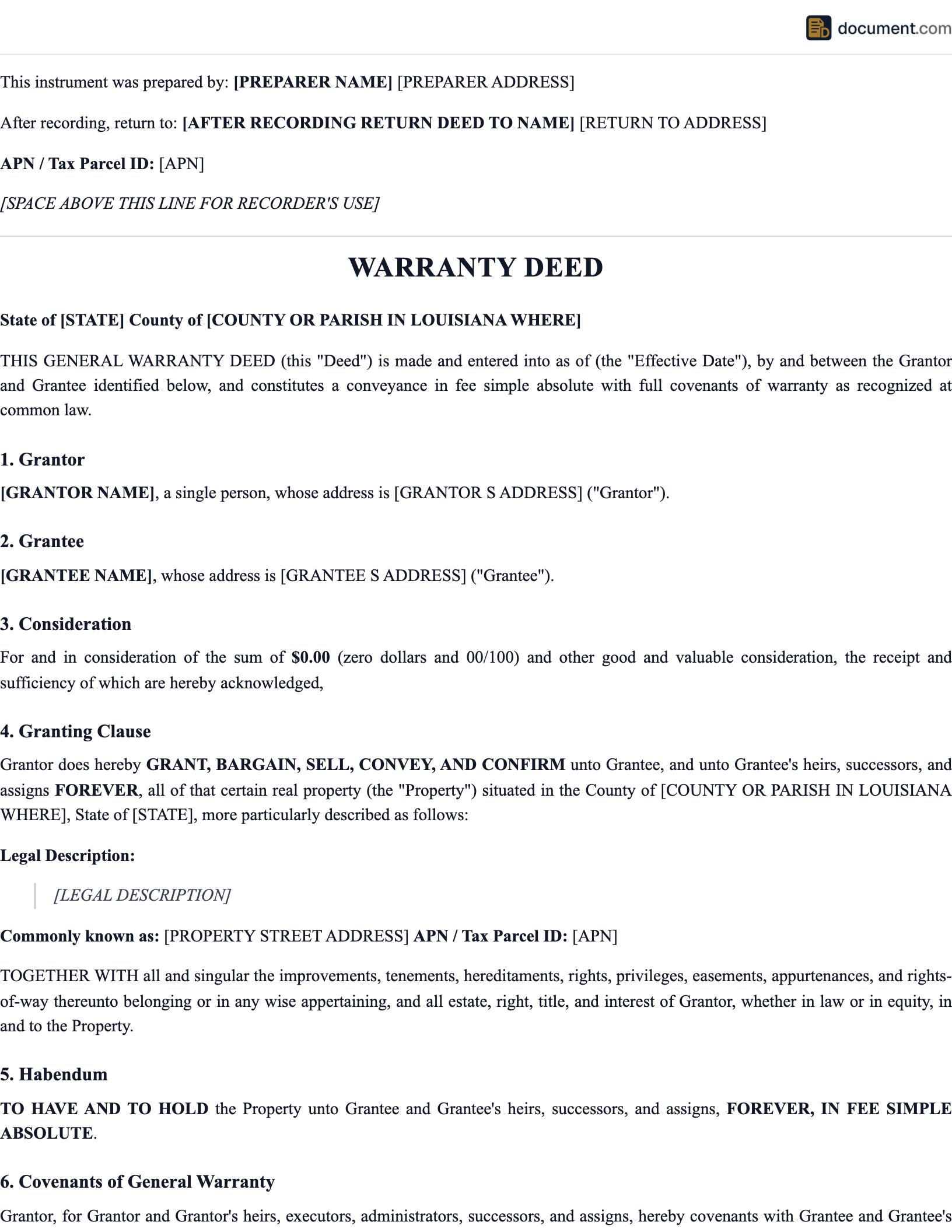
Sample Massachusetts Warranty Deed
Preview of our Massachusetts-specific template. Your document will include all fields required for recording in any Massachusetts county.
WARRANTY DEED (GENERAL WARRANTY DEED)
STATE OF MASSACHUSETTS
Legal Document
PARTY INFORMATION
Name: [Full Legal Name]
Address: [Massachusetts Address]
County: [County]
PROPERTY DESCRIPTION
County: [County] State: Massachusetts
Legal Description: [Per Recorded Plat]
Parcel No.: [APN]
Massachusetts Warranty Deed FAQ
Common questions about filing in Massachusetts, including requirements, fees, and tax implications.
Official Massachusetts Resources
Official state resources for verifying requirements and finding your local recording office.
Important Considerations
The registered land distinction is one of Massachusetts's most consequential title quirks. A property that went through Land Court registration decades ago is subject to Chapter 185 rules that differ from ordinary registry recording in meaningful ways, including different forms, different filing offices, and different notice rules. If you buy a property assuming it is ordinary recorded land and it turns out to be registered, deeds recorded at the wrong office have no legal effect on the title. Check the current deed or call the county registry before you prepare any transfer documents.
Massachusetts attorney-closing culture is deeply embedded in the real estate market. Even if you prepare the deed yourself, expect your lender or title insurer to require an attorney to conduct the closing, certify title, and disburse funds. The Bar Overseers take a firm position that certain functions in a real estate closing constitute the practice of law. This does not mean you cannot use a template, but it does mean the closing itself will involve counsel on at least one side.
Trusts are common vehicles for holding Massachusetts real estate, and they introduce a separate layer of documentation. A trustee conveying real property from a trust must typically record a Certificate of Trust under MGL Chapter 184, Section 35, or a full copy of the trust instrument alongside the deed. The registry wants evidence that the trustee has authority to convey. Missing this step is a frequent source of title defects that surface years later during a subsequent sale.
Massachusetts Practice Note
The Massachusetts Conveyancers Association publishes title standards that define acceptable practice for searching and certifying title in the Commonwealth. Those standards, not just the statutes, govern what defects are considered curable and what problems will hold up a closing. An attorney familiar with those standards is the right person to review any deed that involves unusual circumstances, a gap in the chain of title, or a property with a complicated ownership history.
Related Documents
Depending on your situation, you may need additional documents alongside this one. Below are commonly related documents that are frequently used together in real estate transactions.
Additional Massachusetts Considerations
Massachusetts is a recording race-notice state. A subsequent purchaser who records without actual notice of a prior unrecorded interest takes priority over that prior interest. In practice this means the time between closing and recording is a window of title vulnerability. Most Massachusetts attorneys and title companies record the deed on the day of closing or the day after to close that window. Delays in recording create risk, particularly in active real estate markets where properties change hands quickly.
Estate planning and trust administration frequently intersect with Massachusetts deed practice. When property is being conveyed from a trust, the trustee must include either a recorded Certificate of Trust (MGL Chapter 184, Section 35) or a full copy of the trust instrument with the deed. When property is passing from an estate, the executor or personal representative needs to be authorized under the probate proceedings, and that authorization should be reflected in the recorded deed. Skipping these steps leaves a gap in the chain of title that will surface at a future sale.
Massachusetts also has a Homestead Declaration available under MGL Chapter 188 that provides a homeowner with up to $500,000 of protection in the home against certain creditor claims. Filing a Homestead Declaration is a separate step from the deed transfer itself, but many Massachusetts practitioners record one alongside a deed conveying property to an owner who will occupy it as their primary residence. It is a one-time filing that provides ongoing protection.
Registry of Deeds Access
Massachusetts registries have invested significantly in online access to land records. The Secretary of State's Registry of Deeds portal (deeds.mass.gov) provides free access to recorded documents across most registry districts. You can search by name, document type, and date range. For registered land, the Land Court maintains a separate system. Both systems are publicly accessible without charge, which makes preliminary title research more accessible than in many other states.
Related Documents
Depending on your situation, you may need additional documents alongside this one. Below are commonly related documents that are frequently used together in real estate transactions.
Create your Massachusetts Warranty Deed in under 5 minutes.
Answer a few questions and download a Massachusetts-compliant document, ready for the state agency.