



Maryland Warranty Deed Overview
Maryland's land records system is administered through the Circuit Court in each county and Baltimore City, under the oversight of the State Department of Assessments and Taxation (SDAT). Recording a warranty deed in Maryland involves more steps than most states. Beyond the deed itself, you need to submit an SDAT intake form (Certificate of Consideration), pay the state transfer tax, pay the local county transfer tax, and pay the recordation tax. These are separate obligations calculated on the consideration amount, and they must all be addressed at the time of recording.
The state transfer tax is 0.5% of consideration, typically split between buyer and seller. First-time homebuyers are exempt from their half of the state transfer tax. The recordation tax is $4.95 per $500. County transfer taxes range from 0 to 1.5% depending on the jurisdiction. Recording fees start at approximately $60. Notarization by a Maryland notary is required; no witnesses are needed. SDAT uses deed recordings to update property assessments, which can affect future property tax bills.
$60
Recording fee
0.5%-1.5%
Transfer tax
Required
Notarization
0
Witnesses required
Maryland Requirements
Maryland deed recording requirements are governed by the Maryland Code, Real Property Article. Beyond the deed, the Circuit Court Land Records office requires an intake sheet and the SDAT Certificate of Consideration form. The deed must include the full names and addresses of grantor and grantee, the property's legal description, the consideration, and a notarized acknowledgment. Maryland also requires that the property's Ground Rent status be disclosed if applicable; ground rents are a historical feature of some Baltimore-area properties that affect ownership rights.
Maryland Specific Note
Maryland imposes both a state transfer tax (0.5%) and a recordation tax ($4.95 per $500) at the state level, plus a county transfer tax that varies by jurisdiction. First-time Maryland homebuyers are exempt from the state transfer tax on their share. You must submit the SDAT Certificate of Consideration form with the deed at recording. Without this form, the Land Records office will refuse the filing. Some counties require additional county-specific intake forms as well. Confirm all requirements with the Circuit Court Land Records office in the applicable county before filing.
Document Requirements
- Notarization: Must be notarized by a Maryland notary public or authorized notary
- Witnesses: Maryland requires 0 additional witness(es)
- Legal Description: Complete legal description as it appears on the current deed of record
- Parcel Number: Assessor's parcel number or tax ID
- Return Address: Mailing address for returning the recorded document
- Formatting: Standard formatting with adequate margins, black ink, minimum 10-point font
How to File in Maryland
Filing in Maryland involves preparing the document, getting it notarized, and recording it. Follow these steps for a smooth process.
Prepare the Deed and Required Forms
Draft the warranty deed with the full legal description from the existing recorded deed, the grantor and grantee's full names and addresses, and the consideration amount. Also prepare the SDAT Certificate of Consideration form, the Circuit Court intake sheet for your county, and any county-specific forms your jurisdiction requires. Montgomery County, for example, uses different forms than Howard County or Prince George's County.
Get the Deed Notarized
All grantors must sign before a Maryland notary public. No witnesses beyond the notary are required. The notary completes the acknowledgment block. If a business entity is conveying, the authorized signatory must sign in their representative capacity, and the entity's authority to convey should be documented in a corporate resolution or equivalent authorization.
Submit to Circuit Court Land Records
Present the original notarized deed, SDAT Certificate of Consideration, and all required intake forms to the Land Records division of the Circuit Court in the county where the property is located. Remember that Baltimore City and Baltimore County are separate jurisdictions; do not confuse them. Most Maryland counties accept e-recording through authorized vendors, which can expedite processing.
Pay All Applicable Taxes and Fees
At recording, pay the state transfer tax (0.5% of consideration), the county transfer tax (varies by county), and the recordation tax ($4.95 per $500). First-time homebuyers are exempt from their share of the state transfer tax. The recording fee itself is separate and varies by page count. Come prepared with a certified check or confirm whether personal checks or cards are accepted in your county.
SDAT and Homestead Credit
After recording, SDAT updates the property ownership records and may reassess the property based on the transfer. New Maryland homeowners who will occupy the property as their primary residence should apply to SDAT for the Homestead Tax Credit, which caps the annual increase in the property's taxable assessment. Apply through SDAT's online system; the credit does not apply automatically and has a one-time application requirement.
Maryland Fees & Costs
Typical costs for filing in Maryland. Actual fees may vary by county.
| Fee / Tax | Amount |
|---|---|
| Recording Fee | $60 |
| Transfer Tax | 0.5%-1.5% |
| Notarization | $5 - $25 per signature |
| Certified Copy | $1 - $10 per page |
| Attorney Review (optional) | $150 - $500 |
Maryland Tax Implications
Maryland's transfer-related tax burden at closing is among the more complex in the Mid-Atlantic region. The state transfer tax is 0.5%, split evenly between buyer and seller in most transactions. First-time homebuyers in Maryland are exempt from paying their half, so the seller bears the full 0.5% in those transactions. The recordation tax is $4.95 per $500 and is typically the buyer's responsibility. On top of both state taxes, each county and Baltimore City imposes its own local transfer tax, ranging from 0% in some counties to 1.5% in others. The combined tax load on a $500,000 purchase in a higher-tax county can easily reach $10,000 or more.
Maryland's non-resident seller withholding requirement is a practical consideration that surprises many out-of-state property owners. When a Maryland property is sold by a non-resident, the buyer or settlement agent must withhold 8% of the total consideration and remit it to the Comptroller at the time of closing. This is not a final tax; it is a prepayment against the seller's Maryland income tax liability on the gain. The seller files a non-resident return to reconcile the actual tax owed against the amount withheld. Failing to make the withholding can expose the buyer to liability.
Maryland's SDAT reassesses residential property on a three-year cycle and sends new assessments to property owners in advance. A deed transfer at a purchase price substantially above the existing assessed value can prompt SDAT to reassess the property sooner, raising future property tax bills. The Homestead Tax Credit caps the annual growth in the taxable assessment for owner-occupied primary residences. New homeowners should apply for this credit through SDAT after recording, as it does not activate automatically and has historically prevented large year-over-year tax increases in rapidly appreciating markets like Montgomery County and Bethesda.
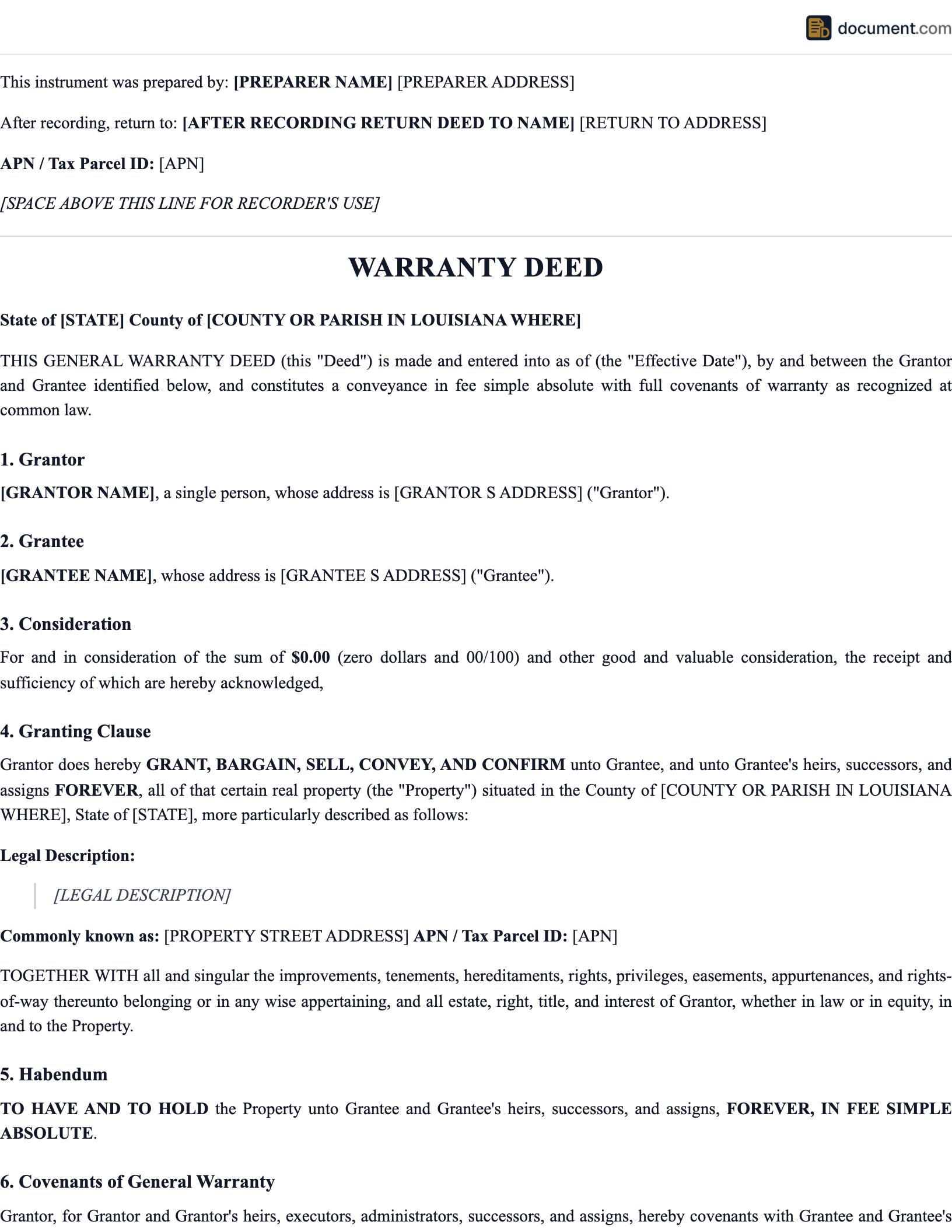
Sample Maryland Warranty Deed
Preview of our Maryland-specific template. Your document will include all fields required for recording in any Maryland county.
WARRANTY DEED (GENERAL WARRANTY DEED)
STATE OF MARYLAND
Legal Document
PARTY INFORMATION
Name: [Full Legal Name]
Address: [Maryland Address]
County: [County]
PROPERTY DESCRIPTION
County: [County] State: Maryland
Legal Description: [Per Recorded Plat]
Parcel No.: [APN]
Maryland Warranty Deed FAQ
Common questions about filing in Maryland, including requirements, fees, and tax implications.
Official Maryland Resources
Official state resources for verifying requirements and finding your local recording office.
Important Considerations
Maryland's multi-layer tax structure at closing is one of the most involved in the country. Knowing the state transfer tax rate is not enough; you also need to know the recordation tax and your specific county's local transfer tax before you can calculate total closing costs. These vary county by county, and jurisdictions like Baltimore City, Montgomery County, and Prince George's County each have their own rates. Budget for all three tiers before finalizing your transaction.
Ground rents are a unique feature of some older Maryland properties, particularly in Baltimore City and surrounding areas. A ground rent is a perpetual lease on the land under the house, with the homeowner paying an annual rent to the ground rent holder. Maryland law created a mechanism for homeowners to redeem ground rents, but not all ground rents have been redeemed. If the property you are transferring has an existing ground rent, it must be disclosed and addressed in the deed transfer.
Unpaid water and sewer charges in Maryland can run with the property as a lien, meaning a new owner can inherit the prior owner's unpaid utility debt. Always obtain a water and sewer payoff as part of the pre-closing title search process. This is particularly important in Baltimore City and the surrounding counties where large unpaid balances can accumulate.
The SDAT intake form (Certificate of Consideration) is a hard stop at the Land Records office. No deed gets recorded without it. If you are handling a transfer without professional assistance, download and complete this form before going to the courthouse. The SDAT website has current forms and instructions.
Note for Non-Resident Sellers
If you are selling Maryland property but do not live in Maryland, the buyer or settlement agent is required by law to withhold 8% of the total sale price and remit it to the Comptroller at closing. This withholding obligation falls on the party receiving funds, and failure to make it can result in penalties. Non-resident sellers should plan for this cash flow impact at closing and file a Maryland non-resident return to claim credit for the amount withheld against the actual tax owed on the gain.
Related Documents
Depending on your situation, you may need additional documents alongside this one. Below are commonly related documents that are frequently used together in real estate transactions.
Important Considerations
Maryland's multi-layer tax structure at closing is one of the most involved in the country. Knowing the state transfer tax rate is not enough; you also need to know the recordation tax and your specific county's local transfer tax before you can calculate total closing costs. These vary county by county, and jurisdictions like Baltimore City, Montgomery County, and Prince George's County each have their own rates. Budget for all three tiers before finalizing your transaction.
Ground rents are a unique feature of some older Maryland properties, particularly in Baltimore City and surrounding areas. A ground rent is a perpetual lease on the land under the house, with the homeowner paying an annual rent to the ground rent holder. Maryland law created a mechanism for homeowners to redeem ground rents, but not all ground rents have been redeemed. If the property you are transferring has an existing ground rent, it must be disclosed and addressed in the deed transfer.
Unpaid water and sewer charges in Maryland can run with the property as a lien, meaning a new owner can inherit the prior owner's unpaid utility debt. Always obtain a water and sewer payoff as part of the pre-closing title search process. This is particularly important in Baltimore City and the surrounding counties where large unpaid balances can accumulate.
The SDAT intake form (Certificate of Consideration) is a hard stop at the Land Records office. No deed gets recorded without it. If you are handling a transfer without professional assistance, download and complete this form before going to the courthouse. The SDAT website has current forms and instructions. are also recommended as a backup.
Professional Recommendation
While our templates are designed to be comprehensive and legally compliant, we recommend having your completed document reviewed by a licensed attorney before recording, especially for high-value transactions or complex situations. Many attorneys offer flat-fee document review services that provide peace of mind at a reasonable cost.
Related Documents
Depending on your situation, you may need additional documents alongside this one. Below are commonly related documents that are frequently used together in real estate transactions.
Create your Maryland Warranty Deed in under 5 minutes.
Answer a few questions and download a Maryland-compliant document, ready for the state agency.