



Maine Warranty Deed Overview
Maine warranty deeds are filed with the county Registry of Deeds, a system that covers Maine's 16 counties from Aroostook in the north to York along the New Hampshire border. The Registry is a straightforward place to record; Maine's requirements are comparatively lean. No witnesses are needed beyond the notary, there is no separate state filing form tied to the deed itself beyond the transfer tax declaration, and most registries provide efficient same-day service for in-person filings.
Maine is one of a small number of states where the real estate transfer tax is divided between buyer and seller. The total rate is $2.20 per $500 of consideration, split so each party pays $1.10 per $500. Recording fees at the Registry start at $13 for the first page. Notarization by a Maine notary public is required; witnesses are not. Maine's coastal, lakefront, and forested rural properties often carry complex descriptions and riparian rights that deserve careful attention in the deed preparation stage.
$13
Recording fee
$2.20 per $500
Transfer tax
Required
Notarization
0
Witnesses required
Maine Requirements
Maine deed requirements are governed by Title 33 of the Maine Revised Statutes. A warranty deed must be signed by the grantor and acknowledged before a notary public. The Registry of Deeds requires adequate margins, legible text, and a completed Real Estate Transfer Tax Declaration (RETTD form) when the deed is presented for recording. The Registry will refuse to record a deed if the RETTD is missing or incomplete, or if the deed lacks the required acknowledgment.
Maine Specific Note
Maine's real estate transfer tax is split equally between buyer and seller at $1.10 per $500 each (total $2.20 per $500). Both the buyer's and seller's portions are calculated on the full consideration amount. You must complete and submit the Real Estate Transfer Tax Declaration (RETTD) form with the deed at recording. Some transfers are exempt from the tax (gifts between spouses, certain government transfers), but the RETTD form is still required to document the exemption. Confirm current recording fees with your county Registry of Deeds before filing.
Document Requirements
- Notarization: Must be notarized by a Maine notary public or authorized notary
- Witnesses: Maine requires 0 additional witness(es)
- Legal Description: Complete legal description as it appears on the current deed of record
- Parcel Number: Assessor's parcel number or tax ID
- Return Address: Mailing address for returning the recorded document
- Formatting: Standard formatting with adequate margins, black ink, minimum 10-point font
How to File in Maine
Filing in Maine involves preparing the document, getting it notarized, and recording it. Follow these steps for a smooth process.
Prepare the Deed and RETTD Form
Draft the warranty deed with the complete legal description taken from the current recorded deed, not from a tax map or online database. Also complete the Maine Real Estate Transfer Tax Declaration (RETTD form) available from the Maine Revenue Services website. You will need the sale price, the names of both parties, and the property's map and lot number from the municipality's tax records.
Get the Deed Notarized
The grantor signs the deed before a Maine notary public. No additional witnesses are required. The notary completes the acknowledgment block, certifying that the grantor appeared and acknowledged the deed. If more than one grantor is conveying (such as joint owners), all must sign before the notary.
File With the Registry of Deeds
Take the original notarized deed and the completed RETTD form to the Registry of Deeds in the county where the property is located. Some Maine registries accept e-recording through authorized vendors. The Registry stamps the deed with the book and page number upon recording, which is the permanent reference for the conveyance in the public record.
Pay Recording Fees and Transfer Tax
Pay the recording fee (starting at $13 for the first page) plus the transfer tax. The tax is $2.20 per $500 of consideration in total, split equally between buyer and seller at $1.10 per $500 each. Exempt transfers must still submit the RETTD form with the exemption indicated. Confirm current per-page fees with your county Registry before filing.
Update the Town or City Assessor
Maine property taxes are assessed and collected at the municipal level, not the county level. After recording, notify the town or city assessor's office of the ownership change so future tax bills go to the correct owner. If the new owner qualifies for the Maine homestead exemption (owner-occupied primary residence), apply to the municipal assessor to reduce the assessed value by $25,000.
Maine Fees & Costs
Typical costs for filing in Maine. Actual fees may vary by county.
| Fee / Tax | Amount |
|---|---|
| Recording Fee | $13 |
| Transfer Tax | $2.20 per $500 |
| Notarization | $5 - $25 per signature |
| Certified Copy | $1 - $10 per page |
| Attorney Review (optional) | $150 - $500 |
Maine Tax Implications
Maine's real estate transfer tax stands out because the cost is shared. Most states that impose a transfer tax put the full burden on the seller or split it in a different way. In Maine, buyer and seller each pay $1.10 per $500 of consideration. Certain transfers are exempt entirely, including transfers between spouses incident to divorce, certain government transfers, and foreclosure sales, though the RETTD form must still be filed. Maine Revenue Services administers the tax; questions about specific exemptions can be directed to their office.
Maine does not have a state income tax on capital gains at a separate rate; capital gains are taxed as ordinary income at the state level. For sellers, the gain on a primary residence may qualify for the federal Section 121 exclusion ($250,000 for single filers, $500,000 for married filing jointly) if ownership and use requirements are met. For buyers receiving gifted property, they inherit the donor's cost basis, and a future sale will trigger tax on the full appreciation from that original basis. This distinction matters significantly for coastal and lakefront properties that may have appreciated substantially over decades.
Maine property taxes are assessed by individual municipalities, not counties. Mill rates and assessment ratios vary considerably from one town to the next. The Maine homestead exemption reduces the assessed value of a primary residence by $25,000 for qualifying owners, which can translate to a meaningful annual savings depending on the local mill rate. New owners must apply for the exemption through the municipal assessor; it is not automatically applied upon transfer.
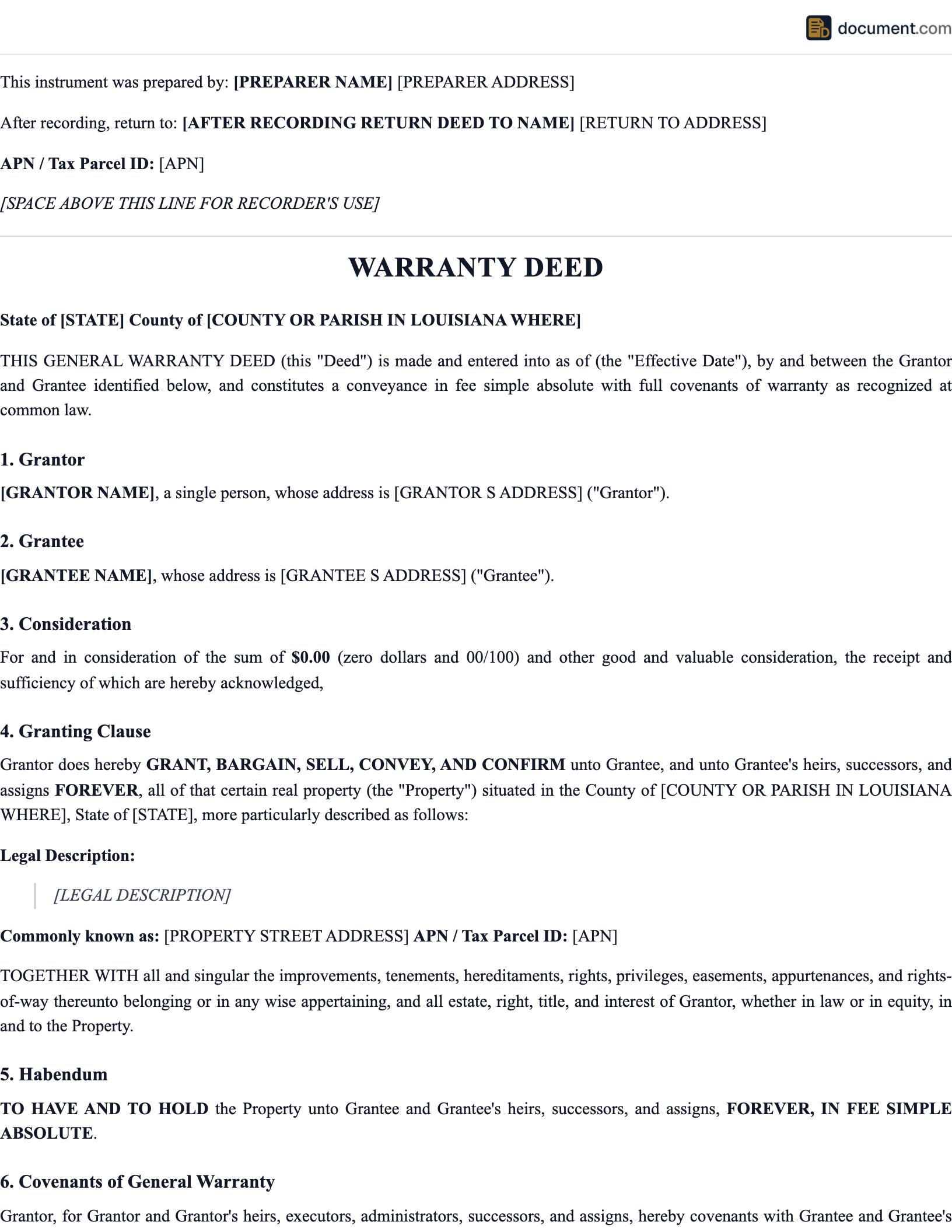
Sample Maine Warranty Deed
Preview of our Maine-specific template. Your document will include all fields required for recording in any Maine county.
WARRANTY DEED (GENERAL WARRANTY DEED)
STATE OF MAINE
Legal Document
PARTY INFORMATION
Name: [Full Legal Name]
Address: [Maine Address]
County: [County]
PROPERTY DESCRIPTION
County: [County] State: Maine
Legal Description: [Per Recorded Plat]
Parcel No.: [APN]
Maine Warranty Deed FAQ
Common questions about filing in Maine, including requirements, fees, and tax implications.
Official Maine Resources
Official state resources for verifying requirements and finding your local recording office.
Important Considerations
Maine's waterfront property market is one of the most active in the state, and it comes with a set of legal considerations that inland properties rarely present. Shoreland zoning applies within 250 feet of most water bodies and wetlands, restricting what can be built or altered on the property. The deed does not describe these restrictions, but they are binding on the owner regardless. A buyer should confirm the shoreland zoning status of any waterfront purchase before closing.
Many Maine properties, particularly in rural areas, have easements for logging roads, utility lines, or public access paths that appear in the chain of title but are not visible on the surface. A title examination by a Maine attorney or title company is the only way to identify these encumbrances. Do not rely on a seller's disclosure alone for rural or wooded parcels.
Maine uses a race-notice recording system. A buyer who records first and is a bona fide purchaser for value without notice of a prior unrecorded transfer prevails over that earlier unrecorded deed. Record promptly after signing; there is no good reason to delay once the deed is notarized.
The RETTD form is a hard requirement. Many people prepare a valid deed only to arrive at the Registry without the form. The Registry will not record a deed without it. Download the form from Maine Revenue Services ahead of time and have it completed before going to the Registry.
Tip for Maine Waterfront Buyers
If you are purchasing lakefront or oceanfront property in Maine, order a survey before closing, not after. Many older deeds reference abutters, stone walls, and iron pins that may have moved or disappeared over time. A survey will confirm the actual boundaries match the deed description, and it is far easier to resolve discrepancies before the transfer than after.
Related Documents
Depending on your situation, you may need additional documents alongside this one. Below are commonly related documents that are frequently used together in real estate transactions.
Important Considerations
Maine's waterfront property market is one of the most active in the state, and it comes with a set of legal considerations that inland properties rarely present. Shoreland zoning applies within 250 feet of most water bodies and wetlands, restricting what can be built or altered on the property. The deed does not describe these restrictions, but they are binding on the owner regardless. A buyer should confirm the shoreland zoning status of any waterfront purchase before closing.
Many Maine properties, particularly in rural areas, have easements for logging roads, utility lines, or public access paths that appear in the chain of title but are not visible on the surface. A title examination by a Maine attorney or title company is the only way to identify these encumbrances. Do not rely on a seller's disclosure alone for rural or wooded parcels.
Maine uses a race-notice recording system. A buyer who records first and is a bona fide purchaser for value without notice of a prior unrecorded transfer prevails over that earlier unrecorded deed. Record promptly after signing; there is no good reason to delay once the deed is notarized.
The RETTD form is a hard requirement. Many people prepare a valid deed only to arrive at the Registry without the form. The Registry will not record a deed without it. Download the form from Maine Revenue Services ahead of time and have it completed before going to the Registry. are also recommended as a backup.
Professional Recommendation
While our templates are designed to be comprehensive and legally compliant, we recommend having your completed document reviewed by a licensed attorney before recording, especially for high-value transactions or complex situations. Many attorneys offer flat-fee document review services that provide peace of mind at a reasonable cost.
Related Documents
Depending on your situation, you may need additional documents alongside this one. Below are commonly related documents that are frequently used together in real estate transactions.
Create your Maine Warranty Deed in under 5 minutes.
Answer a few questions and download a Maine-compliant document, ready for the state agency.