



Louisiana Warranty Deed Overview
Louisiana stands alone among all fifty states in operating under a civil law system rather than common law. This distinction is not cosmetic. The entire framework for property ownership, transfer, and title warranty in Louisiana is drawn from the French and Spanish civil codes that governed the territory before statehood, not from the English legal tradition. What other states call a "warranty deed" is called an "act of sale with full warranty" in Louisiana, and the execution requirements are categorically different from anywhere else in the country.
An act of sale in Louisiana must be executed as a notarial act, meaning all parties sign before a Louisiana-commissioned notary public and two competent witnesses, all present simultaneously. The notary in Louisiana has authority to draft and authenticate legal instruments, a role far more expansive than in other states. Property records are maintained not by county recorders but by the Clerk of Court in each parish, specifically through the Conveyance Office. Louisiana has no state transfer tax on real property conveyances. Community property rules mean both spouses must sign when conveying property acquired during the marriage.
$50
Recording fee
None
Transfer tax
Required
Notarization
2
Witnesses required
Louisiana Requirements
Louisiana's property transfer requirements are governed by the Louisiana Civil Code and associated statutes, not a common law deed recording system. An act of sale must be executed before a Louisiana notary public and two witnesses who are all physically present at the time of signing. The document is not simply acknowledged after signing; it must be executed in full view of the notary and witnesses. A Louisiana notary has the legal authority to draft, execute, and certify the instrument, and the notary's certificate is part of the document itself.
Louisiana Specific Note
Louisiana requires TWO witnesses in addition to the notary. All parties, both witnesses, and the notary must be present at the same time when the act of sale is executed. Louisiana is a community property state, so both spouses must sign when conveying community property. If the property was acquired during the marriage, it is presumed to be community property unless established otherwise. There is no state transfer tax in Louisiana, but parish recording fees apply and vary by parish. The property is recorded in the Conveyance Office of the parish Clerk of Court, not a county recorder.
Document Requirements
- Notarization: Must be notarized by a Louisiana notary public or authorized notary
- Witnesses: Louisiana requires 2 additional witness(es)
- Legal Description: Complete legal description as it appears on the current deed of record
- Parcel Number: Assessor's parcel number or tax ID
- Return Address: Mailing address for returning the recorded document
- Formatting: Standard formatting with adequate margins, black ink, minimum 10-point font
How to File in Louisiana
Filing in Louisiana involves preparing the document, getting it notarized, and recording it. Follow these steps for a smooth process.
Draft the Act of Sale
Prepare the act of sale identifying the vendor and purchaser by full legal name, stating the consideration, including the complete legal description as it appears in the parish conveyance records, and incorporating the full warranty language. If the property is community property (acquired during the marriage), both spouses must be named as vendors. Engage a Louisiana notary or attorney experienced in real estate to draft or review the document.
Execute Before Notary and Two Witnesses
All parties, both witnesses, and the notary must be physically present at the same time. This is not a standard notary acknowledgment. All must sign the act of sale together as a notarial act. The two witnesses must be competent adults who are not parties to the transaction. The notary signs and affixes their seal, certifying that the act was properly executed.
Obtain a Mortgage Certificate
Before or simultaneously with recording, obtain a mortgage certificate from the parish Clerk of Court (Mortgage Office). This certificate confirms whether any mortgages, liens, or privileges are recorded against the property. Most Louisiana closings require a clear mortgage certificate before the act of sale is recorded, protecting the buyer from undisclosed encumbrances.
Record With the Parish Clerk of Court
File the executed act of sale with the Conveyance Office of the Clerk of Court in the parish where the property is located. Louisiana does not have counties; it has parishes. Recording fees vary by parish and are typically charged per page. There is no state transfer tax to calculate. The act is effective against third parties from the date and time of recording.
Update the Parish Assessor
After recording, notify the parish assessor of the ownership change so property tax bills are directed to the correct party. Louisiana property taxes are assessed and collected at the parish level. Homestead exemption, available on owner-occupied residential property, must be applied for separately through the assessor's office and can reduce the assessed value by up to $75,000.
Louisiana Fees & Costs
Typical costs for filing in Louisiana. Actual fees may vary by county.
| Fee / Tax | Amount |
|---|---|
| Recording Fee | $50 |
| Transfer Tax | None |
| Notarization | $5 - $25 per signature |
| Certified Copy | $1 - $10 per page |
| Attorney Review (optional) | $150 - $500 |
Louisiana Tax Implications
Louisiana does not impose a state real estate transfer tax on property conveyances, which is a notable advantage over many states. Recording fees at the parish Clerk of Court are the primary transactional cost at the state and local level, and those fees vary by parish based on page count.
Louisiana's community property system has significant tax implications that are distinct from common-law states. When a spouse dies, the community property gets a full step-up in basis on both halves under current federal tax law, not just the decedent's half as in common-law states. This can be a powerful estate planning advantage. Conversely, if community property is sold during the marriage, both spouses' shares of the gain are recognized for income tax purposes. Louisiana taxpayers should consult a tax professional familiar with the intersection of civil law community property rules and federal income tax.
Louisiana's homestead exemption reduces the assessed value of owner-occupied residential property by up to $75,000 for property tax purposes. The exemption must be applied for through the parish assessor and is not automatically granted upon transfer. New owners should file for the exemption promptly after closing if the property will be their primary residence. Millage rates in Louisiana are set at the local level and vary considerably between parishes and municipalities.
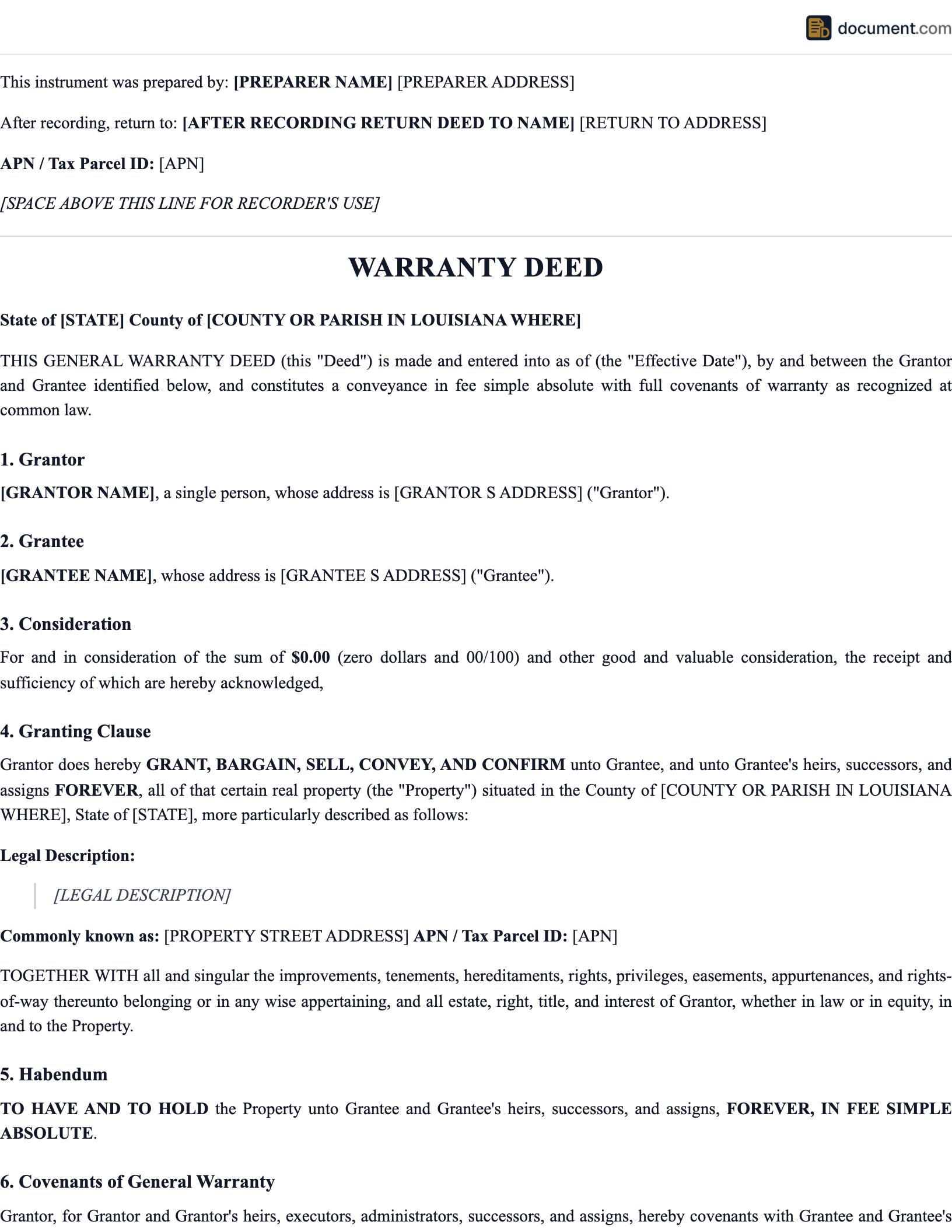
Sample Louisiana Warranty Deed
Preview of our Louisiana-specific template. Your document will include all fields required for recording in any Louisiana county.
WARRANTY DEED (GENERAL WARRANTY DEED)
STATE OF LOUISIANA
Legal Document
PARTY INFORMATION
Name: [Full Legal Name]
Address: [Louisiana Address]
County: [County]
PROPERTY DESCRIPTION
County: [County] State: Louisiana
Legal Description: [Per Recorded Plat]
Parcel No.: [APN]
Louisiana Warranty Deed FAQ
Common questions about filing in Louisiana, including requirements, fees, and tax implications.
Official Louisiana Resources
Official state resources for verifying requirements and finding your local recording office.
Important Considerations
Louisiana's civil law system requires attorneys and buyers from common-law states to recalibrate their assumptions entirely. Concepts that apply in Texas, Florida, or Georgia do not transfer to Louisiana. The act of sale is not just a procedural formality; it is the legal instrument that conveys ownership, and its form and content are prescribed by the Louisiana Civil Code.
Community property classification is one of the most significant factors in any Louisiana transfer. If a vendor acquired the property during the marriage, the property is presumed to be community property owned equally by both spouses. Conveying it without the other spouse's signature is void as to their half interest. Before preparing the act of sale, confirm the property's classification as community or separate.
Successions (estates) in Louisiana follow forced heirship rules that differ from every other state. Children have a legal right to a portion of a parent's estate under certain circumstances, which can affect title if the property passed through an estate that did not honor these rights. A title examination going back through any successions in the chain is important to confirm the property was properly inherited.
Older Louisiana property records, particularly in the southern part of the state, may reference arpents, toises, and other French and Spanish measurements that predate the U.S. government survey system. Working with a Louisiana surveyor familiar with these historical measurement systems is necessary when there is any ambiguity about boundaries.
Louisiana Requires an Experienced Notary or Attorney
Given Louisiana's unique civil law foundation, the notarial act requirement, the two-witness rule, and the community property implications, every Louisiana property transfer benefits from involvement by a Louisiana-licensed attorney or notary who regularly handles real estate. This is not a state where importing a deed template from another jurisdiction will work. The formalities are legally meaningful, and deviating from them can void the transfer entirely.
Related Documents
Depending on your situation, you may need additional documents alongside this one. Below are commonly related documents that are frequently used together in real estate transactions.
Important Considerations
Louisiana's civil law system requires attorneys and buyers from common-law states to recalibrate their assumptions entirely. Concepts that apply in Texas, Florida, or Georgia do not transfer to Louisiana. The act of sale is not just a procedural formality; it is the legal instrument that conveys ownership, and its form and content are prescribed by the Louisiana Civil Code.
Community property classification is one of the most significant factors in any Louisiana transfer. If a vendor acquired the property during the marriage, the property is presumed to be community property owned equally by both spouses. Conveying it without the other spouse's signature is void as to their half interest. Before preparing the act of sale, confirm the property's classification as community or separate.
Successions (estates) in Louisiana follow forced heirship rules that differ from every other state. Children have a legal right to a portion of a parent's estate under certain circumstances, which can affect title if the property passed through an estate that did not honor these rights. A title examination going back through any successions in the chain is important to confirm the property was properly inherited.
Older Louisiana property records, particularly in the southern part of the state, may reference arpents, toises, and other French and Spanish measurements that predate the U.S. government survey system. Working with a Louisiana surveyor familiar with these historical measurement systems is necessary when there is any ambiguity about boundaries. are also recommended as a backup.
Professional Recommendation
While our templates are designed to be comprehensive and legally compliant, we recommend having your completed document reviewed by a licensed attorney before recording, especially for high-value transactions or complex situations. Many attorneys offer flat-fee document review services that provide peace of mind at a reasonable cost.
Related Documents
Depending on your situation, you may need additional documents alongside this one. Below are commonly related documents that are frequently used together in real estate transactions.
Create your Louisiana Warranty Deed in under 5 minutes.
Answer a few questions and download a Louisiana-compliant document, ready for the state agency.