



Kansas Warranty Deed Overview
Kansas uses the "warranty deed" as its standard form for conveying real property with full title guarantees. The grantor warrants title not just from their own period of ownership but stretching back through the entire chain, which is the broadest protection a Kansas buyer can receive. Deeds are recorded with the Register of Deeds in the county where the property is located, not with a county recorder or clerk as in many other states.
Kansas stands out nationally for having no state real estate transfer tax. The documentary stamp tax was repealed long ago and was never replaced. Buyers and sellers pay only the recording fee at the Register of Deeds office, which is $21 for the first page plus $17 for each additional page. Notarization is required; witnesses are not. Most Kansas counties now accept e-recorded documents, which speeds the process considerably.
$21
Recording fee
None
Transfer tax
Required
Notarization
0
Witnesses required
Kansas Requirements
Kansas deed requirements are governed by K.S.A. Chapter 58, which sets out rules for execution, acknowledgment, and recording. The Register of Deeds will reject documents that are missing the grantor's notarized acknowledgment, have an incomplete or ambiguous legal description, or fail to meet basic formatting standards. Kansas does not use a standard fill-in form published by the state, so the deed you file must correctly incorporate all required elements.
Kansas Specific Note
Kansas has no state real estate transfer tax, so there is no tax form to file at closing. Recording fees at the Register of Deeds are $21 for the first page and $17 per additional page. If a married person is conveying property, their spouse must also sign even if the property is held in one spouse's name alone, to release any marital interest under Kansas law. Call your county Register of Deeds to confirm current fees and e-recording availability before filing.
Document Requirements
- Notarization: Must be notarized by a Kansas notary public or authorized notary
- Witnesses: Kansas requires 0 additional witness(es)
- Legal Description: Complete legal description as it appears on the current deed of record
- Parcel Number: Assessor's parcel number or tax ID
- Return Address: Mailing address for returning the recorded document
- Formatting: Standard formatting with adequate margins, black ink, minimum 10-point font
How to File in Kansas
Filing in Kansas involves preparing the document, getting it notarized, and recording it. Follow these steps for a smooth process.
Prepare the Document
Fill in the grantor and grantee names exactly as they should appear in the public record. Pull the legal description directly from the existing recorded deed or obtain a certified copy from the Register of Deeds. Do not rely on a tax statement or online property record for the legal description, as those sources can be abbreviated or inaccurate.
Get the Document Notarized
All grantors must sign in front of a Kansas notary public. If the grantor is married, the spouse must also sign and acknowledge the deed to release any marital interest. No additional witnesses are required beyond the notary. Bring a valid government-issued photo ID.
File With the Register of Deeds
Take the original notarized deed to the Register of Deeds office in the county where the property is located. Many Kansas counties also accept e-recorded submissions through authorized e-recording vendors, which is often faster. The document is not effective against third parties until it is recorded.
Pay Recording Fees
Pay the recording fee, which is $21 for the first page and $17 for each additional page. Kansas collects no state transfer tax, so there is no excise tax to calculate or pay at recording. Accepted payment methods vary by county; confirm with the Register of Deeds office before arriving.
Update Property Tax Records
After recording, notify the county appraiser's office of the ownership change so future property tax statements are sent to the correct party. The recorded deed is returned to the address specified in the deed; keep it with your important documents. You may also want to notify your homeowner's insurance carrier of the new ownership.
Kansas Fees & Costs
Typical costs for filing in Kansas. Actual fees may vary by county.
| Fee / Tax | Amount |
|---|---|
| Recording Fee | $21 |
| Transfer Tax | None |
| Notarization | $5 - $25 per signature |
| Certified Copy | $1 - $10 per page |
| Attorney Review (optional) | $150 - $500 |
Kansas Tax Implications
Kansas imposes no state-level real estate transfer tax. This is a meaningful advantage compared to neighboring states, and it simplifies the closing process considerably. There is no tax return to file with the state, no excise stamps to purchase, and no rate calculation based on sale price. You pay the recording fee and nothing more at the state level.
For federal purposes, transferring property as a gift may trigger the requirement to file IRS Form 709 if the value transferred exceeds the annual gift tax exclusion amount. The recipient of a gifted property takes the donor's adjusted cost basis, not the fair market value at the time of the gift. This matters significantly if the property has appreciated and the recipient plans to sell it, since they may owe capital gains tax on the full appreciation from the original purchase price forward.
Kansas does reassess property for property tax purposes on a regular cycle, but a deed transfer itself does not automatically trigger a mid-cycle reassessment. The county appraiser monitors recorded deeds and may adjust the assessed value at the next scheduled assessment cycle. Kansas assesses residential property at 11.5% of fair market value, with the resulting assessed value subject to the local mill levy. A significant purchase price can prompt the appraiser to revisit the valuation at the next opportunity.
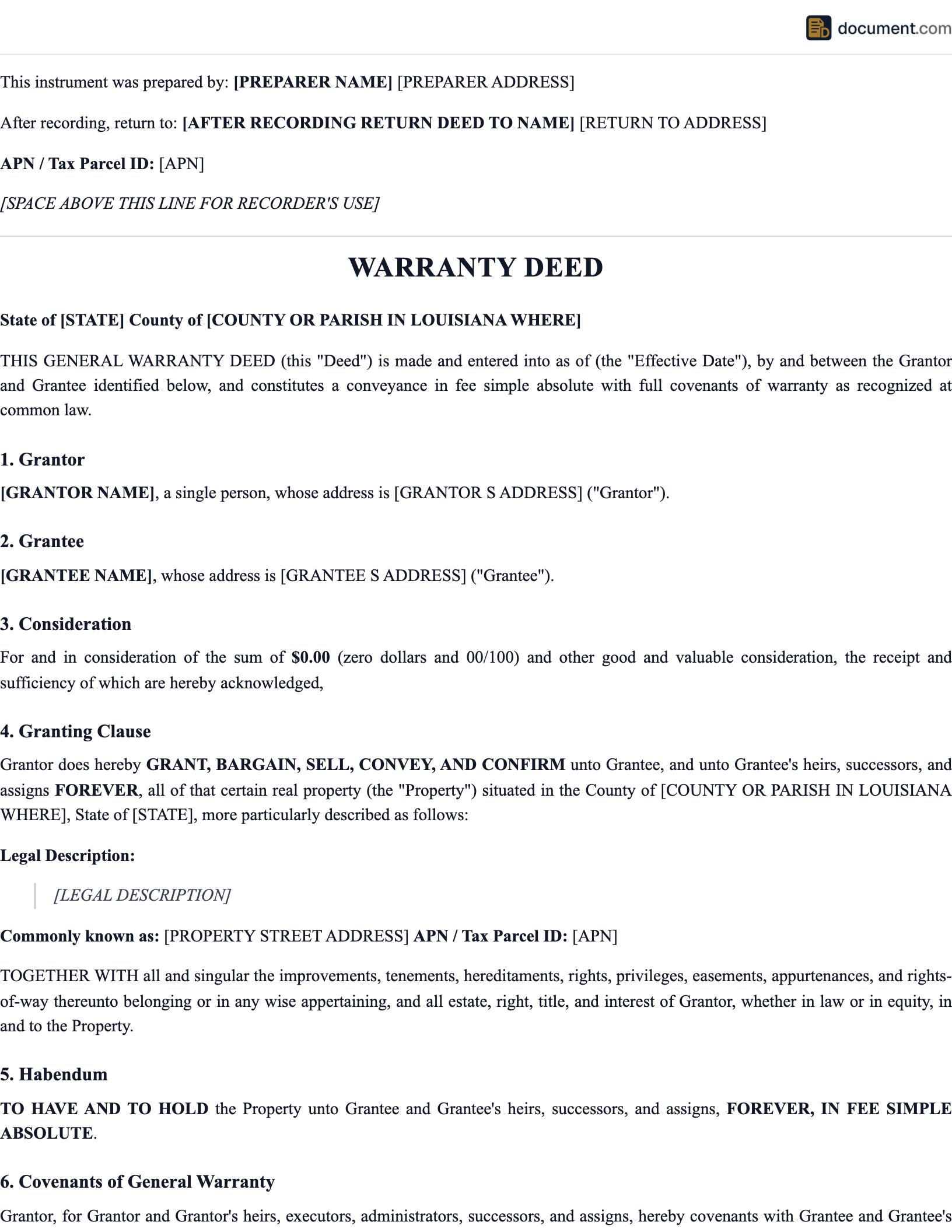
Sample Kansas Warranty Deed
Preview of our Kansas-specific template. Your document will include all fields required for recording in any Kansas county.
WARRANTY DEED (GENERAL WARRANTY DEED)
STATE OF KANSAS
Legal Document
PARTY INFORMATION
Name: [Full Legal Name]
Address: [Kansas Address]
County: [County]
PROPERTY DESCRIPTION
County: [County] State: Kansas
Legal Description: [Per Recorded Plat]
Parcel No.: [APN]
Kansas Warranty Deed FAQ
Common questions about filing in Kansas, including requirements, fees, and tax implications.
Official Kansas Resources
Official state resources for verifying requirements and finding your local recording office.
Important Considerations
The absence of a state transfer tax makes Kansas one of the cleaner states to handle a deed transfer, but the legal description requirement is where most problems originate. Kansas property descriptions often reference government survey system notation with township, range, and section numbers, along with recorded subdivision plat references. A mismatch between the description on your new deed and the description in the existing chain of title can create a gap that requires a court action to resolve.
Kansas follows a race-notice recording system, meaning that a subsequent buyer who records first and has no knowledge of a prior unrecorded transfer can claim priority. This makes prompt recording after signing essential. Do not leave a signed deed sitting unrecorded, even briefly.
If you are transferring property into or out of a trust, confirm that the trust is properly established under Kansas law before recording the deed. A deed to a trust that has not been validly created can be challenged, and the recording itself does not cure underlying defects in trust formation.
Agricultural property transfers in Kansas may have additional considerations related to existing leases, crop rights, and mineral rights. Mineral interests are commonly severed from surface rights in Kansas, so confirm whether the deed conveys both surface and subsurface rights or only the surface estate.
Kansas Attorney Tip
Kansas deed transfers involving agricultural land, mineral rights, oil and gas leases, or properties with complicated easement histories benefit particularly from attorney review. The legal description alone can be complex, and errors in conveying surface versus mineral rights are among the most litigated title disputes in the state. A Kansas real estate attorney can review the chain of title and confirm exactly what you are conveying before the deed is recorded.
Related Documents
Depending on your situation, you may need additional documents alongside this one. Below are commonly related documents that are frequently used together in real estate transactions.
Important Considerations
The absence of a state transfer tax makes Kansas one of the cleaner states to handle a deed transfer, but the legal description requirement is where most problems originate. Kansas property descriptions often reference government survey system notation with township, range, and section numbers, along with recorded subdivision plat references. A mismatch between the description on your new deed and the description in the existing chain of title can create a gap that requires a court action to resolve.
Kansas follows a race-notice recording system, meaning that a subsequent buyer who records first and has no knowledge of a prior unrecorded transfer can claim priority. This makes prompt recording after signing essential. Do not leave a signed deed sitting unrecorded, even briefly.
If you are transferring property into or out of a trust, confirm that the trust is properly established under Kansas law before recording the deed. A deed to a trust that has not been validly created can be challenged, and the recording itself does not cure underlying defects in trust formation.
Agricultural property transfers in Kansas may have additional considerations related to existing leases, crop rights, and mineral rights. Mineral interests are commonly severed from surface rights in Kansas, so confirm whether the deed conveys both surface and subsurface rights or only the surface estate. are also recommended as a backup.
Professional Recommendation
While our templates are designed to be comprehensive and legally compliant, we recommend having your completed document reviewed by a licensed attorney before recording, especially for high-value transactions or complex situations. Many attorneys offer flat-fee document review services that provide peace of mind at a reasonable cost.
Related Documents
Depending on your situation, you may need additional documents alongside this one. Below are commonly related documents that are frequently used together in real estate transactions.
Create your Kansas Warranty Deed in under 5 minutes.
Answer a few questions and download a Kansas-compliant document, ready for the state agency.