



Iowa Warranty Deed Overview
Iowa's warranty deed recording process is comparatively streamlined. The deed goes directly to the county recorder, with no required pre-recording stop at a separate county office. Iowa has 99 counties, and each maintains its own recorder's office where real property documents for that county are filed. The deed must be accompanied by a declaration of value form whenever transfer tax applies, and the recorder calculates and collects the tax at the time of filing.
Iowa's real estate transfer tax is $1.60 per $1,000 of consideration, with the first $500 of consideration exempt from the calculation. The tax is modest by comparison to states like Illinois, and on a median-priced Iowa home it typically amounts to a few hundred dollars. No witnesses are needed beyond the notary. Iowa does not prescribe a specific statutory form for warranty deeds, but the deed must clearly identify the parties, describe the property, state the consideration, contain the warranty covenant, and include a proper acknowledgment.
$15
Recording fee
$0.80 per $500
Transfer tax
Required
Notarization
0
Witnesses required
Iowa Requirements
Iowa county recorders require deeds to be legibly printed or typed, signed in ink by the grantor, and acknowledged before a notary. The first page should include a blank area for the recorder's stamp. The deed must state the complete legal description, the names of all parties, and the consideration amount. Documents with missing or illegible information may be returned for correction before recording.
Iowa Specific Note
Iowa requires a declaration of value form to be submitted with the deed whenever a real estate transfer tax is owed. The form is available from the county recorder and must disclose the full sale price. Calculate the transfer tax before arriving at the recorder's office: $1.60 per $1,000 of consideration, with the first $500 of consideration exempt. Gift transfers and other exempt transactions are not required to file the declaration form, but confirm the applicable exemption with the county recorder before submitting.
Document Requirements
- Notarization: Must be notarized by an Iowa notary public or authorized notary
- Witnesses: Iowa requires 0 additional witness(es)
- Legal Description: Complete legal description as it appears on the current deed of record
- Parcel Number: Assessor's parcel number or tax ID
- Return Address: Mailing address for returning the recorded document
- Formatting: Standard formatting with adequate margins, black ink, minimum 10-point font
How to File in Iowa
Filing in Iowa involves preparing the document, getting it notarized, and recording it. Follow these steps for a smooth process.
Prepare the Deed and Declaration of Value
Complete the deed with the full legal names of all parties, the complete legal description from the existing deed, the parcel number, the consideration amount, and a return mailing address. If a transfer tax applies, also complete the Iowa Declaration of Value form available from the county recorder. Calculate the transfer tax: $1.60 per $1,000 of consideration, with the first $500 exempt.
Get the Deed Notarized
The grantor must sign before an Iowa-commissioned notary public with a valid photo ID. The notary completes the acknowledgment. No witnesses are required. Iowa permits remote online notarization under Iowa Code Chapter 9B, useful for sellers located outside the state.
Submit to the County Recorder
Take the notarized deed and the declaration of value form (if required) to the county recorder in the county where the property is located. Iowa does not require a pre-recording stop at the assessor or auditor, so the recorder is the single submission point. Many Iowa county recorders accept e-recording through approved vendors as an alternative to in-person filing.
Pay Recording Fees and Transfer Tax
Pay the county recording fee and the transfer tax at submission. Recording fees vary by county but typically run $7 to $10 for the first page plus additional per-page charges. The transfer tax is calculated based on the consideration amount disclosed in the declaration of value.
Notify the Assessor and Update Records
After recording, notify the county assessor of the ownership change so property tax bills go to the correct owner. Owner-occupants should inquire about the homestead tax credit from the county assessor. Keep the recorded deed in a secure location alongside other important property documents.
Iowa Fees & Costs
Typical costs for filing in Iowa. Actual fees may vary by county.
| Fee / Tax | Amount |
|---|---|
| Recording Fee | $15 |
| Transfer Tax | $0.80 per $500 |
| Notarization | $5 - $25 per signature |
| Certified Copy | $1 - $10 per page |
| Attorney Review (optional) | $150 - $500 |
Iowa Tax Implications
Iowa's real estate transfer tax, known formally as the real estate transfer tax under Iowa Code Chapter 428A, applies to most warranty deed transfers. The rate is $1.60 per $1,000 of consideration (equivalently $0.80 per $500), with the first $500 of consideration exempt. The tax is paid to the county recorder at the time of recording. Transfers exempt from the tax include gifts and transfers for no consideration, transfers between spouses, transfers correcting a previously recorded instrument, and transfers to or from a government entity. Exempt transfers do not require the declaration of value form.
For gift transfers where no money changes hands, the grantor may need to file a federal gift tax return (Form 709) if the property value exceeds the annual gift exclusion. The recipient of gifted Iowa real estate takes the grantor's adjusted cost basis. If the property was purchased at a low price many years ago, that carryover basis can mean a substantial capital gain when the recipient eventually sells, even if the property does not appreciate further.
Iowa property is reassessed on a regular cycle by county assessors, with assessments reviewed in odd-numbered years. A recent sale at market price provides strong evidence of value that assessors may use to adjust the assessment. New owners who will occupy the property as a primary residence should apply for Iowa's homestead tax credit with the county assessor. Iowa also offers a military service exemption and other property tax relief programs that may apply depending on the owner's circumstances.
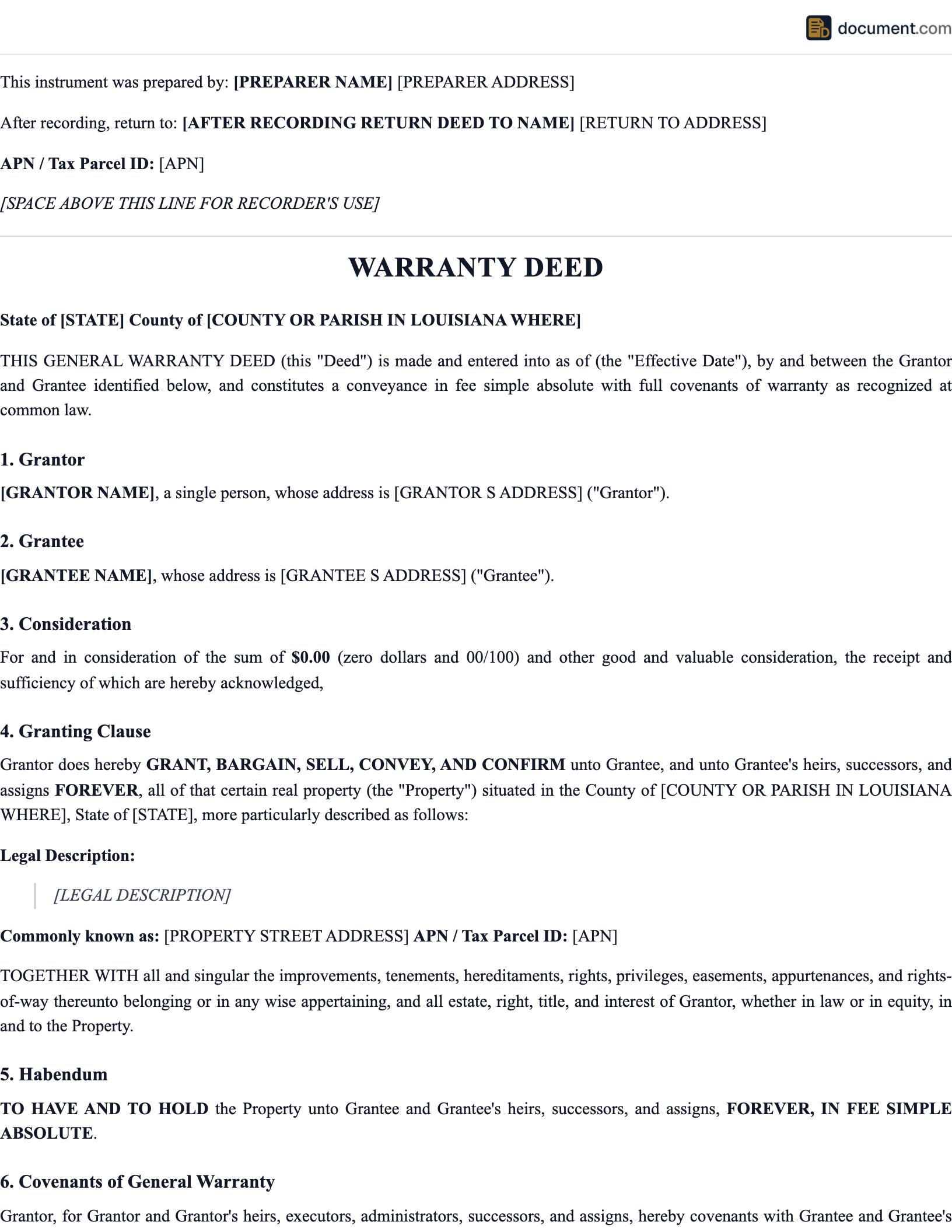
Sample Iowa Warranty Deed
Preview of our Iowa-specific template. Your document will include all fields required for recording in any Iowa county.
WARRANTY DEED (GENERAL WARRANTY DEED)
STATE OF IOWA
Legal Document
PARTY INFORMATION
Name: [Full Legal Name]
Address: [Iowa Address]
County: [County]
PROPERTY DESCRIPTION
County: [County] State: Iowa
Legal Description: [Per Recorded Plat]
Parcel No.: [APN]
Iowa Warranty Deed FAQ
Common questions about filing in Iowa, including requirements, fees, and tax implications.
Official Iowa Resources
Official state resources for verifying requirements and finding your local recording office.
Important Considerations
Iowa's process is notably direct compared to neighboring states. There is no required stop at a county assessor or auditor before recording, and the transfer tax calculation is straightforward. The declaration of value form is the main Iowa-specific document to prepare alongside the deed itself. Getting the consideration amount right on that form matters because the transfer tax is calculated directly from it.
Agricultural land transfers in Iowa deserve particular attention. Iowa has restrictions under Iowa Code Chapter 9H that limit foreign ownership of agricultural land, and certain transfers involving non-citizens or non-resident aliens may require review or disclosure under state law. If the property being conveyed includes farmland, confirming whether any such restrictions apply before preparing the deed is a prudent step.
Easements, drainage districts, and tile line agreements are common encumbrances on Iowa rural properties that may not appear prominently in a standard title search. These affect how land can be used and accessed, and a buyer receiving a warranty deed with undisclosed encumbrances would have a claim against the grantor under the warranty covenants. A thorough title search covering the full chain of title is the appropriate way to surface these before closing.
Once the county recorder returns the stamped deed, keep it with your property documents. The book and page or instrument number assigned at recording is how any future title examiner will locate this deed in the county records. A digital backup copy stored securely is a sensible precaution.
Professional Recommendation
Iowa's recording process is among the more straightforward of any Midwestern state, but agricultural land transfers and transactions involving trusts or estates still benefit from attorney review. An Iowa real estate attorney or licensed title company can confirm the correct transfer tax, prepare the declaration of value form, and verify that the deed's legal description matches the county records before recording.
Related Documents
Depending on your situation, you may need additional documents alongside this one. Below are commonly related documents that are frequently used together in real estate transactions.
Important Considerations
Iowa's process is notably direct compared to neighboring states. There is no required stop at a county assessor or auditor before recording, and the transfer tax calculation is straightforward. The declaration of value form is the main Iowa-specific document to prepare alongside the deed itself. Getting the consideration amount right on that form matters because the transfer tax is calculated directly from it.
Agricultural land transfers in Iowa deserve particular attention. Iowa has restrictions under Iowa Code Chapter 9H that limit foreign ownership of agricultural land, and certain transfers involving non-citizens or non-resident aliens may require review or disclosure under state law. If the property being conveyed includes farmland, confirming whether any such restrictions apply before preparing the deed is a prudent step.
Easements, drainage districts, and tile line agreements are common encumbrances on Iowa rural properties that may not appear prominently in a standard title search. These affect how land can be used and accessed, and a buyer receiving a warranty deed with undisclosed encumbrances would have a claim against the grantor under the warranty covenants. A thorough title search covering the full chain of title is the appropriate way to surface these before closing.
Once the county recorder returns the stamped deed, keep it with your property documents. The book and page or instrument number assigned at recording is how any future title examiner will locate this deed in the county records. A digital backup copy stored securely is a sensible precaution.
Professional Recommendation
While our templates are designed to be comprehensive and legally compliant, we recommend having your completed document reviewed by a licensed attorney before recording, especially for high-value transactions or complex situations. Many attorneys offer flat-fee document review services that provide peace of mind at a reasonable cost.
Related Documents
Depending on your situation, you may need additional documents alongside this one. Below are commonly related documents that are frequently used together in real estate transactions.
Create your Iowa Warranty Deed in under 5 minutes.
Answer a few questions and download a Iowa-compliant document, ready for the state agency.