



Indiana Warranty Deed Overview
Recording a warranty deed in Indiana involves a two-step process that catches many first-time filers off guard. The deed does not go directly to the county recorder. First, it goes to the county auditor, who reviews the sales disclosure form and stamps the deed to certify that the transfer has been disclosed for property tax purposes. Only after that auditor certification can you take the deed to the county recorder for actual recording. Skipping the auditor's office and going straight to the recorder will result in rejection.
Indiana has no state or county real estate transfer tax, so there is no transfer tax to calculate or pay at closing. The recording fees at the county level are modest, typically in the $25 to $50 range depending on page count. Notarization is required, no witnesses are needed, and Indiana does not mandate any specific deed form so long as the document conveys the property clearly and is properly acknowledged. The sales disclosure form is a separate document from the deed itself but must accompany it to the auditor's office.
$20
Recording fee
None
Transfer tax
Required
Notarization
0
Witnesses required
Indiana Requirements
Indiana county recorders require deeds to be legibly printed or typed, signed in ink by all grantors, and acknowledged before a notary. The deed should include a blank space at the top of the first page for the recorder's stamp, the names of all parties, the complete legal description, the parcel number, and a return mailing address. Many Indiana county recorders also require the preparer's name and address to appear on the document.
Indiana Specific Note
Indiana requires the county auditor to certify the deed before the county recorder will accept it. Bring the completed sales disclosure form (State Form 46021) to the auditor's office along with the notarized deed. The auditor will stamp the deed and return it to you for submission to the recorder. Skipping this step will result in rejection at the recorder's office. Indiana has no state real estate transfer tax, so there is no tax to pay at either office.
Document Requirements
- Notarization: Must be notarized by an Indiana notary public or authorized notary
- Witnesses: Indiana requires 0 additional witness(es)
- Legal Description: Complete legal description as it appears on the current deed of record
- Parcel Number: Assessor's parcel number or tax ID
- Return Address: Mailing address for returning the recorded document
- Formatting: Standard formatting with adequate margins, black ink, minimum 10-point font
How to File in Indiana
Filing in Indiana involves preparing the document, getting it notarized, and recording it. Follow these steps for a smooth process.
Prepare the Deed and Sales Disclosure Form
Complete the warranty deed with the full legal names of all parties, the complete legal description, the parcel identification number, consideration amount, and return address. Separately complete Indiana State Form 46021 (Sales Disclosure Form), which will accompany the deed to the county auditor's office. If the transfer is exempt from disclosure, note the applicable exemption on the form.
Get the Deed Notarized
All grantors must sign before an Indiana notary public with a valid government-issued photo ID. The notary completes the acknowledgment certificate. No witnesses are required beyond the notary. Remote online notarization is permitted in Indiana for those unable to appear in person.
Obtain the County Auditor's Certification
Take the notarized deed and the completed sales disclosure form to the county auditor's office in the county where the property is located. The auditor reviews the disclosure, processes the transfer for property tax purposes, and stamps the deed with a certification. This step is required before the county recorder will accept the deed.
Record With the County Recorder
After obtaining the auditor's stamp, take the certified deed to the county recorder's office. Pay the recording fee (typically $25 for the first page, with additional per-page charges). There is no transfer tax in Indiana. The recorder will stamp the deed with the recording date and instrument number and return it to the address on the document.
Update Ownership Records
The county auditor's office will update the property tax records based on the sales disclosure form. Confirm the ownership change has been reflected on the next tax statement. If a mortgage is being assumed or released, provide the lender with a copy of the recorded deed. New owner-occupants should inquire about the homestead deduction from the county assessor.
Indiana Fees & Costs
Typical costs for filing in Indiana. Actual fees may vary by county.
| Fee / Tax | Amount |
|---|---|
| Recording Fee | $20 |
| Transfer Tax | None |
| Notarization | $5 - $25 per signature |
| Certified Copy | $1 - $10 per page |
| Attorney Review (optional) | $150 - $500 |
Indiana Tax Implications
Indiana is one of the states that imposes no real estate transfer tax at either the state or county level. The only government charges are the county recorder's recording fees. This keeps closing costs lower than in many neighboring states and eliminates the need to calculate a complex transfer tax based on the sale price.
Property tax in Indiana is assessed annually based on the property's assessed value, which is determined by the county assessor. A sale at fair market value often triggers a reassessment in the next assessment cycle because assessed values are supposed to reflect market value. The sales disclosure form submitted to the auditor's office at recording feeds directly into the county's assessment data. New owners who plan to occupy the property as their primary residence should apply for Indiana's homestead deduction, which can meaningfully reduce the assessed value for property tax purposes.
On the federal side, gift transfers of real estate, where the grantor conveys property to a family member for little or no consideration, may require a Form 709 filing if the transferred value exceeds the annual gift tax exclusion. The recipient of gifted Indiana property takes the grantor's adjusted cost basis, so a property that was purchased decades ago at a low price and has appreciated significantly will carry a large embedded capital gain for the recipient when they eventually sell.
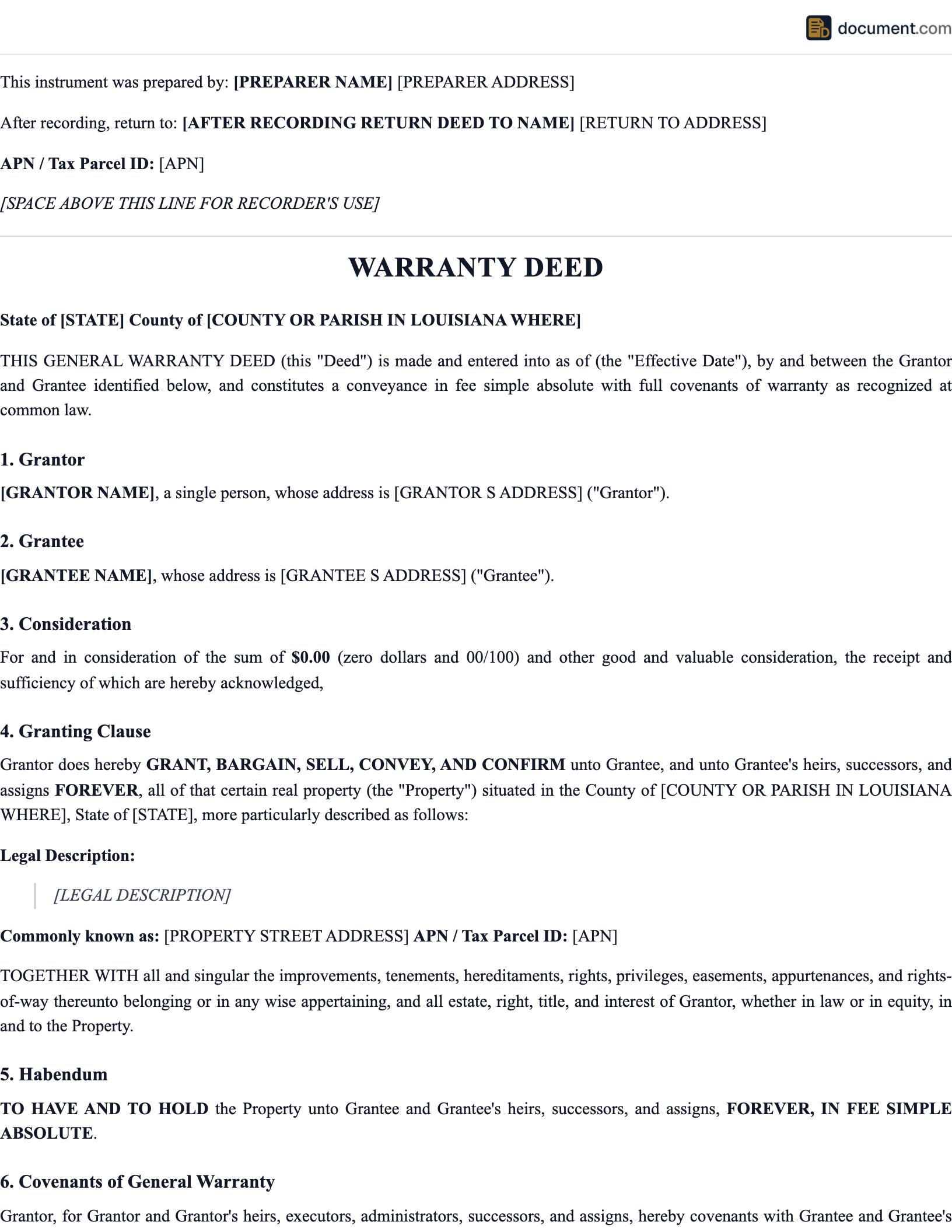
Sample Indiana Warranty Deed
Preview of our Indiana-specific template. Your document will include all fields required for recording in any Indiana county.
WARRANTY DEED (GENERAL WARRANTY DEED)
STATE OF INDIANA
Legal Document
PARTY INFORMATION
Name: [Full Legal Name]
Address: [Indiana Address]
County: [County]
PROPERTY DESCRIPTION
County: [County] State: Indiana
Legal Description: [Per Recorded Plat]
Parcel No.: [APN]
Indiana Warranty Deed FAQ
Common questions about filing in Indiana, including requirements, fees, and tax implications.
Official Indiana Resources
Official state resources for verifying requirements and finding your local recording office.
Important Considerations
The county auditor certification step is Indiana's defining procedural feature, and it catches people off guard when they expect to walk directly into the recorder's office. Both offices are typically in the same county courthouse building, so the two-stop process is not burdensome in practice. Plan to complete the auditor visit first, then walk the certified deed to the recorder the same day.
Indiana's homestead deduction is one of the more significant property tax benefits available to owner-occupants. Qualifying homeowners can deduct the lesser of 60% of the assessed value or $45,000 from the assessed value for property tax purposes. The application must be filed with the county auditor, and the new owner must occupy the property as their primary residence by the applicable deadline. Missing the filing window means waiting until the next year to receive the benefit.
Transfers involving real estate held in a trust, an estate, or a business entity require additional documentation. The county auditor and recorder may request proof that the person signing the deed has authority to convey on behalf of the trust or entity. A trustee signing on behalf of a trust should bring a copy of the relevant trust provisions showing their authority to sign real estate documents.
Keep the recorded deed in a safe place once it is returned. The instrument number assigned by the county recorder is your permanent record of the filing. If you cannot locate the original later, a certified copy can be obtained from the county recorder for a small fee.
Professional Recommendation
Indiana's recording process is procedurally distinct from most states because of the auditor certification requirement. An Indiana real estate attorney can prepare the deed, complete the sales disclosure form, and handle both the auditor and recorder filings in a single trip. For straightforward residential transfers, a title company closing is also a reliable and cost-efficient option.
Related Documents
Depending on your situation, you may need additional documents alongside this one. Below are commonly related documents that are frequently used together in real estate transactions.
Important Considerations
The county auditor certification step is Indiana's defining procedural feature, and it catches people off guard when they expect to walk directly into the recorder's office. Both offices are typically in the same county courthouse building, so the two-stop process is not burdensome in practice. Plan to complete the auditor visit first, then walk the certified deed to the recorder the same day.
Indiana's homestead deduction is one of the more significant property tax benefits available to owner-occupants. Qualifying homeowners can deduct the lesser of 60% of the assessed value or $45,000 from the assessed value for property tax purposes. The application must be filed with the county auditor, and the new owner must occupy the property as their primary residence by the applicable deadline. Missing the filing window means waiting until the next year to receive the benefit.
Transfers involving real estate held in a trust, an estate, or a business entity require additional documentation. The county auditor and recorder may request proof that the person signing the deed has authority to convey on behalf of the trust or entity. A trustee signing on behalf of a trust should bring a copy of the relevant trust provisions showing their authority to sign real estate documents.
Keep the recorded deed in a safe place once it is returned. The instrument number assigned by the county recorder is your permanent record of the filing. If you cannot locate the original later, a certified copy can be obtained from the county recorder for a small fee.
Professional Recommendation
While our templates are designed to be comprehensive and legally compliant, we recommend having your completed document reviewed by a licensed attorney before recording, especially for high-value transactions or complex situations. Many attorneys offer flat-fee document review services that provide peace of mind at a reasonable cost.
Related Documents
Depending on your situation, you may need additional documents alongside this one. Below are commonly related documents that are frequently used together in real estate transactions.
Create your Indiana Warranty Deed in under 5 minutes.
Answer a few questions and download a Indiana-compliant document, ready for the state agency.