



Illinois Warranty Deed Overview
Illinois has one of the more layered warranty deed processes in the country. Deeds are recorded at the county recorder of deeds, but before that happens, the transaction must pass through the state's MyDec transfer tax disclosure system. MyDec is an online platform run by the Illinois Department of Revenue where sellers complete a real estate transfer declaration. The county recorder will not accept a deed for recording until the MyDec declaration has been submitted and a transfer tax stamp or exemption notation has been generated. Cook County uses a parallel process through the Cook County Assessor's Office.
Transfer tax in Illinois stacks across three potential levels: the state imposes $0.50 per $500 of consideration, counties may add their own tax, and municipalities can layer on additional taxes. Chicago's combined rate is among the highest of any city in the United States. For a $500,000 home in Chicago, the combined city, county, and state transfer tax can exceed $20,000. Outside the city, the combined burden is significantly lower, often just the state rate plus a modest county levy. No witnesses are required beyond the notary, and Illinois does not require a specific deed form so long as the statutory covenant language from 765 ILCS 5/9 is included.
$50
Recording fee
$0.50 per $500
Transfer tax
Required
Notarization
0
Witnesses required
Illinois Requirements
Illinois county recorders require deeds to be legibly printed or typed, signed in ink by the grantor, and acknowledged before a notary. The document must include the property's permanent index number (PIN), the names and addresses of the parties, a complete legal description, and a return address. Many Illinois counties also require a specific number of blank lines at the top of the first page for the recorder's stamp. Confirm formatting requirements with the specific county recorder before submission.
Illinois Specific Note
Illinois requires completing the MyDec transfer tax declaration online before the county recorder will accept your deed. Cook County transactions require a separate declaration through the Cook County Assessor's Office. Transfer tax rates vary by location: the state charges $0.50 per $500, but Cook County and Chicago add additional layers that significantly increase the total. Calculate your transfer tax obligation before closing to avoid surprises.
Document Requirements
- Notarization: Must be notarized by an Illinois notary public or authorized notary
- Witnesses: Illinois requires 0 additional witness(es)
- Legal Description: Complete legal description as it appears on the current deed of record
- Parcel Number: Assessor's parcel number or tax ID
- Return Address: Mailing address for returning the recorded document
- Formatting: Standard formatting with adequate margins, black ink, minimum 10-point font
How to File in Illinois
Filing in Illinois involves preparing the document, getting it notarized, and recording it. Follow these steps for a smooth process.
Prepare the Document
Complete the deed with the full legal names of all parties, the property's permanent index number (PIN), the complete legal description from the existing deed, the consideration amount, and a return mailing address. Illinois warranty deeds should include the covenant language from 765 ILCS 5/9.
Complete the MyDec Transfer Tax Declaration
Log into MyDec at mytax.illinois.gov and complete the real estate transfer declaration for the transaction. For Cook County properties, also complete the Cook County Assessor's declaration. These must be done before the recorder will accept the deed. Print or save the generated transfer tax document to submit with the deed.
Get the Document Notarized
The grantor must sign before an Illinois-commissioned notary public, who completes the acknowledgment certificate. No witnesses are required. Illinois permits remote online notarization, which is useful for out-of-state sellers.
Record With the County Recorder
Submit the notarized deed and the MyDec transfer tax document to the county recorder of deeds in the county where the property is located. Pay the recording fee and any applicable transfer tax. The recorder stamps the deed with the date, time, and instrument number, which establishes priority.
Notify the Assessor and Lender
After recording, notify the county assessor's office of the new ownership so property tax bills are sent to the correct party. If a mortgage is involved, provide the lender with a copy of the recorded deed. New owners who will occupy the property as their primary residence may be eligible for a homeowner exemption from the county assessor.
Illinois Fees & Costs
Typical costs for filing in Illinois. Actual fees may vary by county.
| Fee / Tax | Amount |
|---|---|
| Recording Fee | $50 |
| Transfer Tax | $0.50 per $500 |
| Notarization | $5 - $25 per signature |
| Certified Copy | $1 - $10 per page |
| Attorney Review (optional) | $150 - $500 |
Illinois Tax Implications
Illinois's transfer tax is structured as a state base rate of $0.50 per $500 of consideration, but the actual total depends heavily on where the property sits. Cook County adds $0.25 per $500. Chicago imposes an additional $3.75 per $500 on top of the state and county rates. That brings the combined Chicago rate to $4.50 per $500, or 0.9% of the purchase price, paid by the seller. The buyer in Chicago pays a separate $1.50 per $500 transfer tax. On a $750,000 Chicago purchase, the combined seller and buyer transfer tax burden can exceed $20,000. Downstate properties generally pay only the $0.50 per $500 state rate, plus any applicable municipal tax.
Several transfers are exempt from Illinois transfer tax, including transfers between spouses, transfers to a living trust where the grantor is also the trustee and beneficiary, transfers arising from inheritance, and transfers correcting a defect in a previously recorded deed. Exempt transfers still require completing the MyDec declaration and selecting the applicable exemption code. Without the exemption documentation, the recorder will not process the deed.
On the federal side, the same gift transfer rules apply as in other states. Transfers for less than fair market value may require IRS Form 709, and the recipient carries forward the grantor's adjusted cost basis. Illinois property taxes are reassessed periodically based on market value, and a sale at an arm's length price can influence nearby assessments through the comparable sales data used by county assessors.
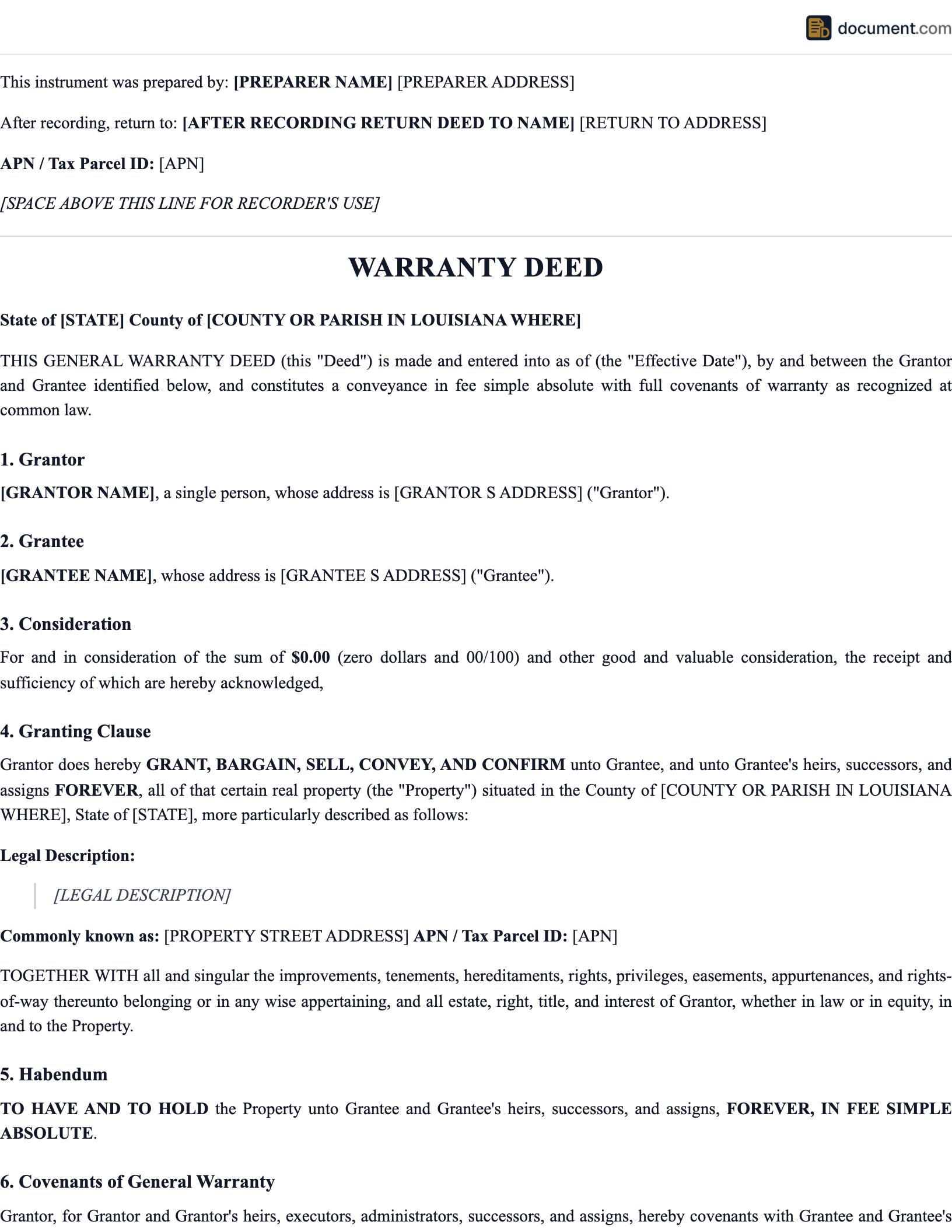
Sample Illinois Warranty Deed
Preview of our Illinois-specific template. Your document will include all fields required for recording in any Illinois county.
WARRANTY DEED (GENERAL WARRANTY DEED)
STATE OF ILLINOIS
Legal Document
PARTY INFORMATION
Name: [Full Legal Name]
Address: [Illinois Address]
County: [County]
PROPERTY DESCRIPTION
County: [County] State: Illinois
Legal Description: [Per Recorded Plat]
Parcel No.: [APN]
Illinois Warranty Deed FAQ
Common questions about filing in Illinois, including requirements, fees, and tax implications.
Official Illinois Resources
Official state resources for verifying requirements and finding your local recording office.
Important Considerations
The MyDec step is where most Illinois deed recording delays originate. Sellers who are unfamiliar with the system often wait until closing to attempt the declaration, only to encounter account setup delays or data entry issues that push back the recording date. Getting MyDec completed a day or two before closing, with the transfer tax confirmed, prevents this problem.
Cook County properties go through a noticeably different process than the rest of the state. In addition to MyDec, Cook County has its own assessor transfer declaration requirements. The Cook County Recorder of Deeds and the Cook County Assessor's Office have separate steps that must both be completed. Transactions in Cook County, particularly in Chicago, benefit from an Illinois real estate attorney or an experienced title company that handles Chicago closings regularly.
Illinois property taxes are paid in arrears, meaning at closing the seller typically credits the buyer for unpaid taxes covering the period the seller owned the property that year. This proration calculation is standard in Illinois real estate contracts but must be handled accurately, particularly for mid-year closings. The county assessor's office is the right starting point for questions about current assessed values and upcoming tax bills.
After recording, keep the stamped deed with all your property documents. The recorded instrument number assigned by the county recorder is your proof of recording. Title insurance companies will need this number for any future transaction involving the property.
Professional Recommendation
Illinois's transfer tax complexity, particularly in Cook County and Chicago, makes professional involvement worthwhile for most transactions. An Illinois real estate attorney can confirm the correct transfer tax calculation, handle the MyDec filing, and review the deed language before recording. Flat-fee closings are common in Illinois, and the cost is usually a fraction of the transfer tax itself.
Related Documents
Depending on your situation, you may need additional documents alongside this one. Below are commonly related documents that are frequently used together in real estate transactions.
Important Considerations
The MyDec step is where most Illinois deed recording delays originate. Sellers who are unfamiliar with the system often wait until closing to attempt the declaration, only to encounter account setup delays or data entry issues that push back the recording date. Getting MyDec completed a day or two before closing, with the transfer tax confirmed, prevents this problem.
Cook County properties go through a noticeably different process than the rest of the state. In addition to MyDec, Cook County has its own assessor transfer declaration requirements. The Cook County Recorder of Deeds and the Cook County Assessor's Office have separate steps that must both be completed. Transactions in Cook County, particularly in Chicago, benefit from an Illinois real estate attorney or an experienced title company that handles Chicago closings regularly.
Illinois property taxes are paid in arrears, meaning at closing the seller typically credits the buyer for unpaid taxes covering the period the seller owned the property that year. This proration calculation is standard in Illinois real estate contracts but must be handled accurately, particularly for mid-year closings. The county assessor's office is the right starting point for questions about current assessed values and upcoming tax bills.
After recording, keep the stamped deed with all your property documents. The recorded instrument number assigned by the county recorder is your proof of recording. Title insurance companies will need this number for any future transaction involving the property.
Professional Recommendation
While our templates are designed to be comprehensive and legally compliant, we recommend having your completed document reviewed by a licensed attorney before recording, especially for high-value transactions or complex situations. Many attorneys offer flat-fee document review services that provide peace of mind at a reasonable cost.
Related Documents
Depending on your situation, you may need additional documents alongside this one. Below are commonly related documents that are frequently used together in real estate transactions.
Create your Illinois Warranty Deed in under 5 minutes.
Answer a few questions and download a Illinois-compliant document, ready for the state agency.