



Idaho Warranty Deed Overview
Recording a warranty deed in Idaho is among the more straightforward processes in the western United States. Each of the state's 44 counties maintains a county recorder, and deeds are filed in the county where the property is physically located. The state imposes no real estate transfer tax, which means the only government charges at recording are the per-page recording fees, currently $10 for the first page and $3 per page after that.
Idaho is a community property state under Title 32 of the Idaho Code. Property acquired during a marriage is generally treated as community property regardless of how title is held, and a warranty deed conveying community property typically requires both spouses to sign even if only one spouse's name is on the title. This is one area where people frequently run into complications, particularly on transfers within a family or between spouses. The county recorder will record a deed signed by only one spouse, but whether that deed effectively conveys the community property interest is a separate legal question.
$10
Recording fee
None
Transfer tax
Required
Notarization
0
Witnesses required
Idaho Requirements
Idaho county recorders follow Idaho Code Section 55-808 for formatting requirements. Documents must be on paper of standard dimensions, printed or typed in legible font, and signed by the grantor in ink. The notarial acknowledgment must be complete and legible. Most county recorders also require that the name of the person to whom the recorded document should be returned is printed or typed on the face of the document.
Idaho Specific Note
Idaho has no state real estate transfer tax, so there is no transfer tax form to complete or tax to pay at recording. However, if the property is community property acquired during a marriage, both spouses should sign the deed to avoid future title problems. Confirm the parcel number with the county assessor before submitting, as incorrect parcel numbers can delay indexing of the recorded document.
Document Requirements
- Notarization: Must be notarized by an Idaho notary public or authorized notary
- Witnesses: Idaho requires 0 additional witness(es)
- Legal Description: Complete legal description as it appears on the current deed of record
- Parcel Number: Assessor's parcel number or tax ID
- Return Address: Mailing address for returning the recorded document
- Formatting: Standard formatting with adequate margins, black ink, minimum 10-point font
How to File in Idaho
Filing in Idaho involves preparing the document, getting it notarized, and recording it. Follow these steps for a smooth process.
Prepare the Document
Fill in the full legal names of all grantors and grantees, the complete legal description from the existing deed or county records, and the assessor's parcel number. If the property is community property, confirm whether both spouses need to sign. Include a return address for the recorded document.
Get the Document Notarized
The grantor (and any co-signing spouse) must appear before an Idaho-commissioned notary public with a government-issued photo ID. The notary completes the acknowledgment certificate. No witnesses are required beyond the notary. Remote online notarization is permitted under Idaho law for those who cannot appear in person.
File With the County Recorder
Take or mail the notarized deed to the county recorder in the county where the property is located. Most Idaho county recorders accept walk-in submissions during business hours and stamp documents with the exact time of receipt. Many counties also accept e-recording through approved vendors.
Pay Recording Fees
Pay the county recorder's fee at submission. Idaho charges $10 for the first page and $3 for each additional page. There is no transfer tax. The total recording cost for a standard warranty deed is typically $13 to $25 depending on document length.
Update Property Records
After recording, notify the county assessor of the ownership change so property tax bills are directed to the new owner. If the property was mortgaged, provide a copy of the recorded deed to the lender. Keep the recorded deed with your other important property documents.
Idaho Fees & Costs
Typical costs for filing in Idaho. Actual fees may vary by county.
| Fee / Tax | Amount |
|---|---|
| Recording Fee | $10 |
| Transfer Tax | None |
| Notarization | $5 - $25 per signature |
| Certified Copy | $1 - $10 per page |
| Attorney Review (optional) | $150 - $500 |
Idaho Tax Implications
Idaho is one of the few states that levies no real estate transfer tax, a straightforward advantage that reduces closing costs compared to most other states. There is no form to complete, no tax to calculate, and no exemption to claim. The recording fee is the only government charge at the county recorder's office.
On the federal side, a gift of real estate, meaning a transfer for little or no consideration, may require the grantor to file IRS Form 709 if the property value exceeds the annual gift tax exclusion. The recipient takes the grantor's adjusted cost basis in a gift transfer. When that property is later sold, capital gains are calculated from the original basis, not the value at the time of the gift. This carryover basis rule can result in a substantial taxable gain if the property has appreciated significantly over many years of ownership.
Idaho property taxes are assessed annually by each county assessor based on market value. Ownership transfers generally do not trigger a reassessment outside the normal annual cycle, but the assessor's office should be notified promptly so future tax bills go to the correct owner. Idaho offers a homeowner's exemption that reduces the taxable value on a primary residence, and a new owner who plans to occupy the home should apply through the county assessor's office.
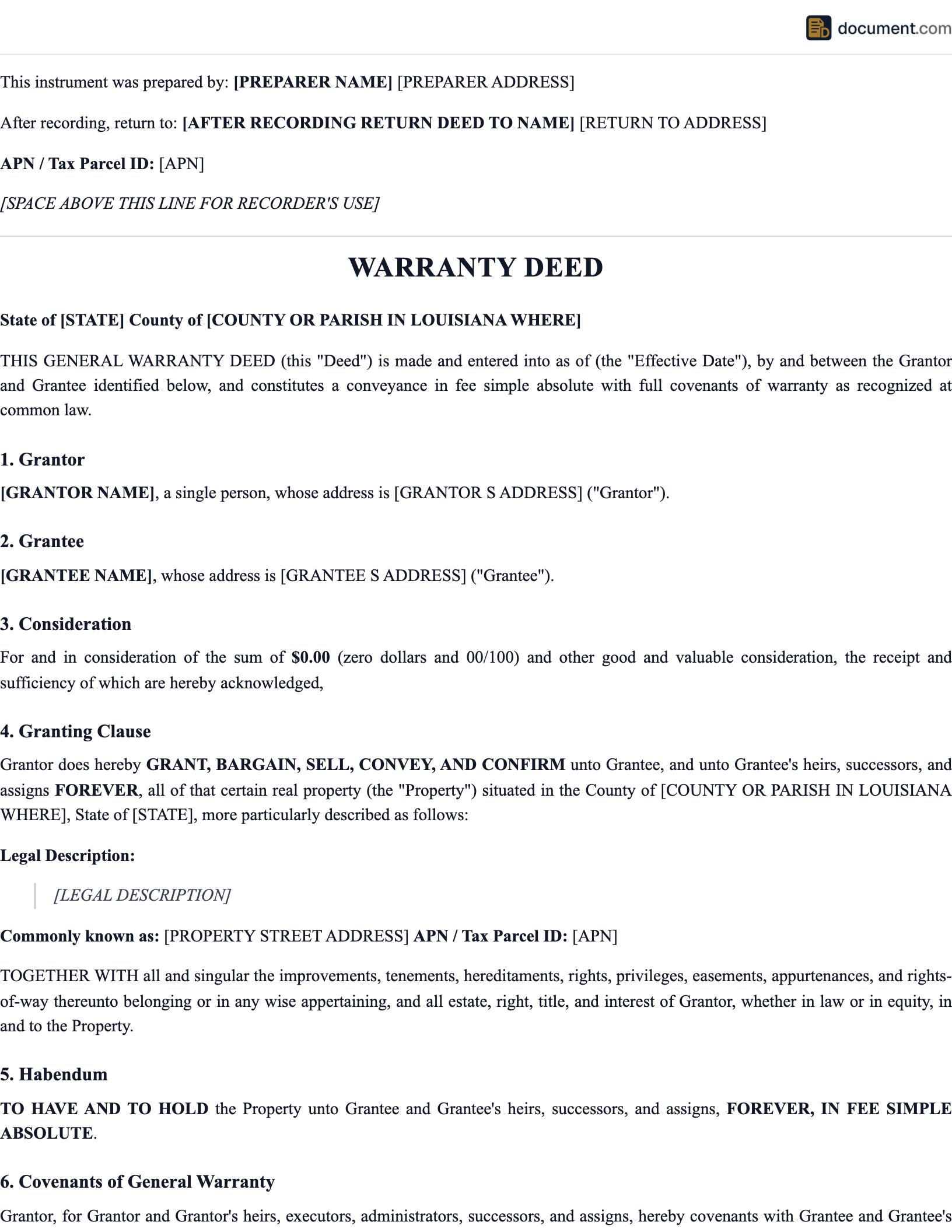
Sample Idaho Warranty Deed
Preview of our Idaho-specific template. Your document will include all fields required for recording in any Idaho county.
WARRANTY DEED (GENERAL WARRANTY DEED)
STATE OF IDAHO
Legal Document
PARTY INFORMATION
Name: [Full Legal Name]
Address: [Idaho Address]
County: [County]
PROPERTY DESCRIPTION
County: [County] State: Idaho
Legal Description: [Per Recorded Plat]
Parcel No.: [APN]
Idaho Warranty Deed FAQ
Common questions about filing in Idaho, including requirements, fees, and tax implications.
Official Idaho Resources
Official state resources for verifying requirements and finding your local recording office.
Important Considerations
Idaho's community property rules are the most common source of problems in warranty deed transfers that are otherwise straightforward. Property a married couple acquires during the marriage is community property under Idaho law, and both spouses hold an equal interest even when title is recorded in only one name. A deed signed by only one spouse may leave the other spouse's community interest in limbo. Before preparing any deed involving married grantors, confirm whether the property is community property or separate property.
Idaho does permit married couples to hold title as community property with right of survivorship, an option created under Idaho Code Section 55-508A. This allows the surviving spouse to take the deceased spouse's interest outside of probate while still receiving the favorable federal tax treatment associated with community property, specifically the double stepped-up basis that can eliminate capital gains on appreciated property. This is worth discussing with an attorney if long-term estate planning is a goal of the transfer.
Rural and agricultural properties in Idaho sometimes have irregular descriptions, water rights attached, or easements that do not appear clearly in the recorded chain of title. A full title search is always advisable on rural parcels, and water rights should be addressed explicitly in the deed or a separate agreement.
Store the recorded deed in a secure place after you receive it from the county recorder. The recorder's office maintains the official record, but retrieving a certified copy later takes time and involves a small fee. A digital scan stored in a secure cloud location is a practical backup.
Professional Recommendation
For straightforward Idaho residential transfers, the recording process itself is simple and inexpensive. The complexity tends to arise in community property situations, transfers involving trusts, and rural properties with water rights or access easements. An Idaho real estate attorney can identify these issues before recording and address them properly rather than discovering a title defect years later.
Related Documents
Depending on your situation, you may need additional documents alongside this one. Below are commonly related documents that are frequently used together in real estate transactions.
Important Considerations
Idaho's community property rules are the most common source of problems in warranty deed transfers that are otherwise straightforward. Property a married couple acquires during the marriage is community property under Idaho law, and both spouses hold an equal interest even when title is recorded in only one name. A deed signed by only one spouse may leave the other spouse's community interest in limbo. Before preparing any deed involving married grantors, confirm whether the property is community property or separate property.
Idaho does permit married couples to hold title as community property with right of survivorship, an option created under Idaho Code Section 55-508A. This allows the surviving spouse to take the deceased spouse's interest outside of probate while still receiving the favorable federal tax treatment associated with community property, specifically the double stepped-up basis that can eliminate capital gains on appreciated property. This is worth discussing with an attorney if long-term estate planning is a goal of the transfer.
Rural and agricultural properties in Idaho sometimes have irregular descriptions, water rights attached, or easements that do not appear clearly in the recorded chain of title. A full title search is always advisable on rural parcels, and water rights should be addressed explicitly in the deed or a separate agreement.
Store the recorded deed in a secure place after you receive it from the county recorder. The recorder's office maintains the official record, but retrieving a certified copy later takes time and involves a small fee. A digital scan stored in a secure cloud location is a practical backup.
Professional Recommendation
While our templates are designed to be comprehensive and legally compliant, we recommend having your completed document reviewed by a licensed attorney before recording, especially for high-value transactions or complex situations. Many attorneys offer flat-fee document review services that provide peace of mind at a reasonable cost.
Related Documents
Depending on your situation, you may need additional documents alongside this one. Below are commonly related documents that are frequently used together in real estate transactions.
Create your Idaho Warranty Deed in under 5 minutes.
Answer a few questions and download a Idaho-compliant document, ready for the state agency.