



Hawaii Warranty Deed Overview
Hawaii handles real property recording differently from every other state. Rather than a network of county recorders, all deeds flow through a single statewide agency: the Bureau of Conveyances in Honolulu. That centralized structure means one set of formatting standards applies to every transaction statewide, but it also means the Bureau is the sole point of submission, whether you are transferring a beachfront parcel on Maui or a rural lot on the Big Island.
A second layer of complexity comes from Hawaii's dual title systems. Most property sits in the regular system and is simply recorded. But some parcels are registered under the Land Court system, created in 1903 to resolve overlapping and uncertain native land claims. Registered land requires a separate filing track and results in a Transfer Certificate of Title rather than a standard recording entry. Mixing up the two systems creates real title problems, so confirming which system applies to a given parcel is the first step before preparing any deed.
$36
Recording fee
$0.10-$1.25 per $100
Transfer tax
Required
Notarization
0
Witnesses required
Hawaii Requirements
The Bureau of Conveyances enforces formatting requirements strictly. Documents must be on letter-size or legal-size paper, use black ink throughout, include at least a half-inch margin on all sides, and be typed or printed in a readable font. Handwritten deeds are generally not accepted. The grantor's signature must be acknowledged before a notary, and the notary certificate must include the notary's commission expiration date.
Hawaii Specific Note
Before submitting, verify whether the property is registered land (Land Court) or regular system land. A deed filed under the wrong system will not convey clear title. The tax map key number appears on your property tax bill and is required on all deeds submitted to the Bureau. Hawaii's conveyance tax must be paid or an exemption certificate filed at the same time as recording.
Document Requirements
- Notarization: Must be notarized by a Hawaii notary public or authorized notary
- Witnesses: Hawaii requires 0 additional witness(es)
- Legal Description: Complete legal description as it appears on the current deed of record
- Parcel Number: Assessor's parcel number or tax ID
- Return Address: Mailing address for returning the recorded document
- Formatting: Standard formatting with adequate margins, black ink, minimum 10-point font
How to File in Hawaii
Filing in Hawaii involves preparing the document, getting it notarized, and recording it. Follow these steps for a smooth process.
Prepare the Document
Confirm whether the property is regular-system or Land Court registered land. Pull the exact legal description and tax map key number from the current deed or Transfer Certificate of Title. Complete all grantor and grantee fields using full legal names.
Get the Document Notarized
All grantors must sign before a Hawaii-commissioned notary public. Bring a valid government-issued photo ID. The notary must complete the acknowledgment certificate with their commission number and expiration date. No additional witnesses are required.
Submit to the Bureau of Conveyances
Submit the notarized deed to the Bureau of Conveyances in Honolulu, either in person at 1151 Punchbowl Street, by mail, or through an e-recording vendor. Land Court documents go through a separate counter at the same office.
Pay Fees and Conveyance Tax
Pay the recording fee ($36 base rate) at submission. Hawaii's conveyance tax must also be settled at the same time. The tax is calculated on the consideration amount using the state's bracket schedule. If an exemption applies, file the exemption certificate alongside the deed.
Receive the Recorded Document
The Bureau will return the recorded deed to the address listed on the document. For Land Court properties, you will receive a new Transfer Certificate of Title. Notify your lender, insurer, and the property tax office of the ownership change.
Hawaii Fees & Costs
Typical costs for filing in Hawaii. Actual fees may vary by county.
| Fee / Tax | Amount |
|---|---|
| Recording Fee | $36 |
| Transfer Tax | $0.10-$1.25 per $100 |
| Notarization | $5 - $25 per signature |
| Certified Copy | $1 - $10 per page |
| Attorney Review (optional) | $150 - $500 |
Hawaii Tax Implications
Hawaii's conveyance tax (HRS Chapter 247) applies to most warranty deed transfers and is one of the more nuanced transfer taxes in the country. The rate depends on both the sale price and the buyer's intended use. Owner-occupants purchasing a principal residence pay a lower rate than investors or buyers acquiring non-owner-occupied property. For a $1 million residential purchase where the buyer will occupy the home, the conveyance tax totals roughly $10,000. For the same purchase as an investment property, the rate is higher. The seller is technically responsible for the tax, though parties frequently negotiate who pays.
Certain transfers are exempt from conveyance tax entirely. These include transfers between spouses as part of a divorce settlement, transfers to a revocable living trust where the grantor is also the trustee, and nominal-consideration transfers in some estate situations. An exemption certificate must be filed with the Bureau at the time of recording even when no tax is owed.
On the federal side, a gift transfer of Hawaii real estate where little or no money changes hands may trigger a Form 709 filing requirement if the property's value exceeds the annual gift tax exclusion. The recipient takes the grantor's adjusted cost basis in a gift transfer, meaning a low-basis property transferred as a gift will carry that built-in gain forward to the recipient's eventual sale. Properties passing through an estate generally receive a stepped-up basis to fair market value at the date of death, which is a meaningfully different outcome worth planning around.
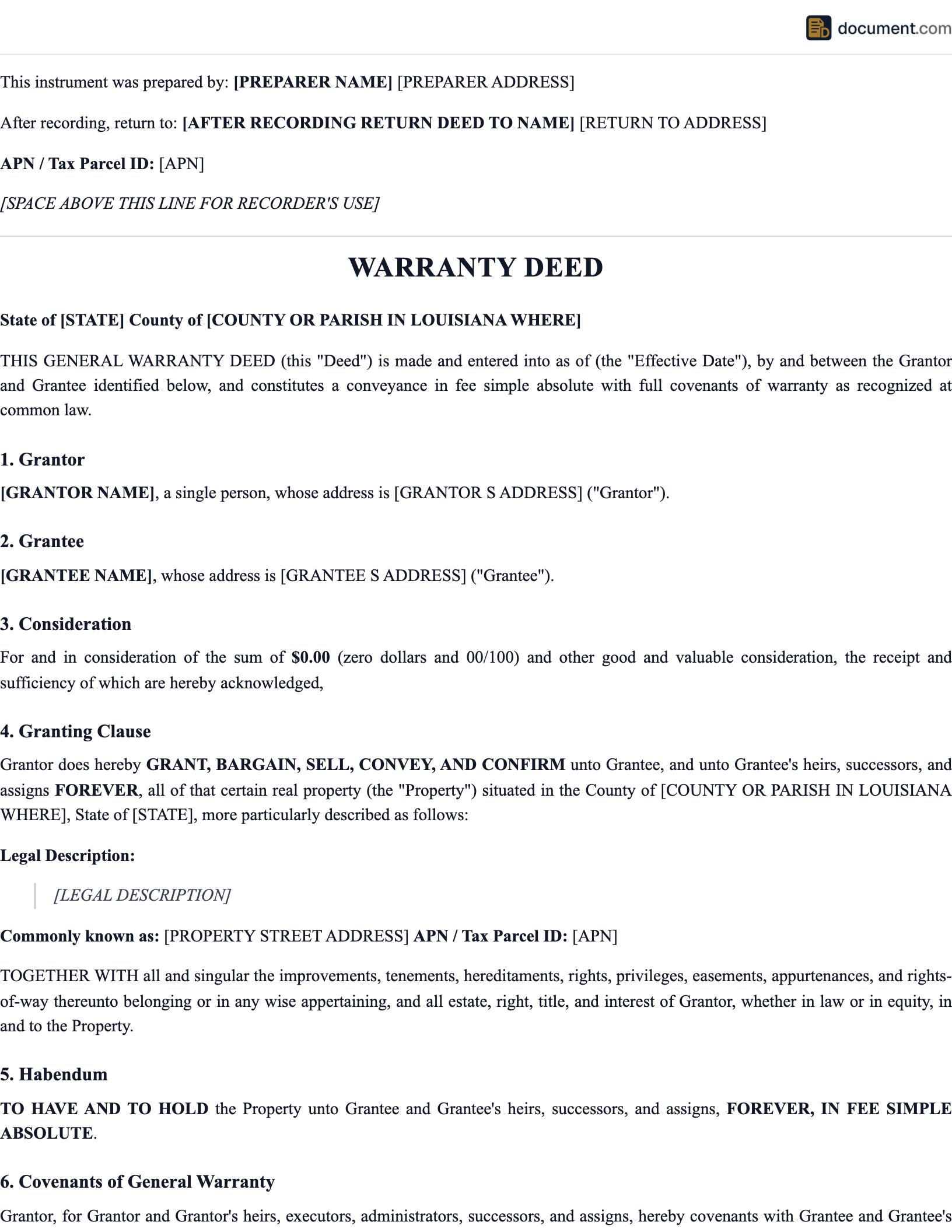
Sample Hawaii Warranty Deed
Preview of our Hawaii-specific template. Your document will include all fields required for recording in any Hawaii county.
WARRANTY DEED (GENERAL WARRANTY DEED)
STATE OF HAWAII
Legal Document
PARTY INFORMATION
Name: [Full Legal Name]
Address: [Hawaii Address]
County: [County]
PROPERTY DESCRIPTION
County: [County] State: Hawaii
Legal Description: [Per Recorded Plat]
Parcel No.: [APN]
Hawaii Warranty Deed FAQ
Common questions about filing in Hawaii, including requirements, fees, and tax implications.
Official Hawaii Resources
Official state resources for verifying requirements and finding your local recording office.
Important Considerations
The Land Court versus regular system distinction is the single most important threshold question in any Hawaii deed transfer. If a property is registered under Land Court, a standard Bureau of Conveyances recording will not convey title to the new owner. The deed must go through the Land Court process, and the buyer receives a Transfer Certificate of Title. You can confirm a property's system by checking with the Bureau or reviewing the current ownership document.
Hawaii's high property values make the conveyance tax a meaningful transaction cost. A $2 million home sale can generate a conveyance tax bill in the range of $25,000 or more depending on buyer occupancy status. Buyers and sellers often negotiate in advance over which party absorbs this cost, and the allocation should be addressed in the purchase agreement, not left to sort out at closing.
Kuleana rights and ancient land grants occasionally affect titles to older parcels, particularly on the neighbor islands and in rural areas. These interests do not always appear in a standard title search and can survive a warranty deed conveyance. A thorough title examination by a Hawaii title company familiar with native land issues is the appropriate protection for any parcel where the chain of title goes back more than a few decades.
Keep originals and certified copies of all recorded documents in a secure location. The Bureau of Conveyances maintains the public record, but waiting for a certified copy from the state when you need it for a future transaction takes time. Store digital scans as a backup alongside the physical originals.
Professional Recommendation
Given Hawaii's unique recording system, dual title tracks, and significant conveyance tax, most real property attorneys on the islands recommend having any warranty deed reviewed before submission. Title companies active in Hawaii are also well-positioned to handle the filing on your behalf and flag any Land Court complications before they become title defects.
Related Documents
Depending on your situation, you may need additional documents alongside this one. Below are commonly related documents that are frequently used together in real estate transactions.
Important Considerations
The Land Court versus regular system distinction is the single most important threshold question in any Hawaii deed transfer. If a property is registered under Land Court, a standard Bureau of Conveyances recording will not convey title to the new owner. The deed must go through the Land Court process, and the buyer receives a Transfer Certificate of Title. You can confirm a property's system by checking with the Bureau or reviewing the current ownership document.
Hawaii's high property values make the conveyance tax a meaningful transaction cost. A $2 million home sale can generate a conveyance tax bill in the range of $25,000 or more depending on buyer occupancy status. Buyers and sellers often negotiate in advance over which party absorbs this cost, and the allocation should be addressed in the purchase agreement, not left to sort out at closing.
Kuleana rights and ancient land grants occasionally affect titles to older parcels, particularly on the neighbor islands and in rural areas. These interests do not always appear in a standard title search and can survive a warranty deed conveyance. A thorough title examination by a Hawaii title company familiar with native land issues is the appropriate protection for any parcel where the chain of title goes back more than a few decades.
Keep originals and certified copies of all recorded documents in a secure location. The Bureau of Conveyances maintains the public record, but waiting for a certified copy from the state when you need it for a future transaction takes time. Store digital scans as a backup alongside the physical originals. are also recommended as a backup.
Professional Recommendation
While our templates are designed to be comprehensive and legally compliant, we recommend having your completed document reviewed by a licensed attorney before recording, especially for high-value transactions or complex situations. Many attorneys offer flat-fee document review services that provide peace of mind at a reasonable cost.
Related Documents
Depending on your situation, you may need additional documents alongside this one. Below are commonly related documents that are frequently used together in real estate transactions.
Create your Hawaii Warranty Deed in under 5 minutes.
Answer a few questions and download a Hawaii-compliant document, ready for the state agency.