



Georgia Warranty Deed Overview
Georgia warranty deeds are recorded with the Clerk of the Superior Court, and Georgia's 159 counties each maintain their own records. Getting a deed recorded in Georgia means more than just showing up at the courthouse: you also need to complete and e-file Form PT-61, the Real Estate Transfer Tax Declaration, through the Department of Revenue's portal before the clerk will accept your deed for recording.
Georgia is one of only a handful of states requiring two witnesses on deeds, a requirement set by O.C.G.A. § 44-2-21. The grantor signs before two witnesses and a notary, all in a single session. Transfer tax runs $1.00 per $1,000 of stated consideration, making it relatively affordable compared to Delaware or Connecticut. Recording fees start around $25. For transactions involving a purchase money mortgage, the lender's security deed also triggers an intangible recording tax of $1.50 per $500 of principal, which is the buyer's cost to bear.
$25
Recording fee
$1.00 per $1,000
Transfer tax
Required
Notarization
0
Witnesses required
Georgia Requirements
Georgia deed execution requirements are set by O.C.G.A. § 44-2-21. Two witnesses are mandatory, and the clerk's office will reject a deed that lacks them. Georgia also requires the PT-61 e-filing before any deed can be recorded. If you arrive at the clerk's office without the printed PT-61 confirmation, you'll be turned away.
Georgia Specific Note
Georgia requires TWO witnesses in addition to notarization. One witness is typically the notary (serving as "official witness") and one is an independent witness. File Form PT-61 electronically through the Georgia DOR portal before recording, then bring the printed confirmation to the clerk's office. Transfer tax is $1.00 per $1,000 of consideration. Recording fees start at $25 for the first page. Transactions involving a purchase money security deed also trigger the intangible recording tax ($1.50 per $500 of principal), paid at recording of the security deed.
Document Requirements
- Notarization: Must be notarized by a Georgia notary public or authorized notary
- Witnesses: Georgia requires 0 additional witness(es)
- Legal Description: Complete legal description as it appears on the current deed of record
- Parcel Number: Assessor's parcel number or tax ID
- Return Address: Mailing address for returning the recorded document
- Formatting: Standard formatting with adequate margins, black ink, minimum 10-point font
How to File in Georgia
Georgia's process has one step most states don't: e-filing Form PT-61 before you can record. Complete that step online first, then proceed to the clerk's office with your deed and the printed PT-61 confirmation.
Prepare the Deed
Draft the warranty deed with the grantor's and grantee's full legal names and addresses, the exact legal description from the current deed of record, the county tax parcel number, the consideration amount, and witness signature lines for two witnesses. Include a return address for the recorded document.
E-File Form PT-61
Go to eTax.dor.ga.gov and complete the Real Estate Transfer Tax Declaration (PT-61) electronically. Enter the parties, property address, tax parcel number, and the purchase price. The system calculates the transfer tax. Print the confirmation page after submission. You cannot record a deed in Georgia without this printed confirmation.
Execute the Deed with Two Witnesses and a Notary
Arrange for the grantor to sign in the presence of two witnesses and a notary public, all at the same time. Under Georgia practice, one witness is typically the notary (as official witness) and one is an independent witness who is not a party to the deed. All sign at the attestation block. No subsequent signing or cure is available for a deed missing proper witnesses.
Record With the Clerk of Superior Court
Bring the executed deed and the printed PT-61 confirmation to the Clerk of the Superior Court in the county where the property is located. Pay the recording fee (around $25 for the first page) and the transfer tax (calculated on the PT-61). Many Georgia counties offer e-recording through approved services if you prefer not to file in person.
Update County Tax Records and Other Notifications
After recording, notify the county tax assessor's office of the ownership change so future tax bills go to the right address. Contact your homeowner's insurance carrier and, if applicable, your HOA or community association. File for any applicable property tax exemptions, such as Georgia's homestead exemption, if the new owner qualifies.
Georgia Fees & Costs
Typical costs for filing in Georgia. Actual fees may vary by county.
| Fee / Tax | Amount |
|---|---|
| Recording Fee | $25 |
| Transfer Tax | $1.00 per $1,000 |
| Notarization | $5 - $25 per signature |
| Certified Copy | $1 - $10 per page |
| Attorney Review (optional) | $150 - $500 |
Georgia Tax Implications
Georgia's real estate transfer tax of $1.00 per $1,000 is one of the lowest in the Southeast. On a $300,000 home, you're paying $300. That said, Georgia's overall closing cost picture includes the intangible recording tax on the security deed, which runs $1.50 per $500 of the loan amount. On a $240,000 mortgage, the intangible tax is $720. Buyers using financing should budget for both the transfer tax on the warranty deed and the intangible tax on the security deed.
Georgia has a state income tax, and capital gains are taxed at ordinary income rates for state purposes. Sellers who have held property for many years should calculate their Georgia tax exposure alongside federal capital gains. The federal primary residence exclusion ($250,000/$500,000 under IRC § 121) still applies, but the Georgia exclusion is more limited. Gift transfers of real property where the consideration is less than fair market value may still require federal Form 709 if the value exceeds the annual exclusion per recipient.
County tax assessors in Georgia may reassess property value after a sale, using the transaction price as market evidence. The Freeport exemption and homestead exemption applications must be filed by April 1 of the tax year for which they apply. New owners who miss the deadline lose the exemption for that entire year, so filing promptly after closing matters.
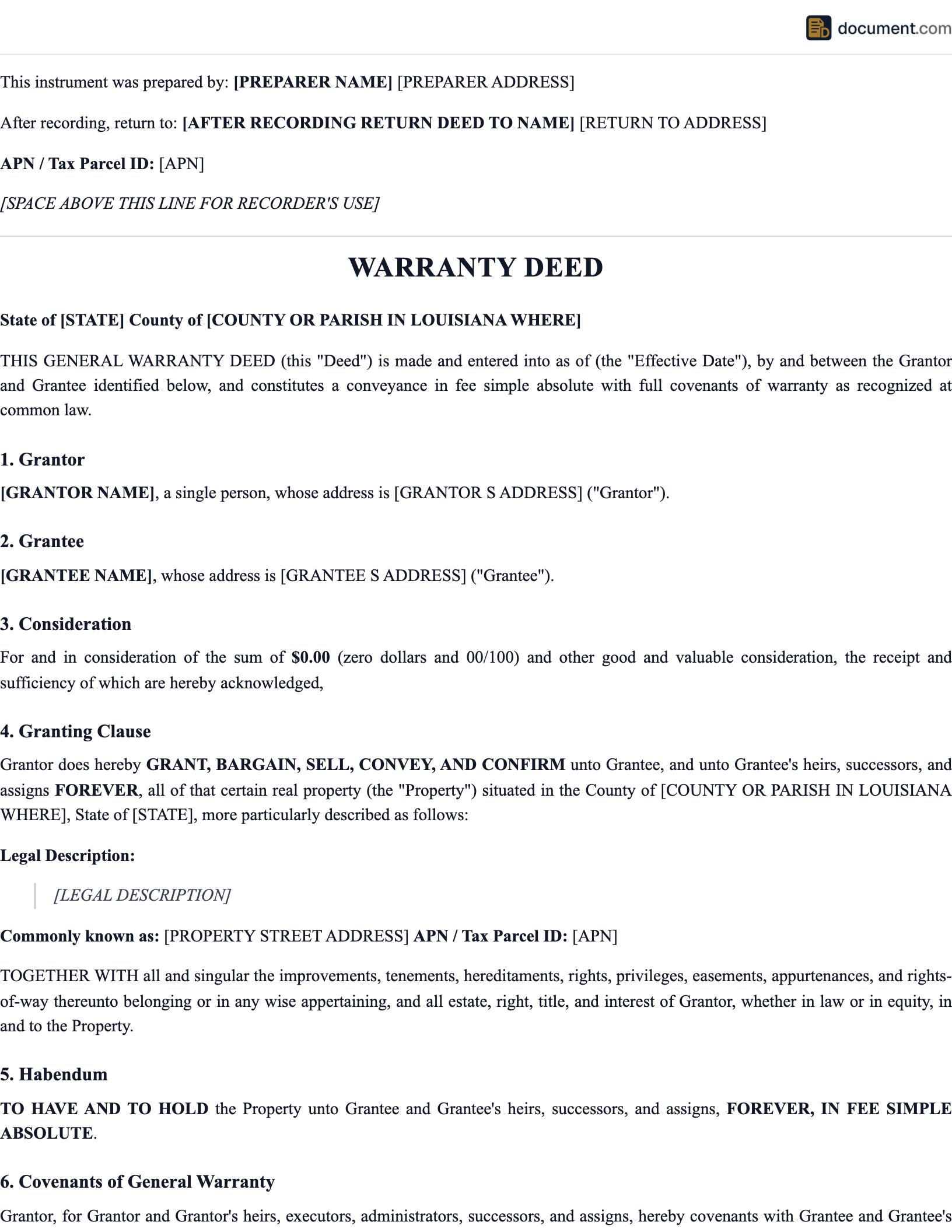
Sample Georgia Warranty Deed
Preview of our Georgia-specific template. Your document will include all fields required for recording in any Georgia county.
WARRANTY DEED (GENERAL WARRANTY DEED)
STATE OF GEORGIA
Legal Document
PARTY INFORMATION
Name: [Full Legal Name]
Address: [Georgia Address]
County: [County]
PROPERTY DESCRIPTION
County: [County] State: Georgia
Legal Description: [Per Recorded Plat]
Parcel No.: [APN]
Georgia Warranty Deed FAQ
Common questions about filing in Georgia, including requirements, fees, and tax implications.
Official Georgia Resources
Official state resources for verifying requirements and finding your local recording office.
Important Considerations
The PT-61 e-filing step trips up people who've closed on property in other states. Georgia eliminated the paper PT-61 form, and you must complete the filing online before going to the clerk's office. Bring your printed confirmation, because the clerk will check it. The PT-61 system is straightforward, but make sure you're using the DOR's current portal at eTax.dor.ga.gov and not a third-party site.
With 159 counties, Georgia's local variation matters. Some rural county clerks have limited e-recording capability or specific formatting requirements not advertised on their websites. Calling the clerk's office before you prepare the final deed is worth five minutes of your time. Ask about margins, font size requirements, and whether they require a specific form of the acknowledgment block.
Georgia uses security deeds (not mortgages or deeds of trust) to secure real estate loans. When a property is sold subject to financing, the buyer signs a security deed to the lender at the same closing. That security deed must also be recorded with the clerk, and its intangible recording tax is the buyer's cost to bear. Make sure your closing attorney or title company accounts for the intangible tax in the closing disclosure.
Transfers involving Georgia LLCs or corporations should include evidence of authority, such as an operating agreement excerpt showing who is authorized to sign deeds on behalf of the entity. Title insurers will require this, and the clerk's office may as well.
Georgia PT-61 Reminder
Complete Form PT-61 online at eTax.dor.ga.gov before recording. The system will calculate the transfer tax based on the stated consideration. Print your confirmation immediately after submission. Without it, the Clerk of Superior Court will not accept your deed for recording. This step applies to all deed types, including warranty deeds, quitclaim deeds, and security deeds.
Related Documents
Depending on your situation, you may need additional documents alongside this one. Below are commonly related documents that are frequently used together in real estate transactions.
Important Considerations
The PT-61 e-filing step trips up people who've closed on property in other states. Georgia eliminated the paper PT-61 form, and you must complete the filing online before going to the clerk's office. Bring your printed confirmation, because the clerk will check it. The PT-61 system is straightforward, but make sure you're using the DOR's current portal at eTax.dor.ga.gov and not a third-party site.
With 159 counties, Georgia's local variation matters. Some rural county clerks have limited e-recording capability or specific formatting requirements not advertised on their websites. Calling the clerk's office before you prepare the final deed is worth five minutes of your time. Ask about margins, font size requirements, and whether they require a specific form of the acknowledgment block.
Georgia uses security deeds (not mortgages or deeds of trust) to secure real estate loans. When a property is sold subject to financing, the buyer signs a security deed to the lender at the same closing. That security deed must also be recorded with the clerk, and its intangible recording tax is the buyer's cost to bear. Make sure your closing attorney or title company accounts for the intangible tax in the closing disclosure.
Transfers involving Georgia LLCs or corporations should include evidence of authority, such as an operating agreement excerpt showing who is authorized to sign deeds on behalf of the entity. Title insurers will require this, and the clerk's office may as well.
Georgia PT-61 Reminder
Complete Form PT-61 online at eTax.dor.ga.gov before recording. The system will calculate the transfer tax based on the stated consideration. Print your confirmation immediately after submission. Without it, the Clerk of Superior Court will not accept your deed for recording. This step applies to all deed types, including warranty deeds, quitclaim deeds, and security deeds.
Related Documents
Depending on your situation, you may need additional documents alongside this one. Below are commonly related documents that are frequently used together in real estate transactions.
Create your Georgia Warranty Deed in under 5 minutes.
Answer a few questions and download a Georgia-compliant document, ready for the state agency.