



Florida Warranty Deed Overview
Florida warranty deeds are recorded with the Clerk of the Circuit Court in the county where the property sits. Florida's 67 counties each maintain their own land records, and most now offer e-recording through approved service providers. The state has no income tax, which draws buyers from high-tax states, but Florida does levy a documentary stamp tax on deeds that represents a meaningful transaction cost.
Two things separate Florida from most states: the two-witness requirement and the documentary stamp tax. Every deed must be signed by the grantor in front of two witnesses and a notary, all at the same time. Get either witness wrong and the deed is void, not voidable. On the tax side, the doc stamp is $0.70 per $100 of consideration statewide (Miami-Dade uses a different structure). For a $500,000 property, that's $3,500 in documentary stamp taxes, typically paid by the seller. Recording fees start around $10 for the first page.
$10
Recording fee
$0.70 per $100
Transfer tax
Required
Notarization
2
Witnesses required
Florida Requirements
Florida deed requirements are governed primarily by § 689.01, Florida Statutes. The two-witness requirement is non-negotiable and strictly enforced. Florida courts have voided deeds that had only one witness or where a witness signed after the fact. Arrange for both witnesses to be present at the signing before anyone puts pen to paper.
Florida Specific Note
Florida requires TWO witnesses and a notary, all present at the same signing. The notary cannot count as one of the two witnesses. A deed executed with only one witness is void under Florida law and cannot be corrected after recording. Florida also imposes a documentary stamp tax of $0.70 per $100 of consideration ($0.60 per $100 in Miami-Dade with an additional surtax), payable at recording. Homestead property transfers may require both spouses to sign even if only one holds title.
Document Requirements
- Notarization: Must be notarized by a Florida notary public or authorized notary
- Witnesses: Florida requires 2 additional witness(es)
- Legal Description: Complete legal description as it appears on the current deed of record
- Parcel Number: Assessor's parcel number or tax ID
- Return Address: Mailing address for returning the recorded document
- Formatting: Standard formatting with adequate margins, black ink, minimum 10-point font
How to File in Florida
Florida deeds are recorded with the Clerk of the Circuit Court. The two-witness requirement makes the signing step more involved than most states, so plan ahead and line up everyone who needs to be present before you start signing.
Prepare the Deed
Complete the deed with the full legal names of grantor and grantee, the legal description from the existing deed, the parcel identification number (from the county property appraiser's records), stated consideration, return address, and the grantor's marital status. For homestead property, check whether the grantor's spouse must also sign under Florida's homestead joinder requirement.
Arrange Two Witnesses and a Notary
Gather two adult witnesses who are not the grantee. A Florida notary public must also be present. All three, the two witnesses and the notary, must observe the grantor's signature in person. The notary cannot serve as one of the two witnesses. Florida permits RON (remote online notarization) for the acknowledgment portion, but the witness requirement still means two people must be physically present with the grantor.
Execute the Deed
The grantor signs first, then both witnesses sign, then the notary completes the acknowledgment block. Everyone must sign in the same session. Do not pre-sign or have anyone sign on a separate day. A deed with a blank acknowledgment filled in later may be challenged.
Record With the Clerk of the Circuit Court
Submit the deed to the Clerk of the Circuit Court in the county where the property sits. Pay the recording fee (typically $10 for the first page plus $8.50 for each additional page) and the documentary stamp tax ($0.70 per $100 of consideration, except in Miami-Dade). Most Florida county clerks offer e-recording through approved services.
Apply for Homestead Exemption and Update Records
If the new owner will use the property as a primary residence, file for Florida's homestead exemption with the county property appraiser by March 1 of the following year. Also notify your homeowner's insurer and mortgage servicer of the ownership change, and update the property tax billing address with the county tax collector.
Florida Fees & Costs
Typical costs for filing in Florida. Actual fees may vary by county.
| Fee / Tax | Amount |
|---|---|
| Recording Fee | $10 |
| Transfer Tax | $0.70 per $100 |
| Notarization | $5 - $25 per signature |
| Certified Copy | $1 - $10 per page |
| Attorney Review (optional) | $150 - $500 |
Florida Tax Implications
The documentary stamp tax is paid at recording and is calculated on the full consideration stated in the deed. Across most of Florida, the rate is $0.70 per $100, or $7 per $1,000. Miami-Dade County operates differently: the base stamp tax there is $0.60 per $100, but there's an additional surtax of $0.45 per $100 on all deeds other than those conveying solely homestead property, bringing the effective rate to $1.05 per $100 in Miami-Dade. On a $600,000 purchase in Miami, that's $6,300 in doc stamps.
Florida has no state income tax, so there's no state-level capital gains tax when you sell. Federal capital gains tax still applies, and Florida sellers of highly appreciated property should consult a tax advisor about the primary residence exclusion under IRC § 121. Gift deeds below fair market value may still trigger the doc stamp tax based on the value of the interest conveyed, not just the stated consideration. Transfers to living trusts are generally not subject to doc stamp tax, provided the beneficial interest doesn't change.
Florida's Save Our Homes cap limits the annual increase in assessed value for homestead properties to 3% or the change in the CPI, whichever is less. When a property is sold, this cap resets for the new owner, which can result in a significant jump in property taxes in the first year after purchase. New owners should check with the county property appraiser to get a realistic estimate of their post-sale tax bill before closing.
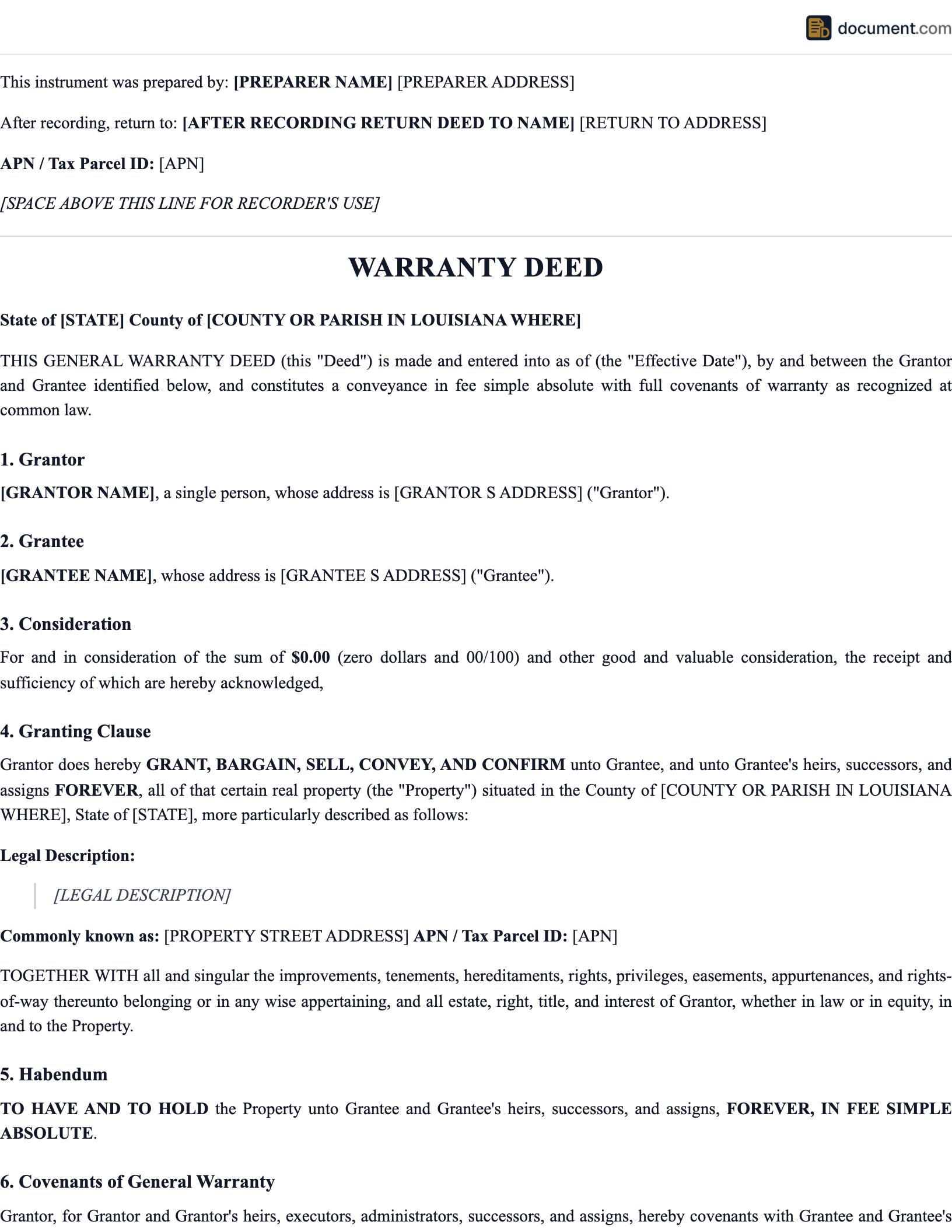
Sample Florida Warranty Deed
Preview of our Florida-specific template. Your document will include all fields required for recording in any Florida county.
WARRANTY DEED (GENERAL WARRANTY DEED)
STATE OF FLORIDA
Legal Document
PARTY INFORMATION
Name: [Full Legal Name]
Address: [Florida Address]
County: [County]
PROPERTY DESCRIPTION
County: [County] State: Florida
Legal Description: [Per Recorded Plat]
Parcel No.: [APN]
Florida Warranty Deed FAQ
Common questions about filing in Florida, including requirements, fees, and tax implications.
Official Florida Resources
Official state resources for verifying requirements and finding your local recording office.
Important Considerations
The two-witness requirement is Florida's most common deed pitfall. Unlike states where a single witness or no witnesses at all are required, Florida courts treat a deed lacking two proper witnesses as void, not just defective. That means the grantee receives no title, and correcting a void deed can require a court proceeding. Arrange for both witnesses before anyone shows up to sign.
Homestead property in Florida comes with both constitutional protections and constraints. A married grantor generally cannot convey homestead property without the non-titled spouse's joinder, even if the property is titled only in one spouse's name. This rule applies regardless of how the deed is prepared. Title companies routinely require both spouses to sign any deed conveying Florida homestead, and a deed that lacks spousal joinder when required may be unenforceable.
The doc stamp tax is generally the seller's responsibility in Florida, though this is a matter of contract, not statute. Purchase agreements sometimes shift all or part of the doc stamp to the buyer, particularly in new construction transactions. Confirm who bears the doc stamp obligation in your purchase contract before closing.
Florida operates a race-notice recording system. Recording promptly protects against subsequent claims. If someone else records a deed to the same property before you, and without actual notice of your prior unrecorded transfer, they may have priority over you in title. Don't sit on an executed deed.
Florida Homestead Note
If you're purchasing Florida property as a primary residence, apply for the homestead exemption with the county property appraiser by March 1 of the year following your purchase. Missing the deadline costs you a full year of the property tax reduction. The exemption reduces your assessed value by up to $50,000 and locks in the Save Our Homes assessment cap going forward.
Related Documents
Depending on your situation, you may need additional documents alongside this one. Below are commonly related documents that are frequently used together in real estate transactions.
Important Considerations
The two-witness requirement is Florida's most common deed pitfall. Unlike states where a single witness or no witnesses at all are required, Florida courts treat a deed lacking two proper witnesses as void, not just defective. That means the grantee receives no title, and correcting a void deed can require a court proceeding. Arrange for both witnesses before anyone shows up to sign.
Homestead property in Florida comes with both constitutional protections and constraints. A married grantor generally cannot convey homestead property without the non-titled spouse's joinder, even if the property is titled only in one spouse's name. This rule applies regardless of how the deed is prepared. Title companies routinely require both spouses to sign any deed conveying Florida homestead, and a deed that lacks spousal joinder when required may be unenforceable.
The doc stamp tax is generally the seller's responsibility in Florida, though this is a matter of contract, not statute. Purchase agreements sometimes shift all or part of the doc stamp to the buyer, particularly in new construction transactions. Confirm who bears the doc stamp obligation in your purchase contract before closing.
Florida operates a race-notice recording system. Recording promptly protects against subsequent claims. If someone else records a deed to the same property before you, and without actual notice of your prior unrecorded transfer, they may have priority over you in title. Don't sit on an executed deed.
Florida Homestead Note
If you're purchasing Florida property as a primary residence, apply for the homestead exemption with the county property appraiser by March 1 of the year following your purchase. Missing the deadline costs you a full year of the property tax reduction. The exemption reduces your assessed value by up to $50,000 and locks in the Save Our Homes assessment cap going forward.
Related Documents
Depending on your situation, you may need additional documents alongside this one. Below are commonly related documents that are frequently used together in real estate transactions.
Create your Florida Warranty Deed in under 5 minutes.
Answer a few questions and download a Florida-compliant document, ready for the state agency.