



Delaware Warranty Deed Overview
Warranty deeds in Delaware are recorded with the Recorder of Deeds for the county where the property sits. Delaware is a three-county state: New Castle (Wilmington), Kent (Dover), and Sussex (Georgetown). Each county has its own office and fee schedule, though the state transfer tax rate is consistent across all three. Delaware's land records are maintained at the county level and are searchable online through each county's portal.
The numbers that most buyers notice first: Delaware's combined state and county realty transfer tax totals 4% of the consideration, split evenly between buyer and seller by default. That's $4,000 per $100,000 of purchase price, making Delaware one of the most expensive transfer tax states in the country. The one meaningful relief valve is the first-time homebuyer exemption, which allows qualifying buyers to skip the buyer's half of the state tax. Recording fees run around $33 for a standard deed, which is a footnote compared to the transfer tax.
$33
Recording fee
4% split
Transfer tax
Required
Notarization
0
Witnesses required
Delaware Requirements
Delaware deed requirements are set by Title 25 of the Delaware Code. Notarization is required; no additional witnesses are needed beyond the notary. Critically, you must also file Form RTT (Realty Transfer Tax Return) at the time of recording, and the Recorder of Deeds will reject any deed that arrives without it.
Delaware Specific Note
Delaware's combined realty transfer tax is 4% of the stated consideration, typically split 2% each between buyer and seller. You must file Form RTT (Realty Transfer Tax Return) at recording, signed by both parties. First-time homebuyers purchasing a primary residence may claim an exemption from the buyer's share of the state transfer tax (1.5%), which must be claimed on the RTT form. No witnesses beyond the notary are required, but notarization is mandatory. Base recording fees run approximately $33 for a standard deed.
Document Requirements
- Notarization: Must be notarized by a Delaware notary public or authorized notary
- Witnesses: Delaware requires 0 additional witness(es)
- Legal Description: Complete legal description as it appears on the current deed of record
- Parcel Number: Assessor's parcel number or tax ID
- Return Address: Mailing address for returning the recorded document
- Formatting: Standard formatting with adequate margins, black ink, minimum 10-point font
How to File in Delaware
Delaware deeds are recorded with the county Recorder of Deeds. The process requires both the deed and the RTT form, so come prepared with both documents and payment for the transfer tax and recording fee.
Prepare the Warranty Deed
Draft the deed with the exact legal description from the current deed of record, the full legal names and addresses of both parties, the parcel number, stated consideration, and a return address for the recorded document. If claiming a first-time homebuyer exemption, make sure the deed and RTT form reflect the exemption claim.
Complete Form RTT
Download the current Realty Transfer Tax Return (Form RTT) from the Delaware Division of Revenue. Both grantor and grantee (or their authorized agents) must sign the form. It requires the parties' tax identification numbers, consideration amount, property type, and any exemption being claimed. This form is non-negotiable at recording.
Get the Deed Notarized
The grantor signs before a Delaware notary public. No witnesses are required beyond the notary. Bring a government-issued photo ID. If the grantor is out of state, an out-of-state notary can acknowledge the deed, but confirm this with the Recorder of Deeds office beforehand.
Record With the County Recorder of Deeds
File the notarized deed and signed RTT form with the Recorder of Deeds in New Castle, Kent, or Sussex County (whichever county contains the property). Pay the recording fee (around $33) and the combined transfer tax (typically 4% of consideration, split per closing agreement). E-recording is available through approved providers.
Update Assessment and Insurance Records
After recording, notify the county assessment office to update the billing address for property tax notices. Contact your homeowner's insurance carrier to update the named insured. File away the recorded deed showing the instrument number for your permanent records.
Delaware Fees & Costs
Typical costs for filing in Delaware. Actual fees may vary by county.
| Fee / Tax | Amount |
|---|---|
| Recording Fee | $33 |
| Transfer Tax | 4% split |
| Notarization | $5 - $25 per signature |
| Certified Copy | $1 - $10 per page |
| Attorney Review (optional) | $150 - $500 |
Delaware Tax Implications
Delaware's 4% combined transfer tax is the top-line number that shocks buyers. What softens it slightly is that the tax is split by custom between buyer and seller, so each party typically bears 2%. For a $500,000 home, each side pays $10,000 in transfer tax. First-time homebuyers who qualify for the state exemption avoid the buyer's 1.5% state share, saving $7,500 on that same transaction. Always confirm current exemption rules with a Delaware real estate attorney, as rates and thresholds have changed over time.
Delaware has no state income tax on capital gains for individuals, which is a meaningful advantage for sellers of highly appreciated property compared to states that tax gains at ordinary income rates. However, federal capital gains tax still applies. Sellers who have lived in the property as their primary residence for at least two of the five years preceding the sale may exclude up to $250,000 ($500,000 for married couples) of gain from federal income tax under IRC § 121.
Gift transfers below fair market value still generate transfer tax calculated on the fair market value, not just the stated consideration. Significant gifts of real property also require federal Form 709 if the value exceeds the annual exclusion. Delaware has no separate gift tax, but the state does impose an estate tax on larger estates, so family property planning involving real estate should involve a Delaware estate planning attorney alongside the deed preparation.
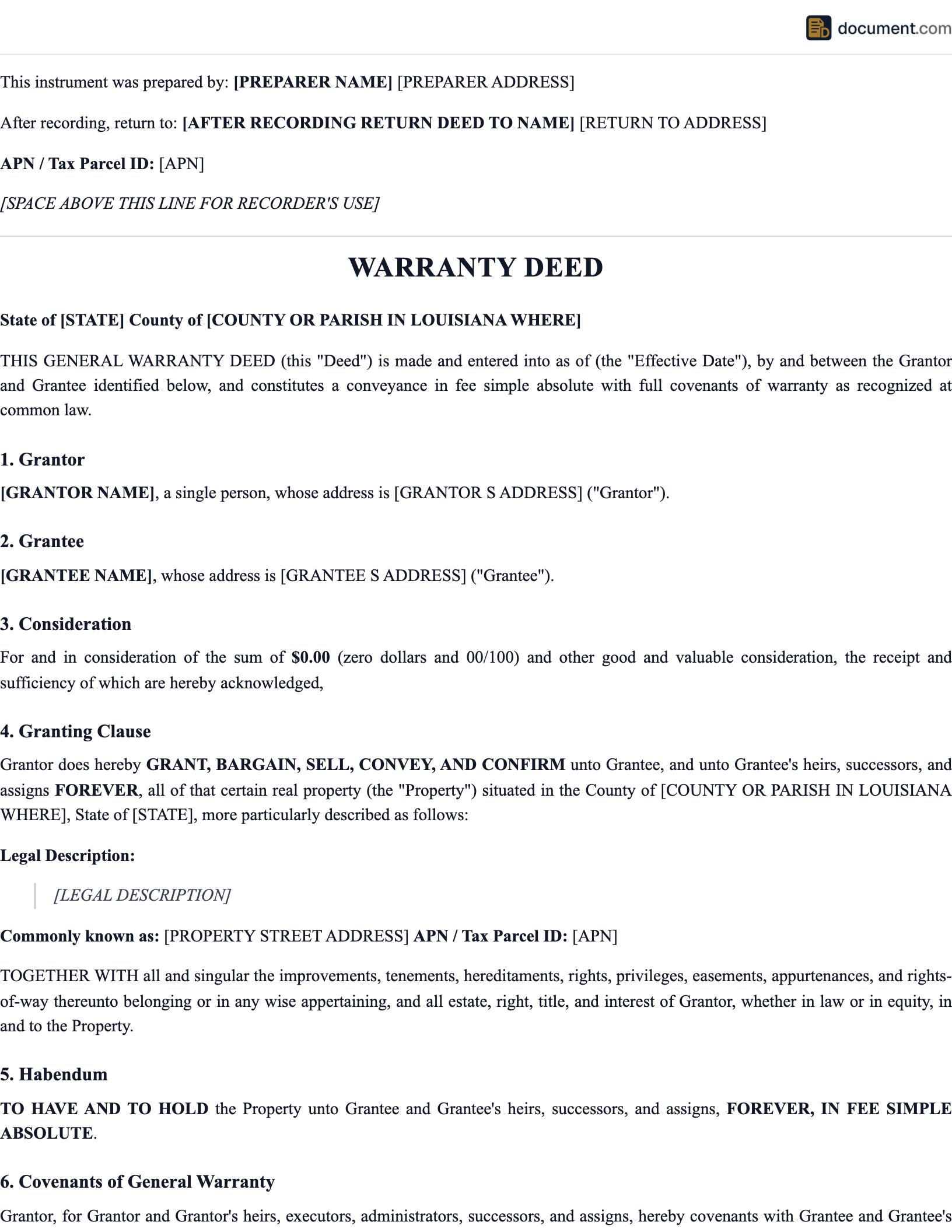
Sample Delaware Warranty Deed
Preview of our Delaware-specific template. Your document will include all fields required for recording in any Delaware county.
WARRANTY DEED (GENERAL WARRANTY DEED)
STATE OF DELAWARE
Legal Document
PARTY INFORMATION
Name: [Full Legal Name]
Address: [Delaware Address]
County: [County]
PROPERTY DESCRIPTION
County: [County] State: Delaware
Legal Description: [Per Recorded Plat]
Parcel No.: [APN]
Delaware Warranty Deed FAQ
Common questions about filing in Delaware, including requirements, fees, and tax implications.
Official Delaware Resources
Official state resources for verifying requirements and finding your local recording office.
Important Considerations
Don't confuse the RTT form requirement with other states' procedures. Delaware will not record a deed without the accompanying Form RTT, full stop. If you arrive at the Recorder of Deeds without a completed RTT form, you'll be turned away. Download the current form from the Division of Revenue website, not a cached or outdated version, since the form is periodically updated.
The first-time homebuyer exemption is worth claiming if you qualify, but the qualification rules are specific. Both spouses (if the buyer is married) must not have owned a home in Delaware in the preceding three years. The property must be used as a primary residence. The exemption applies only to the buyer's share of the state transfer tax, not the county portion or the seller's share. Misstating eligibility on the RTT form can create legal exposure.
Delaware's three-county structure means you need to know exactly where your property sits. New Castle County properties near the Maryland border can be confusing, and some addresses in one town fall in a different county for land record purposes. Verify the correct county with the state's parcel viewer before you head to the recorder's office.
Keep the recorded deed with the instrument number permanently. Delaware land records are searchable online, but having your own certified copy eliminates any need to retrieve it later for a refinance, resale, or estate proceeding.
Delaware Transfer Tax Planning Note
The 4% transfer tax is often negotiable between buyer and seller as part of the purchase contract. In a buyer's market, sellers frequently agree to pay more than the standard 2% share. Discuss the allocation upfront and document it in the purchase agreement rather than assuming the 50/50 default split. Your Delaware real estate attorney can advise on market norms.
Related Documents
Depending on your situation, you may need additional documents alongside this one. Below are commonly related documents that are frequently used together in real estate transactions.
Important Considerations
Don't confuse the RTT form requirement with other states' procedures. Delaware will not record a deed without the accompanying Form RTT, full stop. If you arrive at the Recorder of Deeds without a completed RTT form, you'll be turned away. Download the current form from the Division of Revenue website, not a cached or outdated version, since the form is periodically updated.
The first-time homebuyer exemption is worth claiming if you qualify, but the qualification rules are specific. Both spouses (if the buyer is married) must not have owned a home in Delaware in the preceding three years. The property must be used as a primary residence. The exemption applies only to the buyer's share of the state transfer tax, not the county portion or the seller's share. Misstating eligibility on the RTT form can create legal exposure.
Delaware's three-county structure means you need to know exactly where your property sits. New Castle County properties near the Maryland border can be confusing, and some addresses in one town fall in a different county for land record purposes. Verify the correct county with the state's parcel viewer before you head to the recorder's office.
Keep the recorded deed with the instrument number permanently. Delaware land records are searchable online, but having your own certified copy eliminates any need to retrieve it later for a refinance, resale, or estate proceeding.
Delaware Transfer Tax Planning Note
The 4% transfer tax is often negotiable between buyer and seller as part of the purchase contract. In a buyer's market, sellers frequently agree to pay more than the standard 2% share. Discuss the allocation upfront and document it in the purchase agreement rather than assuming the 50/50 default split. Your Delaware real estate attorney can advise on market norms.
Related Documents
Depending on your situation, you may need additional documents alongside this one. Below are commonly related documents that are frequently used together in real estate transactions.
Create your Delaware Warranty Deed in under 5 minutes.
Answer a few questions and download a Delaware-compliant document, ready for the state agency.