



Connecticut Warranty Deed Overview
Connecticut records deeds at the town clerk's office, a quirk of the state's municipal structure that surprises many people. County government was abolished here in 1960, so each of Connecticut's 169 towns maintains its own land records. A deed for property in Westport gets recorded in Westport, not at some central county office. Town clerks are the gatekeepers of Connecticut's property records, and they're generally accessible and helpful if you call ahead.
The signature formalities here are stricter than most states. Connecticut requires the grantor's signature to be witnessed by two people, both of whom must be present at signing, plus a notary acknowledgment. Miss either witness and the deed is defective. On the tax side, Connecticut operates a two-tier conveyance tax: the state charges 0.75% on the first $800,000 and 1.25% above that, and most municipalities stack an additional 0.25% on top. For a $1 million sale, expect to budget around $9,500 in combined conveyance taxes before recording fees.
$60
Recording fee
0.75% - 2.25%
Transfer tax
Required
Notarization
2
Witnesses required
Connecticut Requirements
Connecticut's recording requirements are set by C.G.S. § 47-5 and related statutes. Two witnesses plus notarization are mandatory for every deed. The town clerk's office will reject a deed that lacks both witnesses, and that rejection can delay or derail a closing.
Connecticut Specific Note
Two witnesses to the grantor's signature are required under Connecticut law, in addition to notarization. The witnesses cannot be the grantee or the notary. You must also file a completed OPT-4 Real Estate Conveyance Tax Return with the town clerk at recording. The state conveyance tax is 0.75% on consideration up to $800,000, and 1.25% above that, plus the municipality's additional tax (usually 0.25%). The recording fee is $53 for the first page.
Document Requirements
- Notarization: Must be notarized by a Connecticut notary public or authorized notary
- Witnesses: Connecticut requires 2 additional witness(es)
- Legal Description: Complete legal description as it appears on the current deed of record
- Parcel Number: Assessor's parcel number or tax ID
- Return Address: Mailing address for returning the recorded document
- Formatting: Standard formatting with adequate margins, black ink, minimum 10-point font
How to File in Connecticut
Connecticut deeds are recorded with the town clerk of the municipality where the property is located. Here's the process from start to finish, including the conveyance tax return that most states don't require.
Prepare the Document
Draft the warranty deed with the grantor's and grantee's full legal names and addresses, the complete legal description copied from the existing deed or town land records, and the actual consideration amount. Connecticut town clerks cross-reference the stated consideration with the conveyance tax return you'll file, so accuracy matters.
Sign Before Two Witnesses and a Notary
Gather two witnesses (neither can be the grantee or the notary) and a Connecticut notary public. All three must be present when the grantor signs. This is not optional. A deed missing either witness will be rejected at recording and cannot simply be corrected after the fact.
Complete the OPT-4 Conveyance Tax Return
Download and complete Form OPT-4 from the Connecticut Department of Revenue Services. This form is required at recording and calculates both the state and municipal conveyance tax. The grantor signs the return. Your closing attorney typically handles this, but if you're proceeding without one, get the form from the DRS website.
File With the Town Clerk
Bring the signed, witnessed, and notarized deed together with the completed OPT-4 to the town clerk's office in the town where the property sits. Pay the recording fee (around $60 for a standard deed) and the conveyance tax. Many Connecticut towns now offer e-recording through approved service providers.
Confirm Recording and Update Tax Records
The town clerk will return a stamped copy showing the volume and page number where the deed was indexed. Keep this certified copy. Notify the town assessor's office to update the mailing address for property tax bills, and inform your homeowner's insurance carrier of the ownership change.
Connecticut Fees & Costs
Typical costs for filing in Connecticut. Actual fees may vary by county.
| Fee / Tax | Amount |
|---|---|
| Recording Fee | $60 |
| Transfer Tax | 0.75% - 2.25% |
| Notarization | $5 - $25 per signature |
| Certified Copy | $1 - $10 per page |
| Attorney Review (optional) | $150 - $500 |
Connecticut Tax Implications
Connecticut's conveyance tax is among the more complex in the Northeast, because it layers a state tax on top of a municipal tax, each calculated at different rates. The state tax is 0.75% on the first $800,000 of consideration, then 1.25% on the next $1.7 million, and 2.25% on amounts above $2.5 million. Most municipalities add another 0.25% across the board (some distressed municipalities are authorized up to 0.5%). On a $900,000 sale, you'd owe approximately $6,750 in state conveyance tax plus $2,250 in municipal tax, or $9,000 total before recording fees.
Gift transfers present a separate question. If you're conveying property to a family member at below fair market value, or transferring without consideration, you still generally owe conveyance tax calculated on the property's fair market value, not just the stated consideration. The DRS can and does audit conveyance tax returns where the stated consideration looks inconsistent with market conditions. Gift transfers above the annual IRS exclusion amount may also require a federal Form 709 filing.
Connecticut does reassess properties at market value on a regular revaluation cycle, which varies by municipality. A sale can provide the assessor with market data that influences valuations at the next revaluation. Additionally, Connecticut has its own estate and gift tax with a $13.61 million exemption as of 2024, so high-value family transfers warrant consultation with a Connecticut tax attorney.
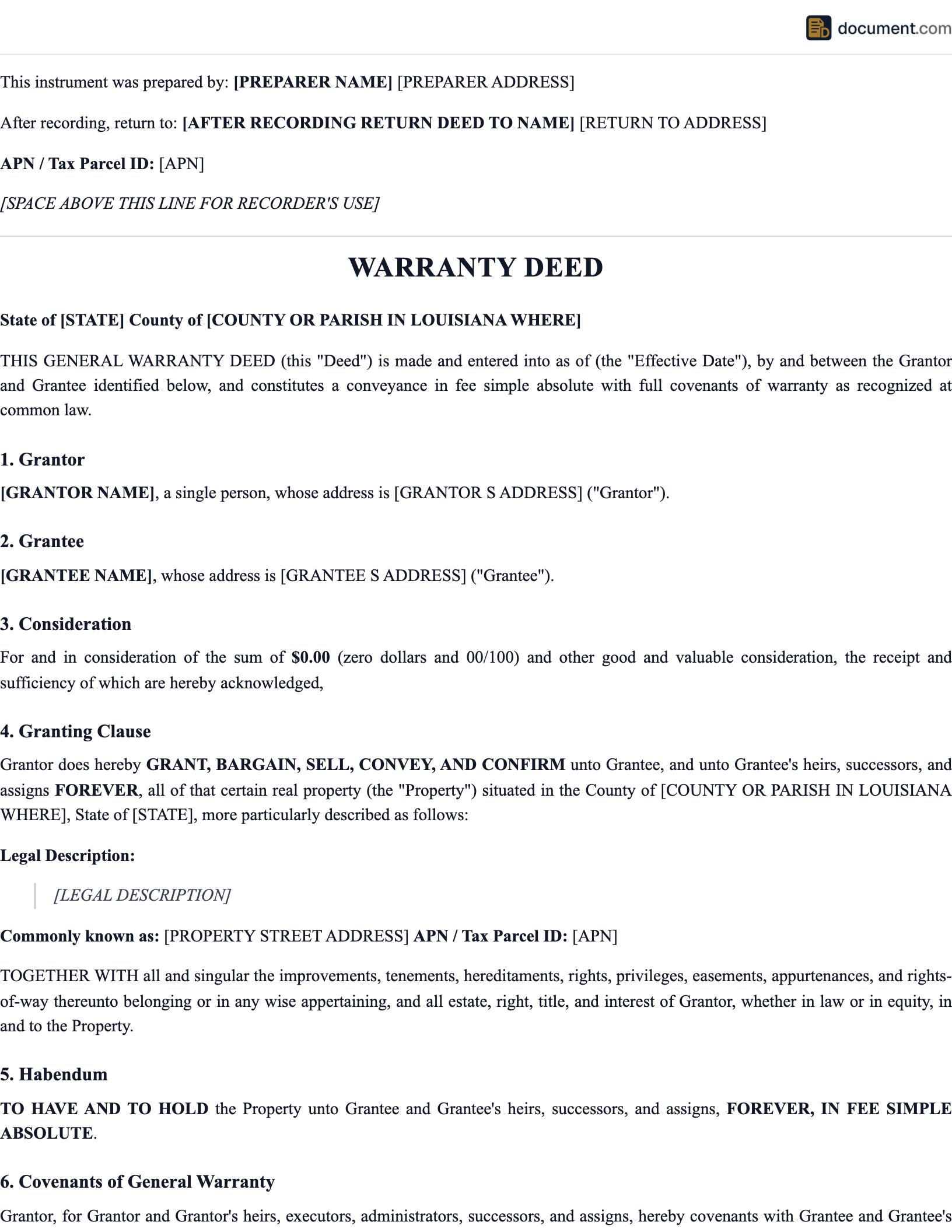
Sample Connecticut Warranty Deed
Preview of our Connecticut-specific template. Your document will include all fields required for recording in any Connecticut county.
WARRANTY DEED (GENERAL WARRANTY DEED)
STATE OF CONNECTICUT
Legal Document
PARTY INFORMATION
Name: [Full Legal Name]
Address: [Connecticut Address]
County: [County]
PROPERTY DESCRIPTION
County: [County] State: Connecticut
Legal Description: [Per Recorded Plat]
Parcel No.: [APN]
Connecticut Warranty Deed FAQ
Common questions about filing in Connecticut, including requirements, fees, and tax implications.
Official Connecticut Resources
Official state resources for verifying requirements and finding your local recording office.
Important Considerations
Attorney involvement in Connecticut real estate closings isn't just common, it's the norm. Connecticut is one of a handful of states where attorneys, not title companies, conduct residential closings and certify title. If you're buying or selling through a traditional transaction, you'll almost certainly have an attorney on each side. For family transfers or gift deeds handled outside a formal closing, at minimum have a Connecticut attorney prepare or review the deed.
The two-witness requirement catches out-of-state parties off guard. If the grantor is signing in another state, the deed can still be acknowledged before an out-of-state notary, but the witness requirement under Connecticut law still applies. Arrange to have two proper witnesses present wherever the signing takes place, and ensure the acknowledgment block correctly identifies the notary's state.
Connecticut's title search standard requires searching back at least 40 years. Given the age of much of the state's housing stock, title chains can involve multiple estates, ancient rights-of-way, and restrictions that aren't obvious from a modern deed. Title insurance provides essential protection, and lenders universally require it. Owner's coverage, while optional, is worth the one-time premium.
After recording, keep the stamped deed showing the volume and page number where it was indexed. Connecticut town land records are publicly searchable online through the town clerk's website or the eRecording network, but your physical copy with the town clerk's stamp provides definitive proof of recording.
Connecticut Closing Practice Note
Connecticut attorney fees for a standard residential closing typically run $800 to $1,500, and title insurance premiums are calculated on a set rate schedule filed with the state Insurance Department. Shop around on title insurance, but not on the legal work. A missed encumbrance or defective deed is far more expensive to fix after the fact.
Related Documents
Depending on your situation, you may need additional documents alongside this one. Below are commonly related documents that are frequently used together in real estate transactions.
Important Considerations
Attorney involvement in Connecticut real estate closings isn't just common, it's the norm. Connecticut is one of a handful of states where attorneys, not title companies, conduct residential closings and certify title. If you're buying or selling through a traditional transaction, you'll almost certainly have an attorney on each side. For family transfers or gift deeds handled outside a formal closing, at minimum have a Connecticut attorney prepare or review the deed.
The two-witness requirement catches out-of-state parties off guard. If the grantor is signing in another state, the deed can still be acknowledged before an out-of-state notary, but the witness requirement under Connecticut law still applies. Arrange to have two proper witnesses present wherever the signing takes place, and ensure the acknowledgment block correctly identifies the notary's state.
Connecticut's title search standard requires searching back at least 40 years. Given the age of much of the state's housing stock, title chains can involve multiple estates, ancient rights-of-way, and restrictions that aren't obvious from a modern deed. Title insurance provides essential protection, and lenders universally require it. Owner's coverage, while optional, is worth the one-time premium.
After recording, keep the stamped deed showing the volume and page number where it was indexed. Connecticut town land records are publicly searchable online through the town clerk's website or the eRecording network, but your physical copy with the town clerk's stamp provides definitive proof of recording.
Connecticut Closing Practice Note
Connecticut attorney fees for a standard residential closing typically run $800 to $1,500, and title insurance premiums are calculated on a set rate schedule filed with the state Insurance Department. Shop around on title insurance, but not on the legal work. A missed encumbrance or defective deed is far more expensive to fix after the fact.
Related Documents
Depending on your situation, you may need additional documents alongside this one. Below are commonly related documents that are frequently used together in real estate transactions.
Create your Connecticut Warranty Deed in under 5 minutes.
Answer a few questions and download a Connecticut-compliant document, ready for the state agency.