



Colorado Warranty Deed Overview
Warranty deeds in Colorado are recorded with the county clerk and recorder, not a statewide office. The state is divided into 64 counties, each maintaining its own land records, so you file where the property is located. Colorado follows a race-notice recording system, meaning the first party to record a deed without knowledge of a prior unrecorded claim generally prevails. Getting your deed recorded promptly matters.
Colorado's documentary fee sits at a modest $0.01 per $100 of consideration, making it one of the lighter transfer tax burdens in the region. Recording fees start around $13. The general warranty deed provides the strongest title guarantee available, with the grantor warranting title against all prior claims regardless of when they arose. For bank-owned or commercial properties, buyers often accept a special warranty deed instead, which limits the grantor's warranty to the period of their own ownership.
$13
Recording fee
$0.01 per $100
Transfer tax
Required
Notarization
0
Witnesses required
Colorado Requirements
Colorado's recording requirements are set by C.R.S. § 38-35-101 and related statutes. The county clerk and recorder will reject a deed that fails to meet these standards, so it's worth confirming requirements with your specific county office before you finalize the document.
Colorado Specific Note
Colorado charges a documentary fee of $0.01 per $100 of stated consideration, payable at recording. This is separate from the base recording fee (typically $13 for the first page). Many counties now offer e-recording, which can shorten processing time. The deed must state the name and address of the person who prepared it, and you must include a return address for the recorded document. No witnesses are required beyond the notary acknowledgment.
Document Requirements
- Notarization: Must be notarized by a Colorado notary public or authorized notary
- Witnesses: Colorado requires 0 additional witness(es)
- Legal Description: Complete legal description as it appears on the current deed of record
- Parcel Number: Assessor's parcel number or tax ID
- Return Address: Mailing address for returning the recorded document
- Formatting: Standard formatting with adequate margins, black ink, minimum 10-point font
How to File in Colorado
Colorado deeds must be recorded with the county clerk and recorder for the county where the property sits. Here's the practical sequence from document preparation through recording.
Prepare the Document
Pull the exact legal description from the current deed or county assessor records. Include the full legal names of all parties, their addresses, the parcel number, the consideration amount, and the name and address of the preparer. Colorado requires this preparer statement on the face of the deed.
Get the Document Notarized
The grantor signs before a Colorado notary public. No additional witnesses are required. Remote online notarization is permitted in Colorado, so this step can often be completed without an in-person meeting. Bring a government-issued photo ID.
File With the County Clerk and Recorder
Submit the deed to the clerk and recorder's office in the county where the property is located. Most Colorado counties offer walk-in, mail-in, and e-recording options. Check your county's website for current hours and accepted filing methods before making the trip.
Pay the Recording Fee and Documentary Fee
Budget for the base recording fee (around $13 for the first page, plus per-page fees for additional pages) and the documentary fee of $0.01 per $100 of consideration. On a $400,000 sale, the documentary fee is $40. Payment methods vary by county.
Notify the Assessor and Update Insurance
After recording, notify the county assessor's office if the mailing address for tax bills should change. Also contact your title insurer and homeowner's insurance carrier to update ownership records. Keep the recorded copy with the stamp and reception number in a safe place.
Colorado Fees & Costs
Typical costs for filing in Colorado. Actual fees may vary by county.
| Fee / Tax | Amount |
|---|---|
| Recording Fee | $13 |
| Transfer Tax | $0.01 per $100 |
| Notarization | $5 - $25 per signature |
| Certified Copy | $1 - $10 per page |
| Attorney Review (optional) | $150 - $500 |
Colorado Tax Implications
Colorado's documentary fee of $0.01 per $100 is one of the lowest deed transfer taxes in the country. On a $600,000 home, you're paying $60, which is a rounding error compared to what buyers face in states like Delaware or Connecticut. That said, the documentary fee is separate from any federal gift tax considerations if you're transferring property without receiving fair market value.
Gifts of real property worth more than the annual IRS exclusion (currently $19,000 per recipient) require filing Form 709, though gift tax is generally only owed once a donor exhausts their lifetime exemption. More practically relevant for most Colorado sellers: capital gains. Colorado conforms to federal capital gains treatment, and while the state rate is relatively modest, sellers who have held appreciated property for years should calculate their exposure before closing.
One Colorado-specific wrinkle worth knowing: the state uses a two-year reassessment cycle, not a sale-triggered reassessment like California. Recording a deed doesn't automatically spike property taxes. However, sale prices feed into the data assessors use when setting values for the next cycle, so buyers should keep an eye on assessment notices after they take ownership.
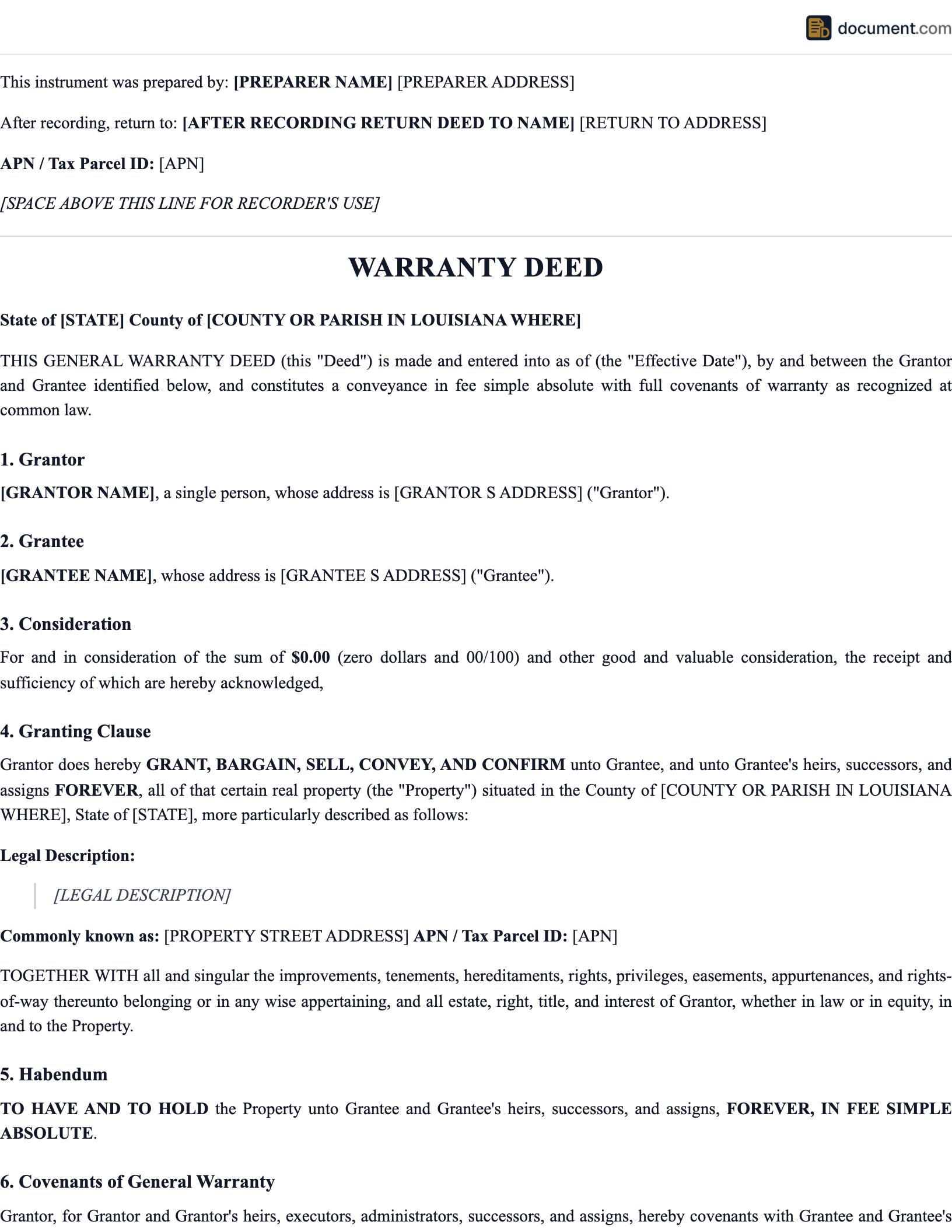
Sample Colorado Warranty Deed
Preview of our Colorado-specific template. Your document will include all fields required for recording in any Colorado county.
WARRANTY DEED (GENERAL WARRANTY DEED)
STATE OF COLORADO
Legal Document
PARTY INFORMATION
Name: [Full Legal Name]
Address: [Colorado Address]
County: [County]
PROPERTY DESCRIPTION
County: [County] State: Colorado
Legal Description: [Per Recorded Plat]
Parcel No.: [APN]
Colorado Warranty Deed FAQ
Common questions about filing in Colorado, including requirements, fees, and tax implications.
Official Colorado Resources
Official state resources for verifying requirements and finding your local recording office.
Important Considerations
Colorado's race-notice recording system means that the first party to record a deed, without notice of a prior unrecorded transfer, takes priority. Delays in recording leave a window where competing claims could arise. Once the county clerk and recorder stamps your document, it becomes part of the public record and is indexed by grantor and grantee name.
The choice between a general warranty deed and a special warranty deed matters in Colorado. General warranty deeds are standard for residential sales, and buyers (especially those financing through a lender) should insist on one. Special warranty deeds are typical for bank-owned properties, foreclosure sales, and commercial deals where the grantor cannot make broad title representations. Accepting a special warranty deed without title insurance is risky.
Transfers involving trusts, LLCs, or estates require additional attention. If the grantor is a trust, the deed must be signed by the trustee with the trustee's capacity stated. If the grantor is an LLC, an authorized member or manager must sign. Title companies will want to see the trust agreement or operating agreement to confirm authority before insuring the transaction.
Keep a certified copy of the recorded deed, together with all related closing documents, in a secure location. Colorado counties maintain digital images of recorded documents that are publicly searchable, but having your own copy with the reception number makes future transactions much simpler.
Colorado Attorney Tip
Colorado does not require an attorney to be involved in a real estate closing, but for transactions involving multiple parcels, easements, mineral rights, or shared ownership structures, a Colorado real estate attorney review is worth the cost. Many Front Range attorneys offer flat-fee deed review for a few hundred dollars, which is trivial relative to the value of the property involved.
Related Documents
Depending on your situation, you may need additional documents alongside this one. Below are commonly related documents that are frequently used together in real estate transactions.
Important Considerations
Colorado's race-notice recording system means that the first party to record a deed, without notice of a prior unrecorded transfer, takes priority. Delays in recording leave a window where competing claims could arise. Once the county clerk and recorder stamps your document, it becomes part of the public record and is indexed by grantor and grantee name.
The choice between a general warranty deed and a special warranty deed matters in Colorado. General warranty deeds are standard for residential sales, and buyers (especially those financing through a lender) should insist on one. Special warranty deeds are typical for bank-owned properties, foreclosure sales, and commercial deals where the grantor cannot make broad title representations. Accepting a special warranty deed without title insurance is risky.
Transfers involving trusts, LLCs, or estates require additional attention. If the grantor is a trust, the deed must be signed by the trustee with the trustee's capacity stated. If the grantor is an LLC, an authorized member or manager must sign. Title companies will want to see the trust agreement or operating agreement to confirm authority before insuring the transaction.
Keep a certified copy of the recorded deed, together with all related closing documents, in a secure location. Colorado counties maintain digital images of recorded documents that are publicly searchable, but having your own copy with the reception number makes future transactions much simpler.
Colorado Attorney Tip
Colorado does not require an attorney to be involved in a real estate closing, but for transactions involving multiple parcels, easements, mineral rights, or shared ownership structures, a Colorado real estate attorney review is worth the cost. Many Front Range attorneys offer flat-fee deed review for a few hundred dollars, which is trivial relative to the value of the property involved.
Related Documents
Depending on your situation, you may need additional documents alongside this one. Below are commonly related documents that are frequently used together in real estate transactions.
Create your Colorado Warranty Deed in under 5 minutes.
Answer a few questions and download a Colorado-compliant document, ready for the state agency.