



Arkansas Warranty Deed Overview
Arkansas uses circuit clerk offices to record real property documents, not a separate recorder of deeds. With 75 counties in the state, each circuit clerk maintains local land records, and you file in the county where the property is physically located. Arkansas imposes a real property transfer tax of $3.30 per $1,000 of stated consideration, which is split between state and county, and this tax is collected at the time of recording. Some family and non-arm's-length transfers qualify for an exemption.
A warranty deed is the strongest form of conveyance available in Arkansas. The grantor covenants that the title is clear and will defend it against any future claim, including claims that predate their ownership. For this reason, sellers in arm's-length transactions typically use warranty deeds, while estate administrators or parties with limited knowledge of the property's history sometimes opt for a limited warranty deed or quitclaim instead. Recording fees start at approximately $15, and only notarization is required for execution, no additional witnesses needed.
$15
Recording fee
$3.30 per $1,000
Transfer tax
Required
Notarization
0
Witnesses required
Arkansas Requirements
Arkansas circuit clerks review documents for compliance before accepting them for recording. A deed with an incomplete acknowledgment, incorrect formatting, or a missing return address will be rejected. The transfer tax calculation must also be correct; circuit clerks will verify the amount due before recording.
Arkansas Specific Note
Arkansas charges a real property transfer tax of $3.30 per $1,000 of stated consideration, paid at the circuit clerk's office at the time of recording. This is the combined state ($1.10) and county ($2.20) rate. Certain family transfers and non-arm's-length conveyances may qualify for an exemption; note the exemption basis on the deed if claiming one. Recording fees start at approximately $15 for the first page. Notarization by an Arkansas notary is required; no additional witnesses are needed beyond the notary.
Document Requirements
- Notarization: Must be notarized by an Arkansas notary public or authorized notary
- Witnesses: Arkansas requires 0 additional witness(es)
- Legal Description: Complete legal description as it appears on the current deed of record
- Parcel Number: Assessor's parcel number or tax ID
- Return Address: Mailing address for returning the recorded document
- Formatting: Standard formatting with adequate margins, black ink, minimum 10-point font
How to File in Arkansas
Arkansas requires filing at the circuit clerk's office, not a separate recorder. The transfer tax must be paid at the time of recording, so arrive with the correct amount calculated in advance.
Prepare the Document
Complete the grantor and grantee information using full legal names, include the complete legal description from the prior recorded deed, add the tax parcel identification number, and state the consideration amount accurately. The consideration figure is used to calculate the transfer tax, so it should reflect the actual transaction value. If claiming a transfer tax exemption, note the basis on the deed.
Get the Document Notarized
The grantor signs before an Arkansas notary public, who completes the acknowledgment certificate and seals the document. No additional witnesses are required beyond the notary. Confirm the notary's commission is current; an expired commission is grounds for rejection at the circuit clerk's office.
File at the County Circuit Clerk's Office
Bring the executed deed to the circuit clerk's office in the county where the property is located. Call ahead to confirm whether the office accepts mail filings or e-recording, and confirm their hours. Some circuit clerk offices process filings on a walk-in basis; others prefer appointments for deed recording.
Pay the Recording Fee and Transfer Tax
The base recording fee is approximately $15. The real property transfer tax is $3.30 per $1,000 of stated consideration. Calculate the tax amount before arriving. For example, a $250,000 sale generates $825 in transfer tax. Confirm accepted payment methods with the circuit clerk's office before going.
Update the County Assessor
Notify the county assessor's office of the ownership change after recording. Arkansas conducts periodic property reassessments, and getting the new ownership information on file ensures the new owner receives accurate tax notices. If the property qualifies for a homestead exemption, the new owner should apply with the assessor promptly.
Arkansas Fees & Costs
Typical costs for filing in Arkansas. Actual fees may vary by county.
| Fee / Tax | Amount |
|---|---|
| Recording Fee | $15 |
| Transfer Tax | $3.30 per $1,000 |
| Notarization | $5 - $25 per signature |
| Certified Copy | $1 - $10 per page |
| Attorney Review (optional) | $150 - $500 |
Arkansas Tax Implications
The Arkansas real property transfer tax is $3.30 per $1,000 of consideration, a rate that is among the higher per-thousand rates in the South. The tax is split between the state and county portions and is due at the time of recording. Certain transfers are exempt: gifts between spouses, transfers to living trusts where the grantor is also the trustee and beneficiary, and transfers to or from LLCs where the ownership percentages do not change are among the commonly cited exemptions. Note the claimed exemption on the face of the deed and confirm its applicability with the circuit clerk before relying on it.
Federal gift tax rules apply to below-market transfers. If the property is conveyed as a gift or at a price substantially below fair market value, the IRS may treat the difference as a taxable gift. The grantor would then need to file Form 709 if the gift exceeds the annual exclusion. The recipient takes the grantor's carryover basis, not the current value, which can create a capital gains liability on a future sale. Arkansas does not have a state income tax on capital gains beyond the standard income tax rate, but the federal rate applies in full.
Arkansas reassesses property values on a countywide basis periodically, and an ownership change can prompt the assessor to review the assessed value. New owners who qualify for the homestead exemption should file with the county assessor promptly after recording. The homestead exemption in Arkansas reduces the assessed value of an owner-occupied primary residence, which directly lowers the property tax bill.
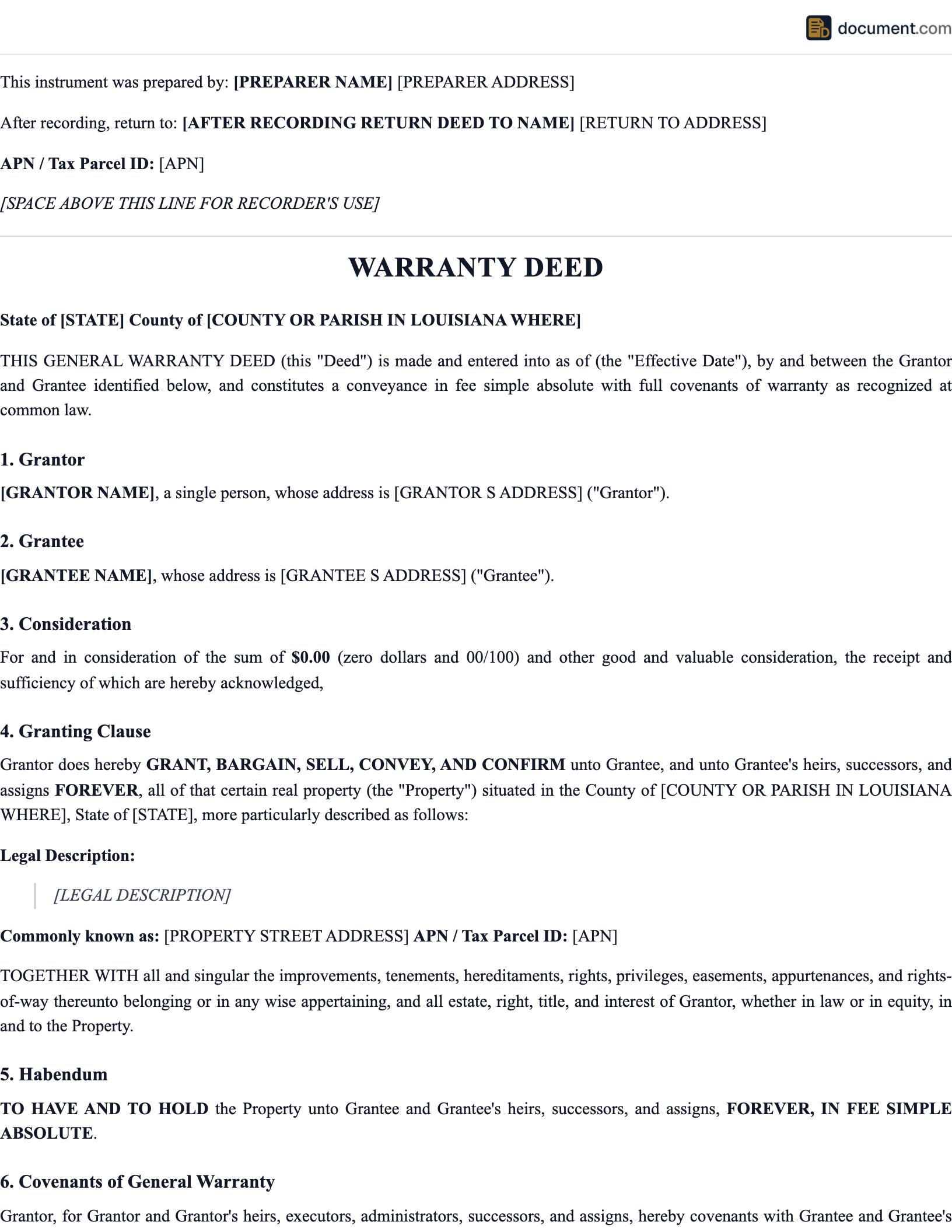
Sample Arkansas Warranty Deed
Preview of our Arkansas-specific template. Your document will include all fields required for recording in any Arkansas county.
WARRANTY DEED (GENERAL WARRANTY DEED)
STATE OF ARKANSAS
Legal Document
PARTY INFORMATION
Name: [Full Legal Name]
Address: [Arkansas Address]
County: [County]
PROPERTY DESCRIPTION
County: [County] State: Arkansas
Legal Description: [Per Recorded Plat]
Parcel No.: [APN]
Arkansas Warranty Deed FAQ
Common questions about filing in Arkansas, including requirements, fees, and tax implications.
Official Arkansas Resources
Official state resources for verifying requirements and finding your local recording office.
Important Considerations
The transfer tax calculation matters in Arkansas. Understating the consideration to reduce the tax is a bad idea; the circuit clerk can challenge the stated amount, and fraud in a tax filing creates legal exposure that far outweighs any small savings. If the transaction is a genuine gift or a below-market family transfer, claim the applicable exemption properly rather than understating value.
Arkansas follows a race-notice recording statute, which means that the first party to record without actual notice of a prior unrecorded conveyance wins the priority dispute. If you receive a deed but delay recording, a later buyer from the same grantor who records first could potentially take priority over you. Record promptly after closing, ideally the same day.
Timber and mineral rights are significant in many parts of Arkansas, particularly in the Ouachita and Ozark regions. In Arkansas, mineral rights can be severed from surface rights and transferred separately. A warranty deed that conveys "all right, title, and interest" may or may not include severed mineral rights depending on the prior conveyance history. Check whether mineral rights have been severed from the parcel before relying on the deed to convey them.
Agricultural land makes up a substantial portion of Arkansas real estate, particularly in the Mississippi Delta region. Agricultural property transfers sometimes involve crop leases, farm program payment rights, or drainage district assessments that do not appear on the deed itself. Buyers of agricultural land should conduct due diligence on these encumbrances before closing.
Arkansas Transfer Tax Note
At $3.30 per $1,000, Arkansas's transfer tax adds meaningful cost to larger transactions. For a $400,000 property, that is $1,320 due at recording. Plan for this cost in your closing budget. If you believe your transfer qualifies for an exemption, gather documentation before going to the circuit clerk, as the clerk may ask for supporting information before waiving the tax.
Related Documents
Depending on your situation, you may need additional documents alongside this one. Below are commonly related documents that are frequently used together in real estate transactions.
Important Considerations
The transfer tax calculation in Arkansas must be done correctly before you arrive at the circuit clerk's office. Showing up with the wrong amount means a delay while you sort out payment, and in some counties the clerk will simply return the document unfiled. Calculate $3.30 per $1,000 of consideration, round up to the nearest dollar, and have that amount ready along with the recording fee.
Mineral and timber rights are severable in Arkansas and are commonly severed from surface rights in many parts of the state. A deed that conveys the surface estate may not convey mineral rights if those rights were reserved by a prior grantor. Before signing a warranty deed that guarantees title to "all right, title, and interest," confirm through a title search whether mineral or timber rights remain with the property or have been separately conveyed.
Arkansas follows a race-notice recording statute. Filing the deed promptly after execution is not just administrative housekeeping. A subsequent purchaser who records before you and without actual knowledge of your earlier deed can take priority. For any transaction where immediate recording is not possible on closing day, take steps to ensure the deed is filed as soon as physically practicable.
Some Arkansas circuit clerk offices still operate more traditionally and may not offer online deed searches or e-recording. Call your county's circuit clerk before assuming you can file electronically or look up prior deeds online. For rural counties, an in-person visit to the clerk's office or a local title attorney familiar with the county's records is often the most reliable approach.
Arkansas Transfer Tax Note
If you believe your transfer qualifies for a transfer tax exemption, document the basis on the face of the deed and be prepared to explain it to the circuit clerk. Common exemptions include transfers between spouses, transfers to revocable living trusts where the grantor retains beneficial interest, and transfers that are part of a corporate reorganization where beneficial ownership does not change. The clerk has authority to question an exemption claim, so having clear documentation supports a smoother filing.
Related Documents
Depending on your situation, you may need additional documents alongside this one. Below are commonly related documents that are frequently used together in real estate transactions.
Create your Arkansas Warranty Deed in under 5 minutes.
Answer a few questions and download a Arkansas-compliant document, ready for the state agency.