



Arizona Warranty Deed Overview
Arizona is a community property state with no real estate transfer tax at any level of government, making it one of the cleaner states for deed transactions from a cost and complexity standpoint. Warranty deeds are recorded at the county recorder's office in the county where the property is located. Arizona has fifteen counties, and all of them accept e-recording, which has become the standard method for title companies and attorneys handling residential closings.
Because Arizona is community property, both spouses must typically sign any deed conveying community property, even if title is held in only one name. This is a critical point that catches people off guard. Recording fees run around $30, notarization by an Arizona notary is required, and no witnesses beyond the notary are needed. The county recorder indexes recorded deeds by both grantor/grantee name and by the assessor's parcel number, making it straightforward to search title after recording.
$30
Recording fee
None
Transfer tax
Required
Notarization
0
Witnesses required
Arizona Requirements
Arizona county recorders apply technical standards for document formatting. Pages must meet minimum margin requirements, text must be legible, and the acknowledgment block must be properly completed. Most importantly for Arizona, the community property status of the grantor matters for whether one or two signatures are needed.
Arizona Specific Note
Arizona prohibits real estate transfer taxes at both the state and local level under A.R.S. 11-1134, so you will not face the per-thousand-dollar charges common in other states. Recording fees start at approximately $30. Arizona is a community property state, meaning both spouses must sign if the property being conveyed is community property, regardless of whose name appears on the title. Confirm with your county recorder whether e-recording is available, as it is standard in Maricopa, Pima, and most other counties.
Document Requirements
- Notarization: Must be notarized by an Arizona notary public or authorized notary
- Witnesses: Arizona requires 0 additional witness(es)
- Legal Description: Complete legal description as it appears on the current deed of record
- Parcel Number: Assessor's parcel number or tax ID
- Return Address: Mailing address for returning the recorded document
- Formatting: Standard formatting with adequate margins, black ink, minimum 10-point font
How to File in Arizona
Arizona's process is clean compared to many states, with no transfer tax to calculate, no witnesses required, and county recorders that accept electronic filings from most locations in the country.
Prepare the Document
Complete all fields: grantor and grantee names exactly as they appear on title, the full legal description from the recorded deed (not the abbreviated assessor description), the assessor's parcel number, consideration amount, and the preparer's name and address as required by A.R.S. 11-480. Confirm whether both spouses need to sign based on the property's community or separate characterization.
Get the Document Notarized
The grantor(s) sign in front of an Arizona notary public, who completes the acknowledgment block. No additional witnesses are required. Arizona allows remote online notarization, which is useful if parties are out of state at the time of signing.
Submit to the County Recorder
File with the county recorder's office in the county where the property sits. Maricopa, Pima, and most other Arizona counties accept e-recording through approved vendors. In-person and mail filings are also accepted. E-recording provides a digital confirmation of receipt and recording date, which is useful for establishing priority.
Pay the Recording Fee
Expect approximately $30 for a standard warranty deed. Arizona charges no transfer tax at any level, so no additional per-thousand calculation is required. Confirm the exact current fee with the county recorder before filing, as fees can change.
Update the County Assessor
Notify the county assessor of the ownership change so that property tax bills are directed to the new owner. If the property will be the new owner's primary residence, file for the owner-occupied classification, which carries a lower assessment ratio under Arizona's property tax system, typically 10% of full cash value versus 18% for non-owner-occupied residential.
Arizona Fees & Costs
Typical costs for filing in Arizona. Actual fees may vary by county.
| Fee / Tax | Amount |
|---|---|
| Recording Fee | $30 |
| Transfer Tax | None |
| Notarization | $5 - $25 per signature |
| Certified Copy | $1 - $10 per page |
| Attorney Review (optional) | $150 - $500 |
Arizona Tax Implications
Arizona has no real estate transfer tax at the state or local level, a deliberate policy choice reinforced by statute. This distinguishes Arizona from California, where documentary transfer taxes can add thousands of dollars to a closing. What you pay in Arizona is essentially the recording fee and any professional fees for title, escrow, or legal services.
For gift transfers or transfers between family members at below-market consideration, federal gift tax rules apply. The grantor may need to file IRS Form 709 if the value of the transfer exceeds the annual exclusion. The recipient acquires the grantor's original cost basis rather than the current fair market value, which creates a deferred capital gains liability. Arizona does not have a state gift tax or an inheritance tax, so those federal rules are the only layer to plan around.
Arizona classifies residential property for property tax purposes based on owner-occupancy. Owner-occupied homes are assessed at 10% of full cash value, while non-owner-occupied residential properties are assessed at 18%. A change in ownership can affect this classification. New owners who plan to occupy the property as their primary residence should file the appropriate documentation with the county assessor after recording to secure the lower assessment ratio and any available exemptions.
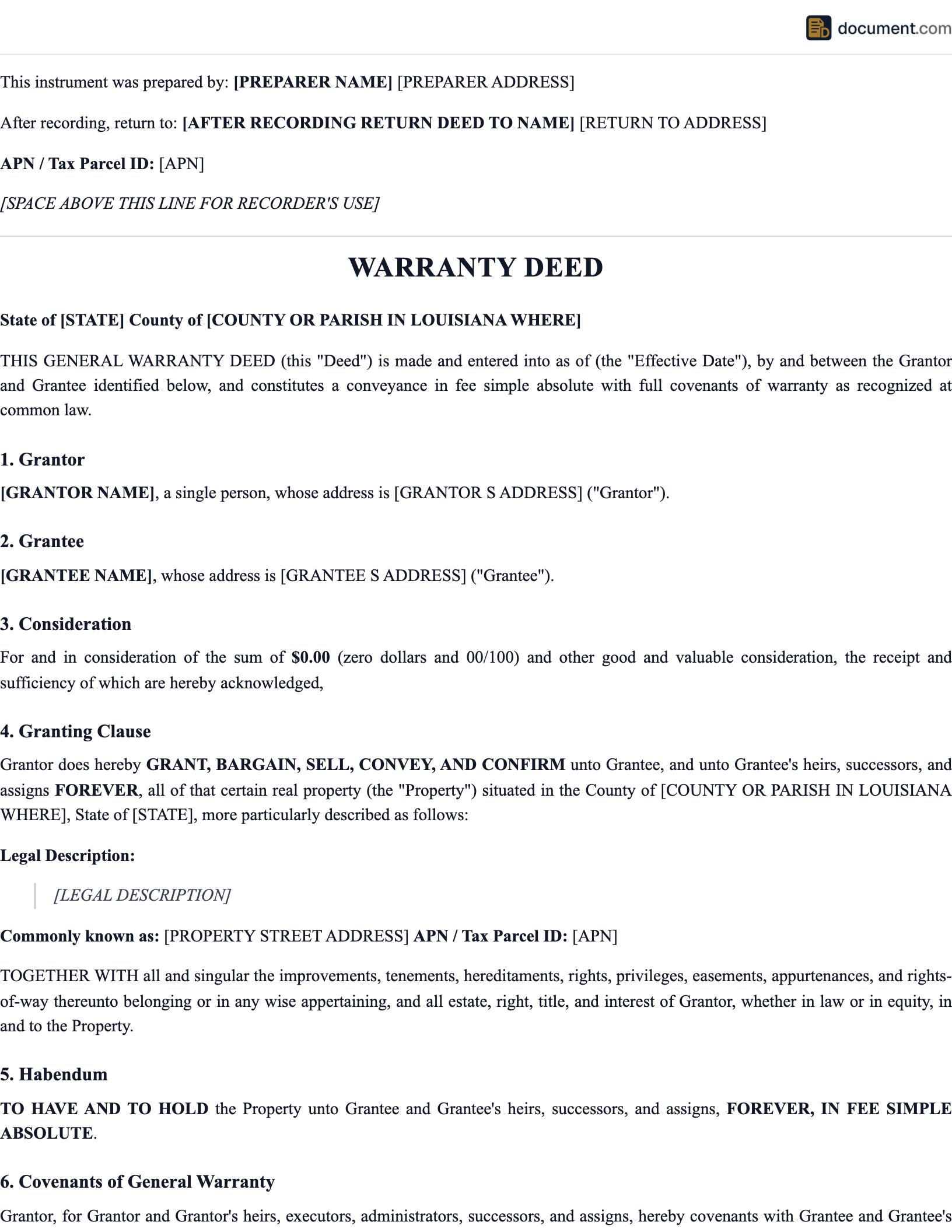
Sample Arizona Warranty Deed
Preview of our Arizona-specific template. Your document will include all fields required for recording in any Arizona county.
WARRANTY DEED (GENERAL WARRANTY DEED)
STATE OF ARIZONA
Legal Document
PARTY INFORMATION
Name: [Full Legal Name]
Address: [Arizona Address]
County: [County]
PROPERTY DESCRIPTION
County: [County] State: Arizona
Legal Description: [Per Recorded Plat]
Parcel No.: [APN]
Arizona Warranty Deed FAQ
Common questions about filing in Arizona, including requirements, fees, and tax implications.
Official Arizona Resources
Official state resources for verifying requirements and finding your local recording office.
Important Considerations
Community property is the single most important concept for Arizona deed transactions. When a married couple acquires property during marriage, both spouses own it equally as community property under Arizona law. That means both spouses must sign the deed to convey clear title, even if only one name appears on the vesting. A deed signed by one spouse may not fully release the other spouse's community property interest, creating a title defect that will surface at the next closing.
Arizona also recognizes community property with right of survivorship, a vesting option that combines the tax advantages of community property with the probate-avoiding benefit of survivorship. If a married couple holds title this way, the deed must convey both spouses' interests to be effective. Review the current vesting language on the existing deed before preparing the new deed.
Planned communities and HOAs are widespread in Arizona, particularly in the Phoenix and Tucson metro areas. Many HOAs require sellers to pay outstanding assessments before transfer, and some have right-of-first-refusal clauses that could affect the transaction. Check the CC&Rs and confirm with the HOA whether there are any holds or outstanding amounts before recording the deed.
Water rights in Arizona are a separate and serious matter. Arizona follows the prior appropriation doctrine for surface water and has a complex groundwater rights framework under the Groundwater Management Act. Water rights do not automatically transfer with the land in all cases. If the property has appurtenant water rights, those rights should be explicitly addressed in the deed or in a separate water rights assignment.
Arizona Community Property Note
Arizona's community property rules mean that getting one spouse's signature when both are required is a genuine title defect, not a minor technicality. If you are at all uncertain about whether the property is community or separate property, an Arizona real estate attorney can review the acquisition history and advise on whose signature is required before you execute the deed.
Related Documents
Depending on your situation, you may need additional documents alongside this one. Below are commonly related documents that are frequently used together in real estate transactions.
Important Considerations
Community property is the dominant consideration for married Arizona property owners. Both spouses must sign a deed conveying community property. If you are not certain whether the property is community or separate, look at how the property was acquired and how title is currently held. Separate property conveyed by only one spouse does not require the other's signature, but getting it wrong is a serious title defect.
Water rights are critically important in Arizona and do not transfer automatically with the land in all situations. The state has one of the most complex water law regimes in the country, governing both surface water through prior appropriation and groundwater through the Groundwater Management Act. Properties in active management areas have additional water rights restrictions. Verify whether the property includes any appurtenant water rights and ensure those rights are properly addressed in the deed or through a separate written assignment.
HOA encumbrances are extremely common in Arizona, particularly in Maricopa County's planned communities. CC&Rs run with the land and bind subsequent owners whether or not they are mentioned in the deed. Before recording, confirm whether the property is subject to HOA governing documents, whether any outstanding assessments exist, and whether the HOA has a right of first refusal or approval right over transfers.
The preparer's name and address requirement under A.R.S. 11-480 is sometimes overlooked on self-prepared deeds. Many county recorders will flag a deed that omits this information. Include the preparer's name and address either in a designated block on the face of the deed or at the end of the document, before the signature and notarization.
Arizona Community Property Note
Before executing any Arizona warranty deed involving a married grantor, confirm whether the property is community or separate property. An Arizona real estate attorney can review the acquisition history and title vesting to answer this question definitively. Getting one signature when two are required is a title defect that survives the deed and will surface at every subsequent transfer.
Related Documents
Depending on your situation, you may need additional documents alongside this one. Below are commonly related documents that are frequently used together in real estate transactions.
Create your Arizona Warranty Deed in under 5 minutes.
Answer a few questions and download a Arizona-compliant document, ready for the state agency.