



Alabama Warranty Deed Overview
Alabama handles real property recording through its county probate courts, a structure that distinguishes it from most other states. When you convey property using a warranty deed here, you file with the probate judge's office in the county where the land is located, not a recorder's office or circuit clerk. The probate court assigns a book and page number, and that recorded instrument becomes the official public record of the transfer.
One practical advantage of recording in Alabama is the absence of a state transfer tax on most residential deeds. Recording fees start at roughly $13 and do not climb steeply with page count. Notarization by an Alabama notary is required; no witnesses beyond the notary are necessary. The warranty deed is the strongest conveyance instrument available in the state, as the grantor covenants to defend title against all claims, past and future, which makes it the standard choice for arm's-length sales.
$13
Recording fee
None
Transfer tax
Required
Notarization
0
Witnesses required
Alabama Requirements
Alabama probate courts are particular about document formatting and notarization. A deed that arrives with a defective acknowledgment block, missing return address, or illegible print will be returned unfiled. Getting the execution right the first time saves the delay of re-signing and re-notarizing, especially if the grantor has already relocated or is difficult to reach.
Alabama Specific Note
Alabama does not impose a state real estate transfer tax on most deed recordings, which keeps closing costs lower than in many neighboring states. Recording fees begin at approximately $13 per instrument. Confirm the exact fee schedule with your county probate court before filing, as some counties charge additional administrative fees. The grantor must sign before a currently commissioned Alabama notary public, no additional witnesses are required.
Document Requirements
- Notarization: Must be notarized by an Alabama notary public or authorized notary
- Witnesses: Alabama requires 0 additional witness(es)
- Legal Description: Complete legal description as it appears on the current deed of record
- Parcel Number: Assessor's parcel number or tax ID
- Return Address: Mailing address for returning the recorded document
- Formatting: Standard formatting with adequate margins, black ink, minimum 10-point font
How to File in Alabama
Alabama's process is straightforward once you know which office to visit. The probate court is your destination for recording, not a separate recorder's office.
Prepare the Document
Pull the legal description verbatim from the current recorded deed, not the tax bill or survey. Confirm the grantor's name matches exactly how it appears on the title. Fill in all party names, addresses, the parcel ID number, and the consideration amount.
Get the Document Notarized
The grantor signs in front of an Alabama notary public who completes the acknowledgment. Bring a government-issued photo ID. Alabama does not require witnesses beyond the notary, so execution can be quick. Do not sign the deed before appearing before the notary.
File at the County Probate Court
Take the executed deed to the probate court in the county where the property is situated. Some courts accept documents by mail or through e-recording platforms. Bring the original; certified copies can be ordered after recording if needed.
Pay the Recording Fee
The base recording fee is approximately $13. Alabama charges no state transfer tax on most residential deed transfers, so you will not face the per-thousand tax common in other states. Confirm the exact fee by calling the probate court before you go.
Notify the County Tax Assessor
After recording, notify the county tax assessor's office of the ownership change so property tax bills are directed to the new owner. Alabama property taxes are reassessed periodically, and the assessor needs the updated ownership information on file before the next assessment cycle.
Alabama Fees & Costs
Typical costs for filing in Alabama. Actual fees may vary by county.
| Fee / Tax | Amount |
|---|---|
| Recording Fee | $13 |
| Transfer Tax | None |
| Notarization | $5 - $25 per signature |
| Certified Copy | $1 - $10 per page |
| Attorney Review (optional) | $150 - $500 |
Alabama Tax Implications
Alabama is one of the few states with no state-level real estate transfer tax on deed recordings, which keeps transaction costs lower than in states like Arkansas or Tennessee. The state abolished its documentary stamp tax years ago, so what you pay at the probate court counter is essentially an administrative recording fee, not a tax on the value being transferred.
Federal tax considerations still apply. If the deed transfers property as a gift rather than an arm's-length sale, the IRS gift tax rules come into play. Transfers exceeding the annual exclusion amount may require the grantor to file IRS Form 709. The recipient of a gifted property inherits the grantor's original cost basis, which can create a significant capital gains tax exposure if the property has appreciated and the recipient later sells.
Alabama property taxes are administered at the county level. An ownership change can prompt a reassessment, though Alabama's overall property tax rates are among the lowest in the country. New owners should file a homestead exemption application with the county assessor if the property will serve as their primary residence, as this can meaningfully reduce the assessed value subject to taxation.
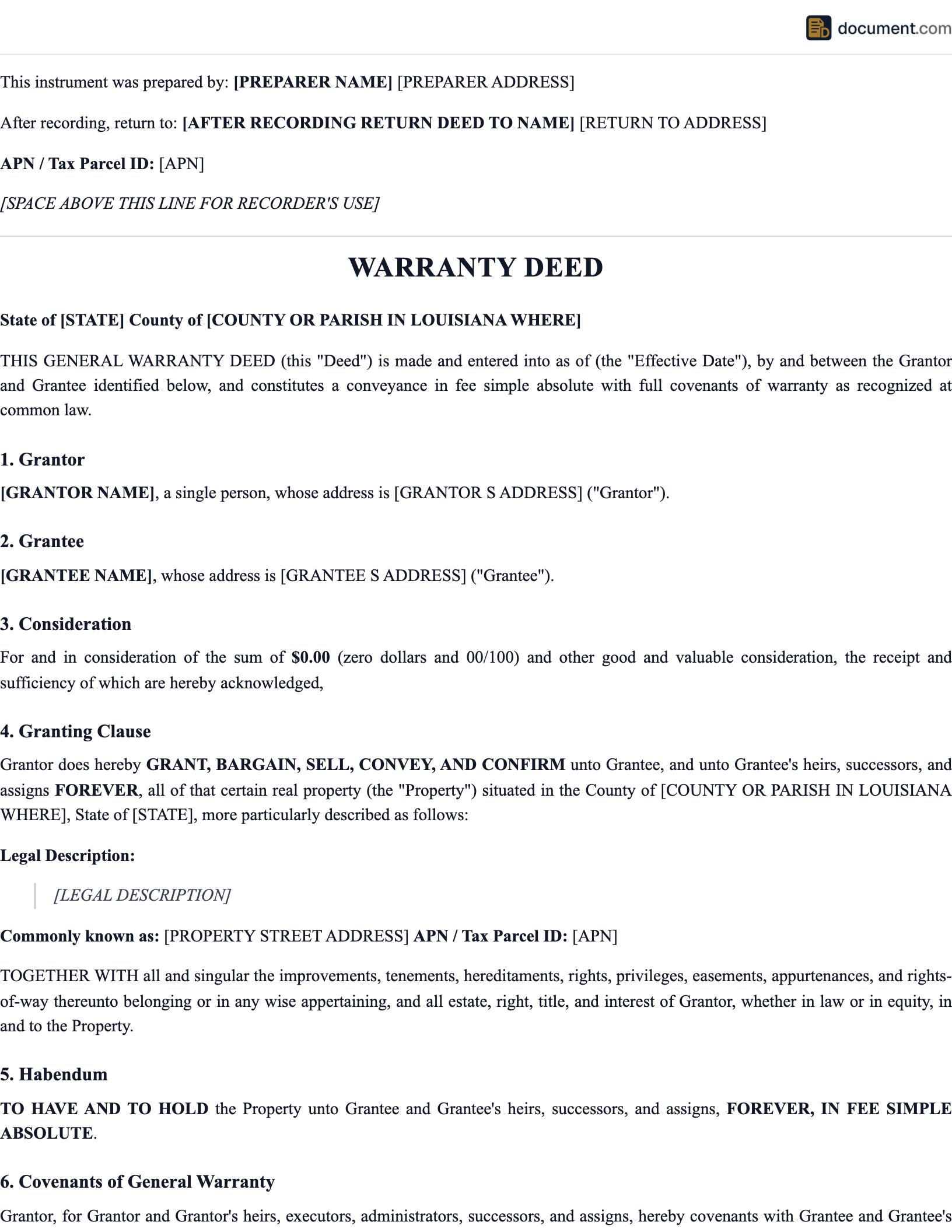
Sample Alabama Warranty Deed
Preview of our Alabama-specific template. Your document will include all fields required for recording in any Alabama county.
WARRANTY DEED (GENERAL WARRANTY DEED)
STATE OF ALABAMA
Legal Document
PARTY INFORMATION
Name: [Full Legal Name]
Address: [Alabama Address]
County: [County]
PROPERTY DESCRIPTION
County: [County] State: Alabama
Legal Description: [Per Recorded Plat]
Parcel No.: [APN]
Alabama Warranty Deed FAQ
Common questions about filing in Alabama, including requirements, fees, and tax implications.
Official Alabama Resources
Official state resources for verifying requirements and finding your local recording office.
Important Considerations
Alabama uses county probate courts exclusively for real property recording, which surprises people accustomed to recorder's offices or clerks of court. Before you file, confirm your specific county's hours and accepted payment methods. Some probate courts are cash-only; others accept checks or credit cards. A rejected document means a return trip.
The warranty deed is the most legally binding deed form in Alabama. When a grantor signs a general warranty deed, they are personally guaranteeing that the title is clean going back to the original grant, not just to when they acquired the property. Sellers of distressed properties, estates, or properties with a complicated ownership history sometimes prefer a quitclaim deed precisely to avoid that lifetime guarantee. Know which deed type fits your situation before you execute anything.
Married grantors need to pay attention to Alabama's marital property rules. If the property is a homestead, both spouses may need to sign the deed regardless of how title is held, to properly release any homestead rights. Failing to get the non-titled spouse's signature can cloud the title and create problems at the next closing.
Request a certified copy of the recorded deed from the probate court once recording is confirmed. Store it with your other important property documents. The probate court's records are public and searchable, but having your own certified copy means you can respond quickly if a title question ever arises without waiting for the court to pull records.
Alabama Attorney Note
Alabama's warranty deed commits the grantor to defend title against all claims, including those that predate their ownership. For high-value properties, estate transfers, or any parcel with a complex chain of title, having an Alabama real estate attorney conduct a title search and review the deed before execution is a sound investment. Many attorneys charge a flat fee for deed review, and that cost is minimal relative to the value being conveyed.
Related Documents
Depending on your situation, you may need additional documents alongside this one. Below are commonly related documents that are frequently used together in real estate transactions.
Important Considerations
Alabama probate courts are exclusively the right venue for recording warranty deeds, not a recorder's office, circuit clerk, or secretary of state. Filing in the wrong office will not provide constructive notice, and the transaction will effectively be unrecorded from a legal notice standpoint until the deed is filed in the correct probate court.
Spousal signature requirements in Alabama deserve attention for homestead property. The Alabama Constitution provides homestead protections that require both spouses to sign a deed conveying homestead property, even if only one spouse holds title. A deed signed by only one spouse that purports to convey homestead property may be voidable, creating a title defect that the title company or the next buyer's attorney will flag.
Alabama's warranty deed provides the grantor's personal guarantee of title. Sellers who are uncertain about the property's title history, including estates where the decedent's records are incomplete or heirs are numerous, sometimes elect a special warranty or quitclaim deed to limit their exposure. The type of deed matters not just at the current closing but at every future transfer.
Request a certified copy of the deed once it is recorded and filed. Store it with your mortgage documents, insurance policies, and other property records. If you need to prove ownership quickly for a refinance, estate proceeding, or dispute, having the recorded copy readily accessible saves time.
Alabama Attorney Note
For transactions involving homestead property, multiple heirs, or a title history that includes periods of unclear ownership, consulting an Alabama real estate attorney is worthwhile. Title issues in Alabama can often be resolved before a deed is recorded; they become far more expensive to cure after the fact.
Related Documents
Depending on your situation, you may need additional documents alongside this one. Below are commonly related documents that are frequently used together in real estate transactions.
Create your Alabama Warranty Deed in under 5 minutes.
Answer a few questions and download a Alabama-compliant document, ready for the state agency.