



What Is a State Tax Power of Attorney?
A state tax power of attorney is a form filed directly with a state department of revenue that gives a third party (typically a CPA, enrolled agent, or tax attorney) legal authority to interact with the agency on the taxpayer's behalf. It is narrower than a general financial POA in two respects: it covers only state tax matters, and it is filed with the agency itself rather than recorded with a county clerk or held privately. The authority becomes effective only after the state agency processes the form into its representative database, which adds 5 to 30 days to the engagement timeline depending on the state and submission method.
The legal foundation varies by state but follows a uniform pattern. California Revenue and Taxation Code § 19045 authorizes representation before the Franchise Tax Board. New York Tax Law § 174 authorizes the Department of Taxation and Finance to recognize representatives. Texas Tax Code § 111.022 authorizes the Comptroller to do the same for franchise tax. The agency-specific form (FTB 3520, POA-1, 85-113) implements the statutory authority and defines the scope, duration, and acts authorized. A POA that complies with state requirements binds the agency to recognize the representative for the listed tax types and periods.
Taxpayers most often need a state tax POA at four moments. The first is upon receipt of an audit notice, when the practitioner needs to call the auditor and request the document request list. The second is upon receipt of a notice of assessment, when the practitioner needs to file an administrative protest within the statutory window (60 days in California for FTB protests under R&TC § 19044, 90 days in New York for BCMS protests, 90 days in Texas for Comptroller redeterminations). The third is upon transition to collections, when an installment agreement or offer in compromise is on the table. The fourth is upon a multi-year back-tax problem requiring a coordinated workout across return preparation, transcript review, and assessment review.
The CAF-equivalent at the state level is critical. California maintains its representative records in MyFTB; New York in the Online Services Tax Professional account; Illinois in the MyTax Illinois Tax Professional account; Texas in eSystems. Each system requires the representative to hold a state-issued practitioner identifier (CPA license number, EA enrollment number, attorney bar number) and to register the engagement before transcript access becomes available. The POA filing initiates that linkage; without it, the practitioner cannot access account history, balance details, or notice copies even by phone.
State tax authority does not automatically transfer from federal filings. A taxpayer simultaneously under IRS and state audit must file both Form 2848 and the corresponding state POA. Mixing the two is one of the most common errors in multistate tax representation and routinely causes missed protest deadlines. The federal CAF unit and the state representative database do not communicate; each requires its own filing and its own renewal cycle.
State Form Comparison
The five highest-volume state tax POA forms account for roughly 70 percent of practitioner submissions nationwide. Each carries its own scope, expiration, and submission rules.
California FTB 3520, New York POA-1, and the high-volume forms
California FTB 3520 covers personal income tax, corporation tax, partnership/LLC tax, and limited liability company fee. Sales and use tax requires a separate CDTFA 392 filed with the Department of Tax and Fee Administration. The form expires automatically six years from execution. New York POA-1 covers all 16 enumerated state taxes (income, corporate franchise, sales, withholding, real estate transfer, mortgage recording, MTA surcharge, and others) on a single grid; no automatic expiration. Illinois IL-2848 covers income, withholding, sales and use, and excise taxes; expiration capped at three years. Texas 85-113 covers franchise tax exclusively; remains effective until revoked or the periods are statute-barred. Florida DR-835 covers sales, reemployment, communications services, and corporate income tax; expiration as set by taxpayer.
Acts authorized and revocation procedure across states
All five high-volume forms confer the same default acts: receive confidential information, sign documents related to listed tax periods, represent in audits and appeals, and execute closing agreements. Specific advanced acts (signing returns on the taxpayer's behalf, receiving refund checks) require explicit grant in a separate line. Refund-check authority is rare and never automatic. Revocation procedures track the original filing channel: California uses Form FTB 3535 for partial revocations and accepts a marked-up copy of the original POA otherwise; New York accepts a letter on taxpayer letterhead; Illinois accepts the same; Texas requires a written notice referencing the original POA date.
| State | Form Number | Tax Types |
|---|---|---|
| California | FTB 3520 / CDTFA 392 | Income, sales, franchise |
| New York | POA-1 | Income, sales, corporate |
| Illinois | IL-2848 | Income, withholding |
| Texas | 85-113 | Franchise, sales |
| Florida | DR-835 | Sales, reemployment |
How to File a State Tax POA
The mechanics matter because a defective POA strands the practitioner outside the agency's system at the moment statutory deadlines are running. Work the six steps in order. Allow two to four weeks of processing time between submission and effective representative status; filing earlier in the engagement is strictly better than filing later.
Identify the Correct Form
Visit the state department of revenue website and download the current POA form for your tax type.
Enter Taxpayer Information
Match the name and ID number exactly as they appear on past state tax returns.
List Your Representative
Include full name, firm, address, phone, and credential number.
Specify Scope
Check every applicable tax type and list each tax period separately.
Sign and Date
The taxpayer must sign; business filings require an authorized officer's signature and title.
Submit to the State
File by mail, fax, or online portal according to the state's instructions.
Key Components
Taxpayer Information
Name, address, and state tax ID of the individual or business.
Representative Details
Name, firm, credential (CPA, EA, attorney), and contact information.
Tax Types
Check boxes for income, sales, withholding, franchise, excise, or other state taxes.
Tax Periods
Specific years, quarters, or periods covered by the authorization.
Acts Authorized
Range from receiving notices only to full audit and appeal representation.
Signatures
Taxpayer signature and, in some states, the representative's declaration.
Form Preview
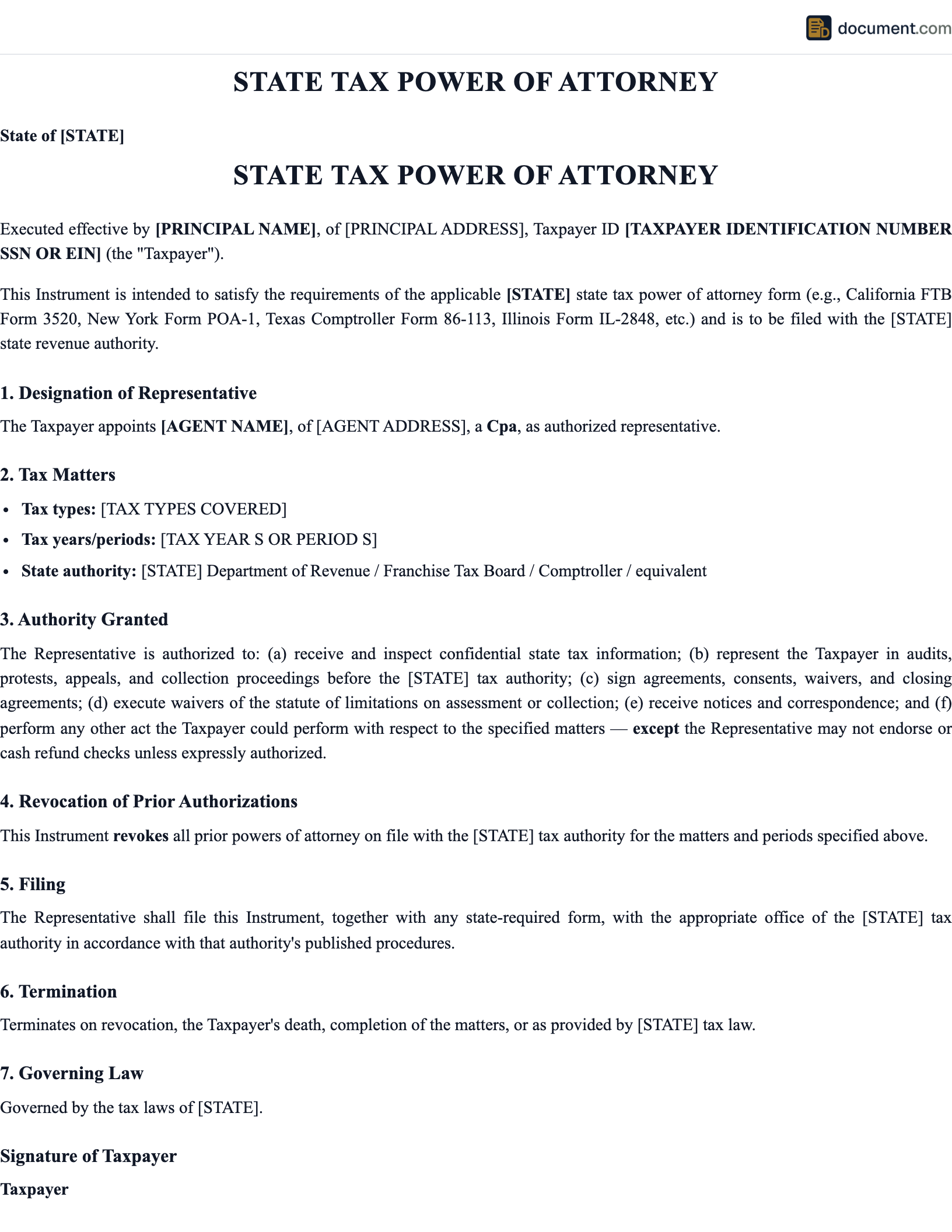
STATE TAX POWER OF ATTORNEY
Taxpayer: [Name] State ID: [#####] Address: [Address]
Representative: [CPA / EA / Attorney Name] Credential #: [Number]
Tax Types: [ ] Individual Income [ ] Sales/Use [ ] Corporate [ ] Withholding [ ] Franchise
Tax Periods: [Year(s) / Quarter(s)]
Acts Authorized: Receive confidential tax information, represent in audits and appeals, execute agreements.
_____________________________ (Taxpayer Signature / Date)
_____________________________ (Representative Declaration / Date)
Frequently Asked Questions
Common questions about state tax POAs, the high-volume agency forms, and the relationship between federal and state authorizations.
Official Resources
Authoritative sources for state tax practitioner authorization across the highest-volume agencies.
File your State Tax POA in under 10 minutes.
Answer a few questions and download a state-specific POA with the tax-type grid and credential block filled in.