



West Virginia Warehouse Lease Overview
West Virginia's industrial warehouse market is modest in scale, concentrated in the Charleston, Huntington, and Morgantown areas, and shaped by the state's historically energy and chemical-dependent economy. The Kanawha Valley around Charleston houses one of the country's most significant chemical manufacturing clusters, creating specialized demand for chemical-compatible warehousing and materials handling. The broader state market serves regional distribution functions for the state's population along the I-64, I-77, and I-79 corridors.
West Virginia has relatively low property taxes compared to northern industrial states, creating modest NNN property tax passthroughs for warehouse tenants. The state's mountainous terrain limits available flat land for large-format industrial development, concentrating industrial supply in river valley locations. The market is small enough that institutional landlords are uncommon, and tenants should ensure standard protective provisions are included even when dealing with smaller local landlords.
$20
Recording fee
$1.10 per $500
Transfer tax
Required
Notarization
0
Witnesses required
West Virginia Requirements
West Virginia warehouse leases are governed by general contract law. The chemical industry context for Kanawha Valley facilities, low property tax environment, and limited flat industrial land are the most important contextual factors for West Virginia warehouse lease negotiations.
West Virginia Specific Note
West Virginia commercial property is assessed at 60% of fair market value by county assessors, creating relatively low property tax obligations compared to northern industrial states. NNN warehouse tenants should still review current county tax bills and three years of history. In the Charleston area, Kanawha County rates apply; other regions have their own county rates. Negotiate a base year and cap on increases for multi-year NNN leases.
Document Requirements
- Physical specifications: Document ceiling height, dock count, floor load rating, and sprinkler specifications as exhibits
- Chemical/hazmat provisions (Kanawha Valley): For chemical-adjacent storage, address hazardous materials handling requirements, spill containment, OSHA compliance, and environmental indemnification explicitly
- Mountain access provisions: Address seasonal road access, weight restrictions on local roads, and any limitations on truck access during winter weather events
- County property tax base year: West Virginia's low assessment ratio creates modest taxes; establish a base year and cap for multi-year NNN terms
- Permitted use: Define industrial use precisely under the applicable city or county zoning code
How to Execute a West Virginia Warehouse Lease
Executing a warehouse lease in West Virginia requires addressing the chemical industry context for Kanawha Valley facilities, understanding the mountainous terrain limitations on truck access, and navigating a small market with limited institutional landlord experience. These steps apply to Charleston, Huntington, and Morgantown market facilities.
Evaluate Site Topography and Truck Access
West Virginia's mountains limit large-format industrial sites to river valleys. Confirm year-round truck access, road grade limitations, and whether winter weather can close access routes to the facility. This is a more significant due diligence item than in flat terrain states.
Review Environmental History for Chemical Areas
For Kanawha Valley facilities, request Phase I environmental assessment results and review proximity to known Superfund and WVDEP cleanup sites. Chemical manufacturing history in the Charleston area has left legacy contamination in specific industrial parcels.
Confirm County Tax Assessment
Obtain the county property tax bill. West Virginia assesses at 60% of market value, creating relatively low NNN tax passthroughs. Confirm the current assessment and negotiate a base year with a cap on increases.
Address Chemical/Hazmat Requirements
For facilities near or serving the chemical manufacturing sector, confirm compliance obligations under OSHA Process Safety Management, West Virginia DHHR, and EPA RMP programs as applicable. Address these in the lease's permitted use and compliance provisions.
Execute and Distribute Copies
Both parties sign. Set up utilities. Store executed originals securely.
West Virginia Fees & Costs
Typical costs for filing in West Virginia. Actual fees may vary by county.
| Fee / Tax | Amount |
|---|---|
| Recording Fee | $20 |
| Transfer Tax | $1.10 per $500 |
| Notarization | $5 - $25 per signature |
| Certified Copy | $1 - $10 per page |
| Attorney Review (optional) | $150 - $500 |
West Virginia Tax Implications
West Virginia imposes a state income tax on wages and business income. The state's Consumers Sales and Service Tax may apply to certain commercial transactions, and its applicability to specific commercial real estate lease arrangements should be confirmed with a West Virginia tax professional. West Virginia also has a Real Property Transfer Tax on certain sales, though a standard commercial lease is generally not subject to this tax.
West Virginia commercial property is assessed at 60% of fair market value by county assessors. This low assessment ratio, combined with moderate county millage rates, creates property tax obligations that are generally lower than in most northeastern and midwestern industrial markets. NNN warehouse tenants are responsible for property tax passthroughs and should review current bills and three years of history before agreeing to NNN terms. Kanawha County and Cabell County rates differ from rural West Virginia counties.
CAM charges in West Virginia warehouse leases typically include parking lot maintenance, landscaping, property management fees, and common area utilities. West Virginia winters create meaningful snow removal costs in the mountain areas and even in valley locations. Request multi-year CAM history before agreeing to NNN terms and negotiate annual reconciliation requirements. Some West Virginia industrial facilities have simplified lease forms that may not include standard CAM reconciliation obligations, so ensure these are addressed explicitly.
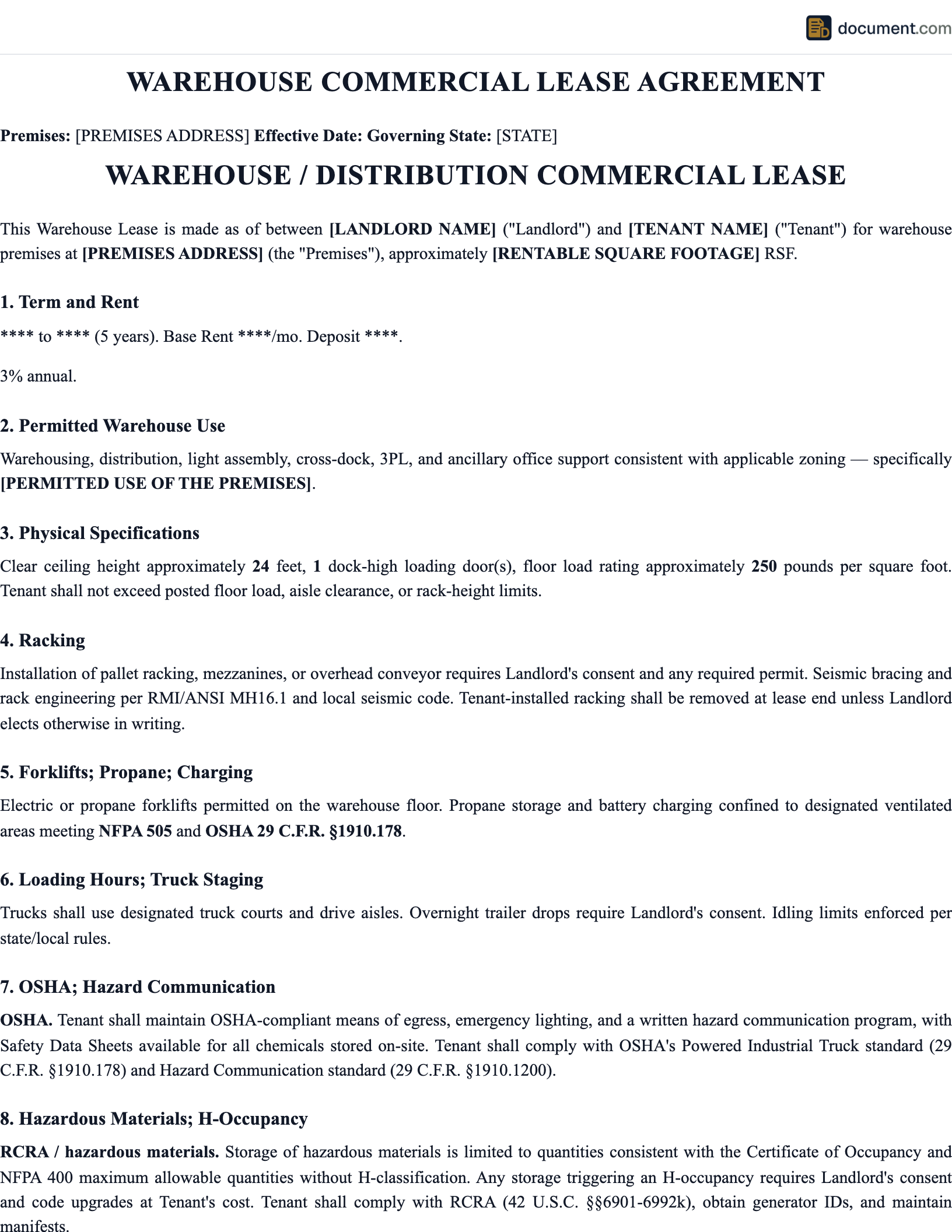
Sample West Virginia Warehouse Lease
Preview of our West Virginia-specific template. Your document will include all fields required for recording in any West Virginia county.
WAREHOUSE LEASE AGREEMENT
STATE OF WEST VIRGINIA
Legal Document
PARTY INFORMATION
Name: [Full Legal Name]
Address: [West Virginia Address]
County: [County]
PROPERTY DESCRIPTION
County: [County] State: West Virginia
Legal Description: [Per Recorded Plat]
Parcel No.: [APN]
West Virginia Warehouse Lease FAQ
Common questions about filing in West Virginia, including requirements, fees, and tax implications.
Official West Virginia Resources
Official state resources for verifying requirements and finding your local recording office.
Important Considerations
West Virginia's chemical manufacturing concentration in the Kanawha Valley creates specific compliance obligations for any tenant handling, storing, or distributing chemical products. OSHA's Process Safety Management standard, the EPA Risk Management Program, and West Virginia DHHR regulations apply to facilities above certain threshold quantities of regulated substances. Before leasing space intended for chemical storage in the Kanawha Valley, confirm the applicable regulatory obligations and ensure they are compatible with your operations.
West Virginia's mountainous terrain severely limits the availability of large-format flat industrial sites. Tenants needing more than 100,000 square feet of modern distribution space will likely find limited options within the state. For operations that can work within West Virginia's available supply, valley-floor sites in Charleston, Huntington, and Morgantown offer the most accessible industrial real estate. Confirm actual available clear height and dock configurations, as older West Virginia industrial buildings may have lower ceiling heights than modern distribution standards require.
West Virginia's energy sector, while declining from historical peaks in coal, continues to include significant natural gas production and processing in the state's northern and eastern counties. The Marcellus and Utica shale formations in northern West Virginia have created demand for equipment storage and materials staging in areas distant from the state's main population centers. Tenants serving the natural gas sector should confirm road access ratings and seasonal access limitations for rural northern West Virginia locations before committing.
West Virginia Market Note
West Virginia's industrial market is best suited for Kanawha Valley chemical sector support, regional distribution for the state's population, and energy sector logistics in specific producing regions. Low property taxes, available valley floor industrial space at modest rents, and limited competition from institutional tenants create a manageable leasing environment for the right user profile. The terrain, environmental legacy in chemical areas, and small market size are the key constraints.
Related Documents
Depending on your situation, you may need additional documents alongside this one. Below are commonly related documents that are frequently used together in real estate transactions.
Important Considerations
Before proceeding with your document, there are several important factors to consider. Each real estate transaction is unique, and understanding the specific requirements and implications of your situation will help ensure a smooth and legally compliant process.
Real estate laws and regulations are subject to change, and local requirements may differ from state-level rules. It is always advisable to verify current requirements with your local recording office before submitting any documents for recording.
If your transaction involves complex circumstances such as multiple parties, commercial properties, trusts, estates, or interstate elements, consulting with a licensed real estate attorney is strongly recommended. An attorney can provide guidance specific to your situation and help you avoid potential legal issues.
Keep copies of all documents related to your real estate transaction in a safe place. Recorded documents become part of the public record, but having your own copies ensures you can reference the terms and conditions at any time. Digital copies stored securely are also recommended as a backup.
Professional Recommendation
While our templates are designed to be comprehensive and legally compliant, we recommend having your completed document reviewed by a licensed attorney before recording, especially for high-value transactions or complex situations. Many attorneys offer flat-fee document review services that provide peace of mind at a reasonable cost.
Related Documents
Depending on your situation, you may need additional documents alongside this one. Below are commonly related documents that are frequently used together in real estate transactions.
Create your West Virginia Commercial Warehouse Lease Agreement in under 5 minutes.
Answer a few questions and download a West Virginia-compliant document, ready for the state agency.