



Washington Warehouse Lease Overview
Washington State's industrial real estate market is anchored by the Seattle-Tacoma Puget Sound region, home to one of the largest container port complexes on the West Coast. The Northwest Seaport Alliance ports at Seattle and Tacoma handle significant Pacific Rim container traffic and generate consistent demand for warehouse and distribution space throughout King, Pierce, and Snohomish counties. Boeing's manufacturing presence creates aerospace supply chain demand, and Amazon's Seattle headquarters and fulfillment network generate e-commerce logistics investment throughout the region.
Washington's Business and Occupation tax on gross receipts creates a distinct tax environment compared to income-tax states, and its application to commercial real estate transactions requires specific analysis. Property taxes are assessed annually at full market value in most counties. Washington's progressive employment regulations, including a high minimum wage and paid leave requirements, add to the total cost of operating warehouse facilities in the state. The Growth Management Act provides industrial land protection from rezoning, which benefits long-term industrial tenants.
$73
Recording fee
1.1%-3%
Transfer tax
Required
Notarization
0
Witnesses required
Washington Requirements
Washington warehouse leases are governed by general contract law. The state's Business and Occupation tax, annual property revaluation, port access considerations, and progressive employment regulations are the most important contextual factors for Washington warehouse lease negotiations.
Washington Specific Note
Washington State's property taxes are assessed annually at full market value by county assessors. King, Pierce, and Snohomish counties have high assessed values in the Puget Sound industrial market, and NNN property tax passthroughs can be substantial. Review the current assessed value and tax bill before agreeing to NNN terms. Washington's annual revaluation means property taxes can increase significantly year over year during periods of industrial real estate appreciation.
Document Requirements
- Physical specifications: Document certified clear height, dock count, floor load rating, and sprinkler specifications as exhibits
- Port access provisions (Tacoma/Seattle): For port-adjacent facilities, address drayage hours, truck route requirements, and any Tideflats or waterway environmental compliance obligations
- Property tax base year: Washington annually revalues at market value; base year and annual cap protections are important in the tight Puget Sound market
- Washington B&O tax allocation: Address how Washington's Business and Occupation tax is treated in the lease if landlord gross receipts from the lease create any B&O obligation
- Employment compliance provisions: Address which party is responsible for compliance with Washington and Seattle employment ordinances affecting warehouse operations
How to Execute a Washington Warehouse Lease
Executing a warehouse lease in Washington State requires understanding the Puget Sound port market, the state's annual property revaluation system, and the Business and Occupation tax implications. These steps apply to Puget Sound area facilities and secondary eastern Washington markets.
Evaluate Port Proximity and Logistics Access
Assess proximity to Port of Seattle or Port of Tacoma terminals, the Kent Valley industrial district, or I-5/SR-167 corridor distribution infrastructure. Port-adjacent space commands a premium; Kent Valley offers logistics access at more moderate costs.
Review Property Tax and Annual Revaluation
Obtain the current King, Pierce, or Snohomish County tax bill and reviewed assessed value. Washington assesses annually at market value. Review three-year history and negotiate a base year with a cap on NNN increases given the active revaluation environment.
Address B&O Tax and Zoning Compliance
Consult a Washington tax professional on B&O and sales tax implications for your specific transaction. Confirm zoning with the applicable city or county. Seattle, Tacoma, Kent, and Auburn have separate codes.
Budget Washington Employment Costs
Model Washington minimum wage, paid sick leave, and paid family and medical leave contribution costs into your total warehouse operating cost before finalizing occupancy cost analysis.
Execute and Distribute Copies
Both parties sign. Set up utilities and Washington state business registrations as required. Store executed originals securely.
Washington Fees & Costs
Typical costs for filing in Washington. Actual fees may vary by county.
| Fee / Tax | Amount |
|---|---|
| Recording Fee | $73 |
| Transfer Tax | 1.1%-3% |
| Notarization | $5 - $25 per signature |
| Certified Copy | $1 - $10 per page |
| Attorney Review (optional) | $150 - $500 |
Washington Tax Implications
Washington State has no state personal or corporate income tax, but imposes a Business and Occupation tax on gross business receipts. The B&O tax rate depends on the business classification and has different implications for landlords and tenants. Washington does impose retail sales tax on certain transactions, and the applicability to commercial real estate lease payments requires specific analysis. Consult a Washington tax professional before executing a long-term commercial lease.
Washington property taxes are assessed annually at full market value by county assessors. King County (Seattle), Pierce County (Tacoma), and Snohomish County (Everett) have different effective rates and all have seen significant assessed value increases following the Pacific Northwest industrial boom. NNN warehouse tenants face potentially significant annual property tax increases in this environment. Negotiate a base year and annual cap on NNN property tax liability before signing.
CAM charges in Washington warehouse leases can be substantial. High property insurance premiums for Puget Sound waterfront locations, parking lot and dock area maintenance for port-traffic facilities, stormwater compliance costs for industrial sites with outdoor storage, and property management fees all contribute. Negotiate annual reconciliation with documentation and audit rights. Address stormwater compliance costs separately if the property requires ongoing permit management.
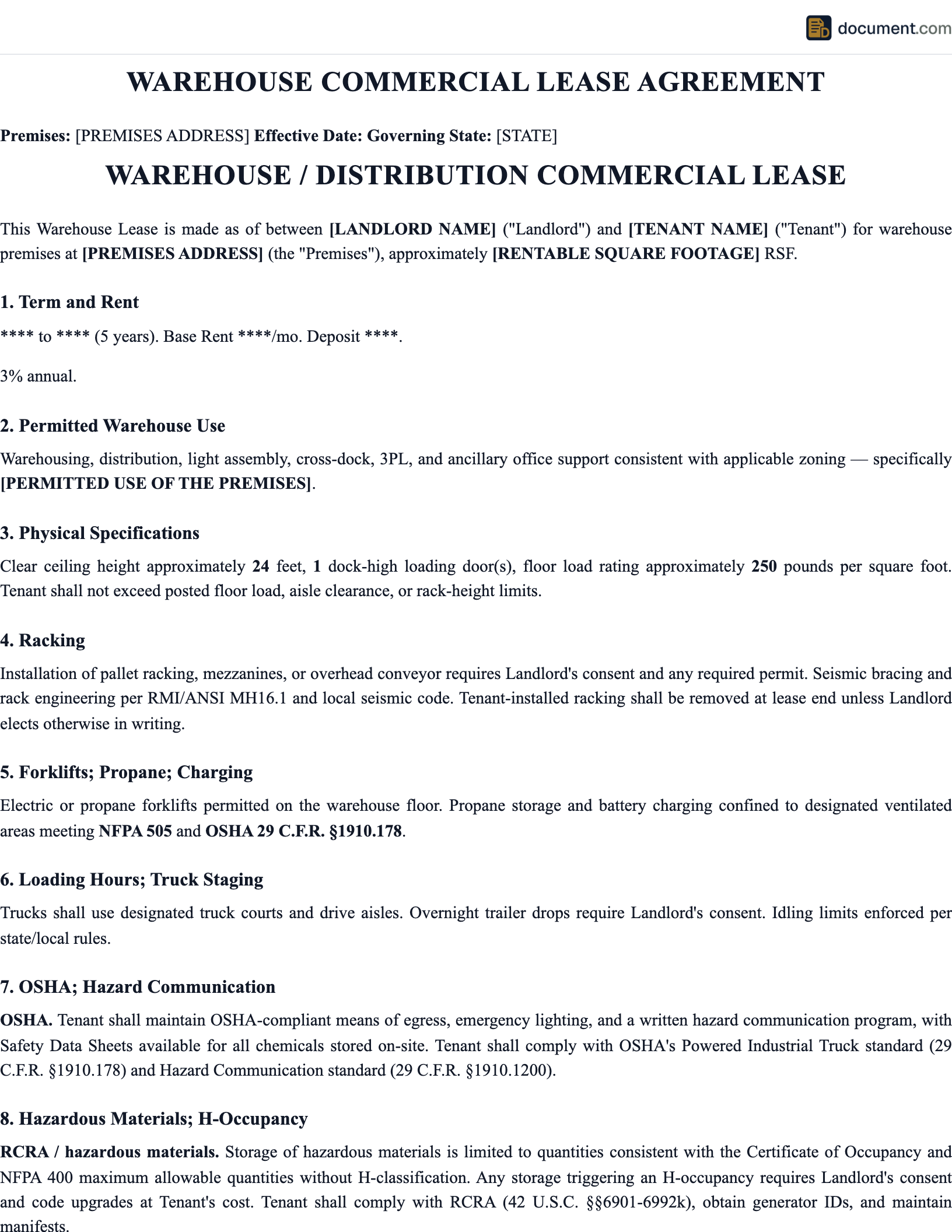
Sample Washington Warehouse Lease
Preview of our Washington-specific template. Your document will include all fields required for recording in any Washington county.
WAREHOUSE LEASE AGREEMENT
STATE OF WASHINGTON
Legal Document
PARTY INFORMATION
Name: [Full Legal Name]
Address: [Washington Address]
County: [County]
PROPERTY DESCRIPTION
County: [County] State: Washington
Legal Description: [Per Recorded Plat]
Parcel No.: [APN]
Washington Warehouse Lease FAQ
Common questions about filing in Washington, including requirements, fees, and tax implications.
Official Washington Resources
Official state resources for verifying requirements and finding your local recording office.
Important Considerations
Washington State's employment regulations create real cost burdens for warehouse operators. Seattle's minimum wage (higher than the state minimum), Washington's paid family and medical leave employer contributions, and the paid sick leave requirements all increase labor costs above what operators from other states typically budget for. For large distribution center operations, model these costs against alternatives in Oregon, Nevada, or Idaho before committing to multi-year Washington leases.
The Duwamish River in Seattle and portions of the Tacoma Tideflats are Superfund cleanup sites with ongoing environmental obligations. Industrial tenants in or near these areas should understand the applicable use restrictions and environmental compliance requirements. The Duwamish cleanup in particular involves multiple responsible parties and ongoing sediment remediation. Confirm with the applicable landlord whether any ongoing cleanup obligations or use restrictions apply to the specific property.
Washington's Growth Management Act requires cities and counties to designate adequate industrial land and protect it from conversion to residential or mixed-use development. This regulatory protection generally benefits long-term industrial tenants by reducing the risk of losing industrial zoning during a lease term. However, it also means that available industrial land within growth boundaries is limited, which constrains new supply and supports high rents in well-located areas.
Washington Market Note
Washington's Pacific Rim port complex, technology sector logistics demand, and strategic Pacific Northwest positioning create genuine industrial advantages. The no-income-tax environment is a significant business attraction. The employment regulation costs, high property values, and annual revaluation environment require careful modeling of full NNN occupancy cost. For Pacific Northwest distribution, Washington's port access and I-5 corridor infrastructure are hard to replicate from alternative Pacific Northwest locations.
Related Documents
Depending on your situation, you may need additional documents alongside this one. Below are commonly related documents that are frequently used together in real estate transactions.
Important Considerations
Before proceeding with your document, there are several important factors to consider. Each real estate transaction is unique, and understanding the specific requirements and implications of your situation will help ensure a smooth and legally compliant process.
Real estate laws and regulations are subject to change, and local requirements may differ from state-level rules. It is always advisable to verify current requirements with your local recording office before submitting any documents for recording.
If your transaction involves complex circumstances such as multiple parties, commercial properties, trusts, estates, or interstate elements, consulting with a licensed real estate attorney is strongly recommended. An attorney can provide guidance specific to your situation and help you avoid potential legal issues.
Keep copies of all documents related to your real estate transaction in a safe place. Recorded documents become part of the public record, but having your own copies ensures you can reference the terms and conditions at any time. Digital copies stored securely are also recommended as a backup.
Professional Recommendation
While our templates are designed to be comprehensive and legally compliant, we recommend having your completed document reviewed by a licensed attorney before recording, especially for high-value transactions or complex situations. Many attorneys offer flat-fee document review services that provide peace of mind at a reasonable cost.
Related Documents
Depending on your situation, you may need additional documents alongside this one. Below are commonly related documents that are frequently used together in real estate transactions.
Create your Washington Commercial Warehouse Lease Agreement in under 5 minutes.
Answer a few questions and download a Washington-compliant document, ready for the state agency.