
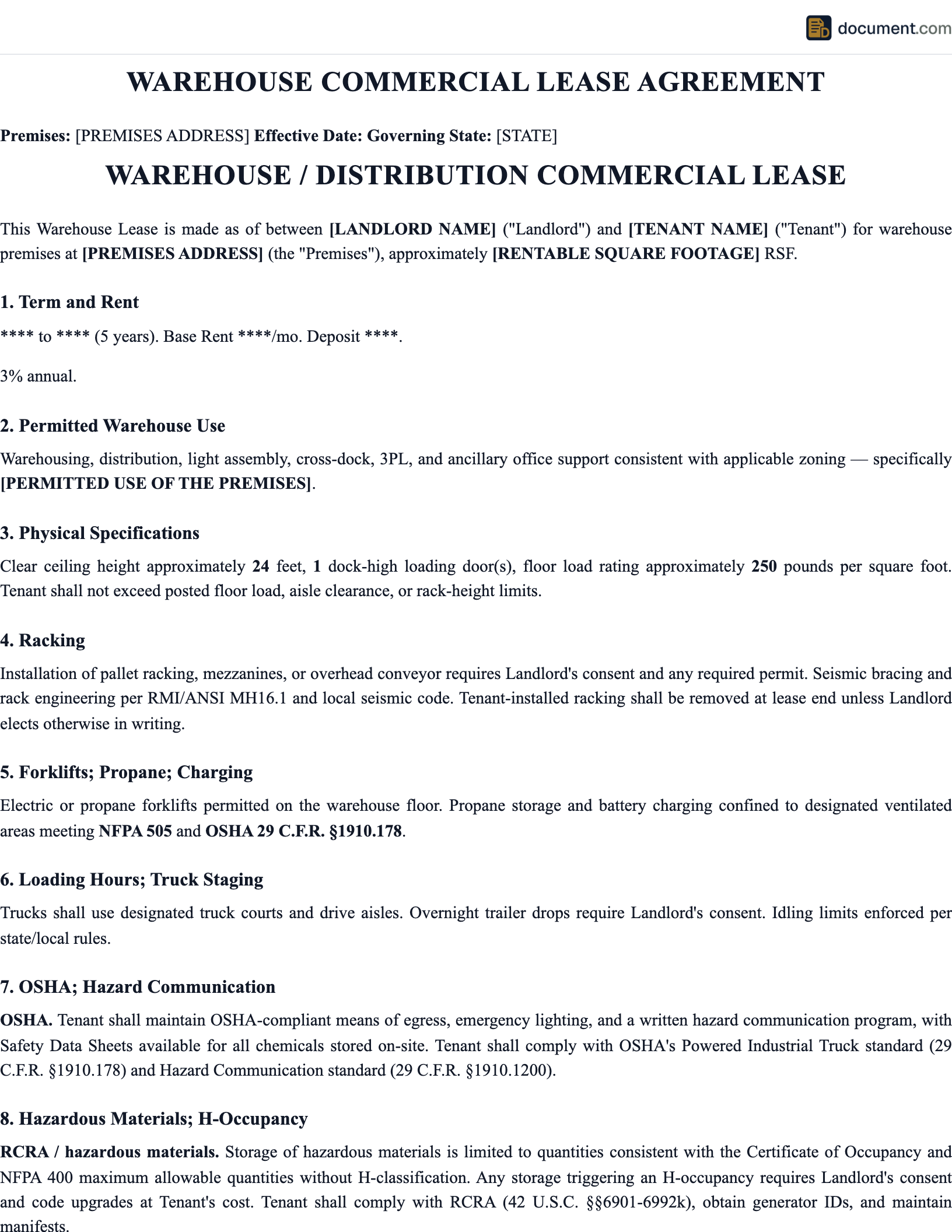



Utah Warehouse Lease Overview
Utah's industrial real estate market has established itself as a major Intermountain West logistics hub, driven by Salt Lake City's position at the I-15, I-80, and I-84 intersection. The Wasatch Front corridor, stretching from Ogden through Salt Lake City to Provo-Orem, has attracted national distribution center investment from e-commerce operators and retailers seeking to serve the western United States from a central mountain location without California costs. Utah's rapidly growing population adds consistent local demand.
Utah's business-friendly tax environment, competitive property taxes, and strong logistics infrastructure have contributed to sustained industrial investment. The state does not impose sales tax on commercial real estate lease payments. Property taxes are assessed at the county level at full market value. The tight vacancy in Class A Salt Lake Valley industrial space reflects the success of the market in attracting national distribution tenants, and renewal options in initial leases are increasingly important.
$15
Recording fee
None
Transfer tax
Required
Notarization
0
Witnesses required
Utah Requirements
Utah warehouse leases are governed by general contract law. No specific industrial lease statute applies. The Wasatch Front air quality considerations, county property tax framework, and the tight Class A market dynamics are the most important contextual factors for Utah warehouse lease negotiations.
Utah Specific Note
Utah property taxes are assessed at 100% of fair market value at the county level. Salt Lake County and Utah County have different effective rates, and the Wasatch Front has multiple separate taxing jurisdictions including city, county, school district, and special district levies. NNN warehouse tenants should review the complete tax bill for all taxing authorities and negotiate a base year with a cap on annual increases for multi-year NNN leases.
Document Requirements
- Physical specifications: Document certified clear height, dock count and type, floor load rating, and sprinkler specifications as exhibits
- County property tax base year: Utah assesses at 100% of fair market value; review complete multi-authority tax bill and negotiate base year protection
- Air quality compliance (if applicable): For diesel cargo handling equipment, confirm compliance with Utah Division of Air Quality requirements and address operational obligations in the lease
- Permitted use: Define industrial use precisely under the applicable city or county zoning classification on the Wasatch Front
- Utah Valley corridor access: For I-15 corridor facilities, address interchange access, truck routes, and any municipality-specific truck regulations
How to Execute a Utah Warehouse Lease
Executing a warehouse lease in Utah requires understanding the Wasatch Front corridor market, Utah's county property tax framework, and air quality considerations for diesel-powered operations. These steps apply to Salt Lake Valley and Utah Valley industrial markets.
Evaluate Wasatch Front Location
Assess whether Salt Lake Valley, Utah Valley, or Davis County north of Salt Lake best fits your logistics needs. Salt Lake City core has the best interstate access; South Jordan and Draper have newer facilities; Utah Valley offers lower rents with similar I-15 access.
Review Property Tax and Multi-Authority Bills
Obtain the current tax bill showing all taxing authority levies (county, city, school district, special districts). Utah assesses at full market value; confirm current valuation. Negotiate a base year and cap on NNN increases.
Confirm Zoning with the Specific Municipality
The Wasatch Front has many separate municipal zoning jurisdictions. Contact the specific city or county planning department. Confirm that your industrial operations are permitted under the applicable zone classification.
Address Air Quality and CAM Provisions
For diesel cargo handling operations, confirm Utah DAQ compliance requirements. Review CAM history for two or more years. Negotiate annual reconciliation and audit rights.
Execute and Distribute Copies
Both parties sign. Set up utilities and any required business registrations with Salt Lake or Utah County. Store executed originals securely.
Utah Fees & Costs
Typical costs for filing in Utah. Actual fees may vary by county.
| Fee / Tax | Amount |
|---|---|
| Recording Fee | $15 |
| Transfer Tax | None |
| Notarization | $5 - $25 per signature |
| Certified Copy | $1 - $10 per page |
| Attorney Review (optional) | $150 - $500 |
Utah Tax Implications
Utah has a state corporate income tax and personal income tax but does not impose sales tax on commercial real estate lease payments. Utah has no real property transfer tax on commercial leases. The overall Utah business tax environment is competitive and has contributed to the state's growth as a western logistics hub.
Property taxes in Utah are assessed at 100% of fair market value by county assessors. The total tax rate includes county, municipal, school district, and any applicable special district levies. Salt Lake County and Utah County have different effective rates. NNN warehouse tenants should review the complete multi-authority tax bill and confirm the current assessed value before agreeing to NNN terms. Negotiate a base year and a cap on annual increases for multi-year leases.
CAM charges in Utah warehouse leases typically include parking lot maintenance, landscaping, property management fees, and common area utilities. Utah winters generate meaningful snow removal costs, particularly for Ogden and Salt Lake City facilities, and CAM history should be reviewed for winter variability. Negotiate annual CAM reconciliation with documentation and an audit right as standard provisions.
Sample Utah Warehouse Lease
Preview of our Utah-specific template. Your document will include all fields required for recording in any Utah county.
WAREHOUSE LEASE AGREEMENT
STATE OF UTAH
Legal Document
PARTY INFORMATION
Name: [Full Legal Name]
Address: [Utah Address]
County: [County]
PROPERTY DESCRIPTION
County: [County] State: Utah
Legal Description: [Per Recorded Plat]
Parcel No.: [APN]
Utah Warehouse Lease FAQ
Common questions about filing in Utah, including requirements, fees, and tax implications.
Official Utah Resources
Official state resources for verifying requirements and finding your local recording office.
Important Considerations
Utah's industrial market has tightened significantly over the past decade as national logistics operators have recognized the Intermountain West distribution advantage of Salt Lake City. Class A vacancy has been very low and new construction, while active, has been absorbed quickly. Tenants seeking large-format modern distribution space should expect a competitive market and should prioritize securing renewal options in initial leases.
Utah's air quality inversions during winter create meaningful air quality restrictions that can affect warehouse and logistics operations with diesel-powered equipment. While Utah's requirements are less stringent than California CARB, diesel forklift and cargo handling operations should confirm Utah Division of Air Quality requirements and budget for compliance. The trend in Utah has been toward increasing air quality regulation, and future tightening of standards could affect operations over a long lease term.
The Utah Valley market south of Salt Lake City in the Provo-Orem-American Fork corridor has grown as an industrial alternative to the more constrained Salt Lake Valley. Major technology employers in Utah Valley have generated demand for tech supply chain warehousing and specialized distribution. The I-15 corridor provides the same national logistics access as Salt Lake Valley at somewhat lower rents and with more development land availability. For tenants whose distribution needs are compatible with Utah Valley, this market deserves comparison to the Salt Lake core.
Utah Market Note
Utah offers western Intermountain distribution positioning with lower costs than California or the Pacific Northwest and a more favorable regulatory environment. Salt Lake City's multi-interstate hub position is genuine, and the state's growth trajectory is creating new consumer demand. The tight Class A market is real, and the property tax base year negotiation is important. Model full NNN occupancy cost before comparing Utah to Nevada or Arizona alternatives for western distribution operations.
Related Documents
Depending on your situation, you may need additional documents alongside this one. Below are commonly related documents that are frequently used together in real estate transactions.
Important Considerations
Before proceeding with your document, there are several important factors to consider. Each real estate transaction is unique, and understanding the specific requirements and implications of your situation will help ensure a smooth and legally compliant process.
Real estate laws and regulations are subject to change, and local requirements may differ from state-level rules. It is always advisable to verify current requirements with your local recording office before submitting any documents for recording.
If your transaction involves complex circumstances such as multiple parties, commercial properties, trusts, estates, or interstate elements, consulting with a licensed real estate attorney is strongly recommended. An attorney can provide guidance specific to your situation and help you avoid potential legal issues.
Keep copies of all documents related to your real estate transaction in a safe place. Recorded documents become part of the public record, but having your own copies ensures you can reference the terms and conditions at any time. Digital copies stored securely are also recommended as a backup.
Professional Recommendation
While our templates are designed to be comprehensive and legally compliant, we recommend having your completed document reviewed by a licensed attorney before recording, especially for high-value transactions or complex situations. Many attorneys offer flat-fee document review services that provide peace of mind at a reasonable cost.
Related Documents
Depending on your situation, you may need additional documents alongside this one. Below are commonly related documents that are frequently used together in real estate transactions.
Create your Utah Commercial Warehouse Lease Agreement in under 5 minutes.
Answer a few questions and download a Utah-compliant document, ready for the state agency.