



Texas Warehouse Lease Overview
Texas has the largest industrial real estate market in the South and one of the largest in the country, spread across four major metros with distinct demand drivers. Dallas-Fort Worth is the dominant market, combining one of the largest intermodal and air cargo platforms in the country with massive e-commerce and retail distribution demand. Houston anchors the Gulf Coast market with the Port of Houston's petroleum and container traffic creating enormous industrial demand across the metro.
Texas has no state income tax and no transfer tax on commercial leases, creating a favorable base tax environment. However, Texas property taxes are among the highest in the nation because the state relies heavily on property taxes in the absence of income taxes. NNN warehouse tenants in Texas face property tax passthroughs that can substantially exceed those in income-tax states. Annual appraisal at market value means that Texas property taxes can increase significantly year over year during periods of rising industrial real estate values.
$16
Recording fee
None
Transfer tax
Required
Notarization
0
Witnesses required
Texas Requirements
Texas warehouse leases are governed by general contract law. No specific industrial lease statute applies, but Texas's high property taxes, Houston's lack of formal zoning, and the NAFTA corridor logistics dynamics create provisions that must be carefully addressed in any Texas warehouse lease.
Texas Specific Note
Texas property taxes are very high by national standards because the state has no income tax and relies heavily on property taxes. Texas appraisal districts value property annually at market value. NNN warehouse tenants should review the current appraisal district valuation and tax bill for all taxing authorities (county, city, school district, MUD or PUD if applicable) and negotiate a base year with a cap on annual NNN increases before signing any multi-year Texas NNN lease.
Document Requirements
- Physical specifications: State certified clear height, dock count and type, floor load rating, and ESFR sprinkler rating as exhibits
- Property tax base year and cap: Texas property taxes are high and assessed annually at market value; base year and annual cap protections are critical for NNN tenants
- Houston deed restrictions (if applicable): For Houston-area facilities without formal zoning, confirm deed restrictions and any MUD/PUD requirements affecting permitted operations
- NAFTA operations (I-35 corridor): For San Antonio and Laredo-area facilities, address US Customs compliance requirements and cross-border logistics operational provisions
- Energy sector provisions (Houston/Eagle Ford): For energy equipment or chemical storage, address hazmat compliance, outdoor storage rights, and environmental indemnification
How to Execute a Texas Warehouse Lease
Executing a warehouse lease in Texas requires addressing the state's high annual property taxes, understanding the specific market dynamics of DFW, Houston, San Antonio, or Austin, and navigating Houston's deed restriction framework. These steps apply across Texas's major industrial markets.
Identify the Texas Market
DFW offers maximum national distribution reach via air, rail, and interstate; Houston serves the Gulf Coast and energy sector; San Antonio serves the NAFTA corridor and Mexico trade; Austin serves tech and semiconductor supply chains. Match your logistics function to the right market.
Review Property Tax Appraisal and History
Obtain the current appraisal district valuation and the multi-authority tax bill (county, city, school district, any MUD/PUD). Texas appraises annually at market value and taxes can increase significantly. A base year protection and annual cap are non-negotiable provisions in any Texas NNN lease.
Address Zoning or Deed Restrictions
For Houston-area facilities, confirm deed restrictions and any utility district (MUD/PUD) requirements affecting your operations. For DFW, San Antonio, and Austin, confirm the applicable industrial zoning classification and permitted use.
Negotiate NNN Terms with Full Tax Stack Visible
Review CAM history for two or more years. Understand the full tax authority stack for the parcel. Negotiate base year, annual cap, and CAM reconciliation requirements before signing.
Execute and Distribute Copies
Both parties sign the fully negotiated lease. Set up Texas state and local tax registrations as required. Store executed originals securely.
Texas Fees & Costs
Typical costs for filing in Texas. Actual fees may vary by county.
| Fee / Tax | Amount |
|---|---|
| Recording Fee | $16 |
| Transfer Tax | None |
| Notarization | $5 - $25 per signature |
| Certified Copy | $1 - $10 per page |
| Attorney Review (optional) | $150 - $500 |
Texas Tax Implications
Texas has no state personal income tax and no corporate income tax, creating a tax-friendly baseline for business operations. Texas does impose a Franchise Tax (margin tax) on business gross revenue above certain thresholds, though cost of goods sold and compensation deductions reduce effective rates for many warehouse and distribution operations. There is no documentary transfer tax on commercial lease transactions.
Texas property taxes are among the highest in the country. County appraisal districts value commercial real estate annually at market value, and the total tax rate includes county, city or town, school district, and any applicable municipal utility district levies. NNN warehouse tenants pay these taxes as a passthrough, and the annual market-value appraisal requirement means that taxes can increase significantly during periods of rising industrial real estate values. A base year protection and annual cap are essential NNN provisions in any Texas industrial lease.
CAM charges in Texas warehouse leases typically include parking lot and truck court maintenance, landscaping, property management fees, and common area utilities. Texas summers create significant HVAC costs for shared building systems. Houston-area facilities may include specialized environmental compliance costs for properties near the Ship Channel. Negotiate annual CAM reconciliation and audit rights as standard provisions for any Texas NNN lease.
Sample Texas Warehouse Lease
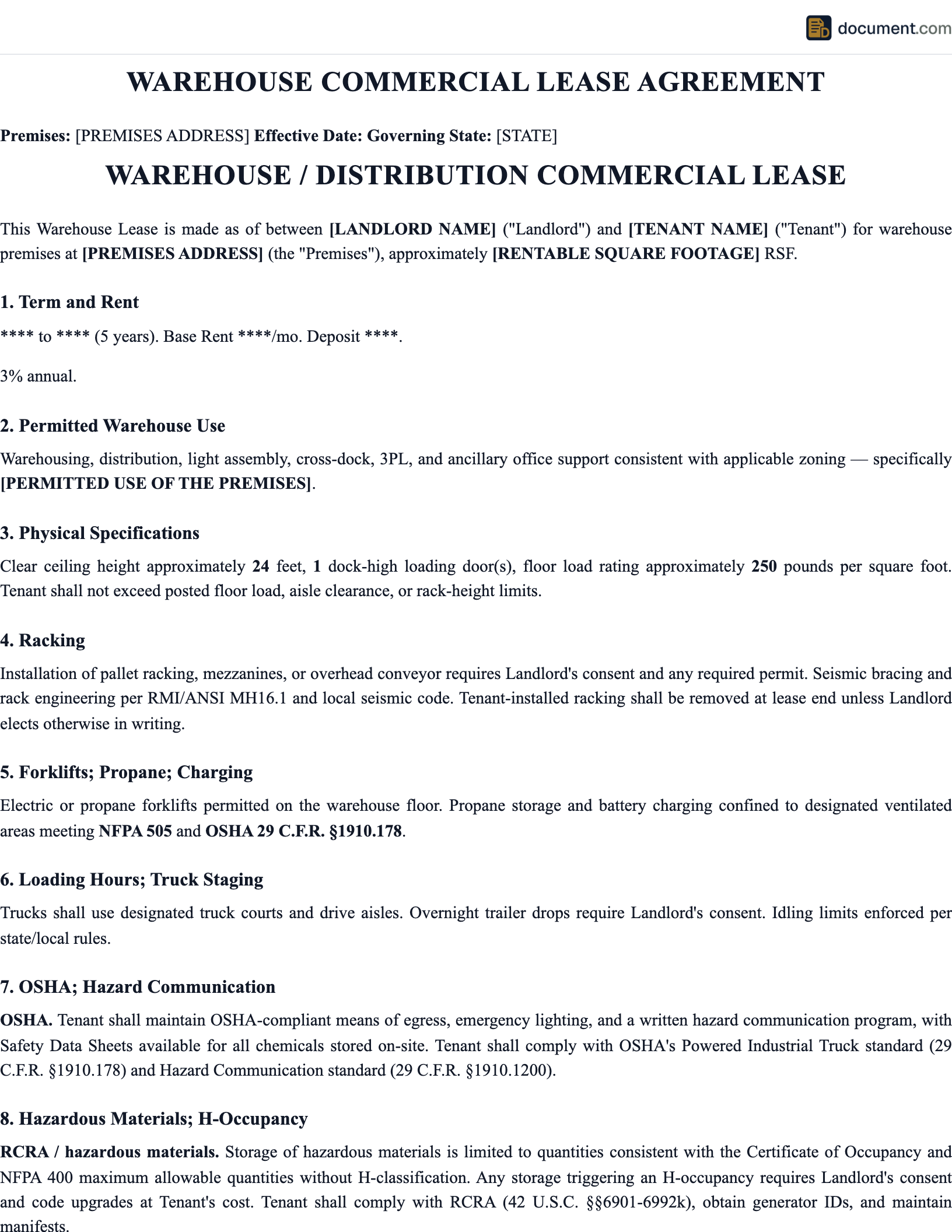
Preview of our Texas-specific template. Your document will include all fields required for recording in any Texas county.
WAREHOUSE LEASE AGREEMENT
STATE OF TEXAS
Legal Document
PARTY INFORMATION
Name: [Full Legal Name]
Address: [Texas Address]
County: [County]
PROPERTY DESCRIPTION
County: [County] State: Texas
Legal Description: [Per Recorded Plat]
Parcel No.: [APN]
Texas Warehouse Lease FAQ
Common questions about filing in Texas, including requirements, fees, and tax implications.
Official Texas Resources
Official state resources for verifying requirements and finding your local recording office.
Important Considerations
DFW's industrial market has expanded dramatically over the past decade, with millions of square feet of new Class A distribution space developed in the AllianceTexas, I-20, and Loop 12 corridors. Despite this new supply, vacancy has remained relatively low because demand from e-commerce, electronics distribution, and retail logistics has absorbed new construction. Tenants seeking large-format modern space in DFW should be prepared for competitive market conditions and should secure renewal options in initial leases.
Houston's industrial market is the most complex in Texas because of the diversity of industrial users. The Ship Channel area serves petrochemical and heavy industrial users with specific hazmat, environmental, and operational requirements. The northwest and northeast Houston submarkets serve general distribution. West Houston serves the oilfield services and technology sectors. Understanding which Houston submarket fits your operations is important; the submarkets have very different regulatory environments and lease structures.
San Antonio's I-35 corridor position as a NAFTA gateway creates logistics opportunities for US-Mexico trade that are not available at most inland U.S. locations. The Laredo crossing is the busiest commercial land border crossing in the country. For businesses with significant Mexico trade flows, a San Antonio or Laredo warehouse location can reduce cross-border logistics time and cost compared to clearing goods through Texas border crossings from farther-away distribution points.
Texas Market Note
Texas's no-income-tax environment and massive industrial market scale offer genuine advantages for businesses needing southeastern, southwestern, or NAFTA corridor logistics positioning. The property tax burden is real and can make the full NNN occupancy cost significantly higher than the base rent suggests. Model the complete tax stack for your specific Texas location before comparing to alternatives. DFW, Houston, San Antonio, and Austin are different enough that the right Texas market depends entirely on your specific logistics function.
Related Documents
Depending on your situation, you may need additional documents alongside this one. Below are commonly related documents that are frequently used together in real estate transactions.
Important Considerations
Before proceeding with your document, there are several important factors to consider. Each real estate transaction is unique, and understanding the specific requirements and implications of your situation will help ensure a smooth and legally compliant process.
Real estate laws and regulations are subject to change, and local requirements may differ from state-level rules. It is always advisable to verify current requirements with your local recording office before submitting any documents for recording.
If your transaction involves complex circumstances such as multiple parties, commercial properties, trusts, estates, or interstate elements, consulting with a licensed real estate attorney is strongly recommended. An attorney can provide guidance specific to your situation and help you avoid potential legal issues.
Keep copies of all documents related to your real estate transaction in a safe place. Recorded documents become part of the public record, but having your own copies ensures you can reference the terms and conditions at any time. Digital copies stored securely are also recommended as a backup.
Professional Recommendation
While our templates are designed to be comprehensive and legally compliant, we recommend having your completed document reviewed by a licensed attorney before recording, especially for high-value transactions or complex situations. Many attorneys offer flat-fee document review services that provide peace of mind at a reasonable cost.
Related Documents
Depending on your situation, you may need additional documents alongside this one. Below are commonly related documents that are frequently used together in real estate transactions.
Create your Texas Commercial Warehouse Lease Agreement in under 5 minutes.
Answer a few questions and download a Texas-compliant document, ready for the state agency.