



South Dakota Warehouse Lease Overview
South Dakota's industrial warehouse market is modest in scale, reflecting the state's relatively small population and agricultural economy. Sioux Falls at the I-29/I-90 junction is the state's primary commercial center and the main regional distribution hub for eastern South Dakota, southwestern Minnesota, and portions of Nebraska. Rapid City in the west serves as the distribution point for western South Dakota and Black Hills tourism-adjacent markets. Both markets have limited Class A industrial supply relative to their regional roles.
South Dakota's combination of no corporate income tax and no personal income tax is notable and attracts business registrations, though manufacturing and distribution operations are driven more by logistics position than by tax advantages. Property taxes are assessed at the county level and are moderate by national standards. South Dakota winters are severe, particularly in the west, and warehouse leases must address heating and winter maintenance obligations more specifically than leases in warmer climates.
$10
Recording fee
$0.50 per $500
Transfer tax
Required
Notarization
0
Witnesses required
South Dakota Requirements
South Dakota warehouse leases are governed by general contract law. No specific industrial lease statute applies. The severe winter climate, agricultural market context, and South Dakota's unique tax-free environment are the most important considerations for warehouse lease negotiations.
South Dakota Specific Note
South Dakota winters are severe, with blizzard conditions common in the western part of the state and cold temperatures throughout. Any warehouse lease must clearly assign responsibility for heating system maintenance, dock approach snow removal, and roof snow load management. Review the heating system type and last service record before committing to any South Dakota warehouse lease.
Document Requirements
- Heating system obligations: Specify maintenance responsibility, performance standards, and winterization requirements for South Dakota winter conditions
- Snow removal responsibility: Assign dock approach, truck court, and parking lot clearing with defined response time standards
- Roof snow load capacity: Confirm the roof's structural snow load rating given South Dakota winter accumulations
- Agricultural use provisions (if applicable): If agricultural commodity storage is intended, confirm regulatory compliance requirements under SDPUC and USDA
- Permitted use: Define industrial use precisely under the applicable city or county zoning classification
How to Execute a South Dakota Warehouse Lease
Executing a warehouse lease in South Dakota requires addressing the severe winter climate, understanding the agricultural market context, and recognizing that the state's limited industrial supply gives tenants less leverage than in larger markets. These steps apply to Sioux Falls, Rapid City, and secondary South Dakota markets.
Identify the Market and Logistics Function
Determine whether Sioux Falls (eastern SD/Upper Midwest regional distribution) or Rapid City (western SD/Black Hills market) fits your logistics needs. Each market has different supply levels and tenant leverage dynamics.
Inspect Winter Infrastructure
Review the heating system, dock seals, and roof condition. Confirm the snow removal contract for the property. South Dakota winters require year-round planning for dock access and building integrity.
Review County Property Tax History
Obtain the current county tax bill and three years of history from the county director of equalization. South Dakota property taxes are moderate, but NNN tenants should still establish a base year and negotiate a cap on increases.
Negotiate Operational Provisions
For agricultural commodity storage, confirm regulatory compliance. For all leases, negotiate CAM history review, annual reconciliation requirements, and winter maintenance obligation assignment.
Execute and Distribute Copies
Both parties sign. Set up utilities and any required state or local business permits. Store executed originals securely.
South Dakota Fees & Costs
Typical costs for filing in South Dakota. Actual fees may vary by county.
| Fee / Tax | Amount |
|---|---|
| Recording Fee | $10 |
| Transfer Tax | $0.50 per $500 |
| Notarization | $5 - $25 per signature |
| Certified Copy | $1 - $10 per page |
| Attorney Review (optional) | $150 - $500 |
South Dakota Tax Implications
South Dakota has no state corporate income tax and no personal income tax, creating a favorable tax environment for businesses operating in the state. Commercial lease payments are generally not subject to state income tax. South Dakota does impose a state sales tax on tangible goods, but most commercial real estate lease payments for land and improvements are not subject to South Dakota sales tax.
Property taxes in South Dakota are assessed at the county level by county directors of equalization. South Dakota property taxes are moderate by national standards. NNN warehouse tenants are responsible for property tax passthroughs and should review current bills and three years of history before agreeing to NNN terms. Minnehaha and Lincoln counties (Sioux Falls) and Pennington County (Rapid City) have different effective rates.
CAM charges in South Dakota warehouse leases typically include snow removal (a significant and variable cost given South Dakota winters), parking lot maintenance, heating fuel where shared systems exist, and property management fees. Snow removal costs can vary significantly between high-snowfall and low-snowfall years in the western part of the state. Request three years of CAM history to understand variability before agreeing to NNN terms.
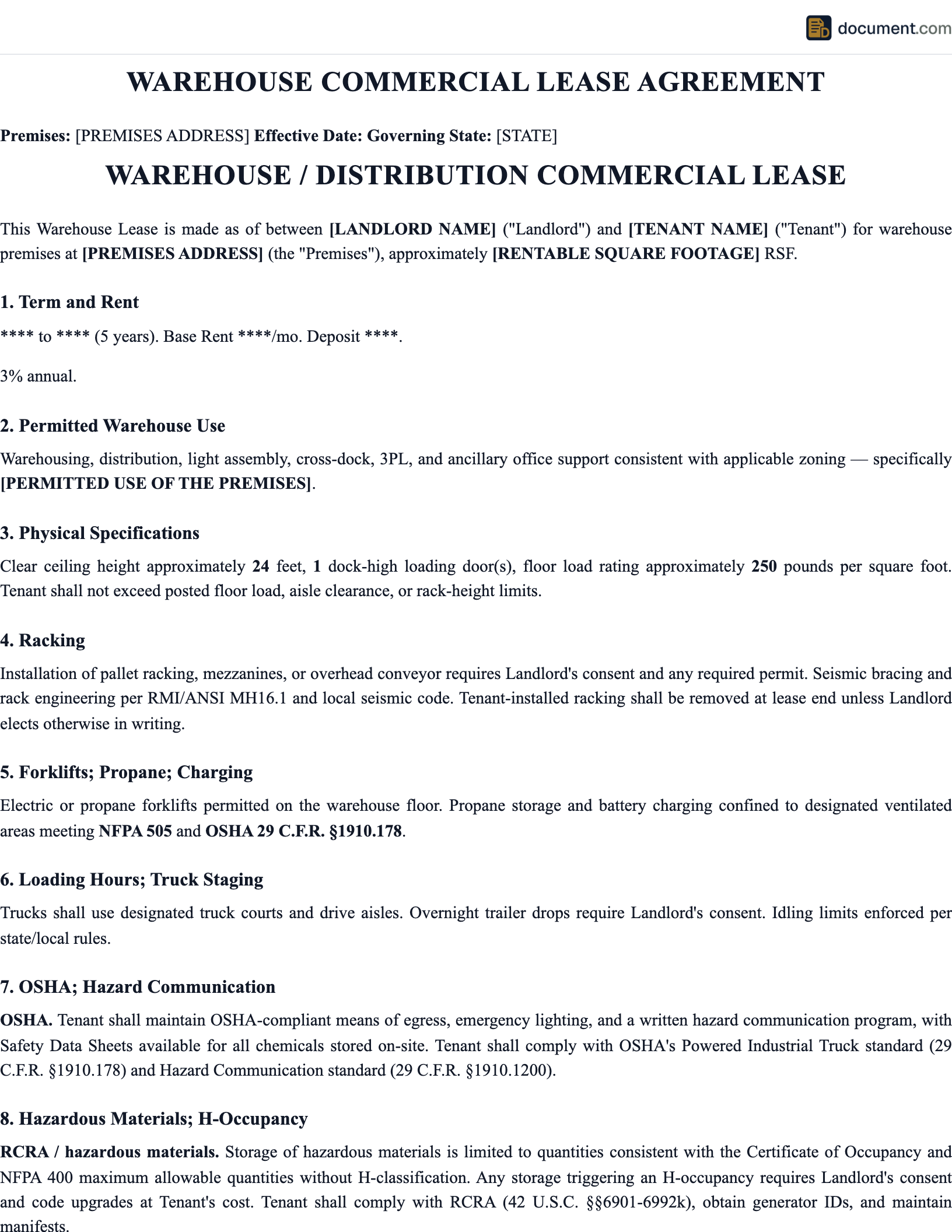
Sample South Dakota Warehouse Lease
Preview of our South Dakota-specific template. Your document will include all fields required for recording in any South Dakota county.
WAREHOUSE LEASE AGREEMENT
STATE OF SOUTH DAKOTA
Legal Document
PARTY INFORMATION
Name: [Full Legal Name]
Address: [South Dakota Address]
County: [County]
PROPERTY DESCRIPTION
County: [County] State: South Dakota
Legal Description: [Per Recorded Plat]
Parcel No.: [APN]
South Dakota Warehouse Lease FAQ
Common questions about filing in South Dakota, including requirements, fees, and tax implications.
Official South Dakota Resources
Official state resources for verifying requirements and finding your local recording office.
Important Considerations
South Dakota's industrial market is small enough that Class A large-format warehouse space is limited, particularly in Sioux Falls. Tenants with requirements for 200,000 square feet or more of modern distribution space may find that available South Dakota inventory cannot satisfy their needs and may need to consider southeastern Minnesota or western Iowa as alternatives with similar logistics positioning for Upper Midwest distribution.
Agricultural commodity handling in South Dakota generates specific regulatory requirements that differ from standard commercial warehousing. USDA licensed grain warehouses and SDPUC bonded commodity handlers must meet distinct bonding, inspection, and recordkeeping requirements. Tenants converting general warehouse space to commodity storage should confirm with the applicable regulatory agencies before making operational commitments in a lease.
Rapid City's industrial market is more specialized and smaller than Sioux Falls, serving primarily the western South Dakota tourism economy and the Black Hills region. Weather patterns near the Black Hills create more dramatic winter events than eastern South Dakota, including rapid temperature swings that can cause ice hazards and rapid snowmelt creating dock flooding risks. Lease provisions covering weather-related access interruptions are more important in Rapid City than in most comparable markets.
South Dakota Market Note
South Dakota's no-income-tax environment and I-29/I-90 logistics position make Sioux Falls a legitimate regional distribution hub for the Upper Midwest at costs significantly below Minneapolis. The market is small, which limits large-format space options, but also means competition for good industrial space is real. The severe winter climate is the common operational factor for all South Dakota warehouse leases.
Related Documents
Depending on your situation, you may need additional documents alongside this one. Below are commonly related documents that are frequently used together in real estate transactions.
Important Considerations
Before proceeding with your document, there are several important factors to consider. Each real estate transaction is unique, and understanding the specific requirements and implications of your situation will help ensure a smooth and legally compliant process.
Real estate laws and regulations are subject to change, and local requirements may differ from state-level rules. It is always advisable to verify current requirements with your local recording office before submitting any documents for recording.
If your transaction involves complex circumstances such as multiple parties, commercial properties, trusts, estates, or interstate elements, consulting with a licensed real estate attorney is strongly recommended. An attorney can provide guidance specific to your situation and help you avoid potential legal issues.
Keep copies of all documents related to your real estate transaction in a safe place. Recorded documents become part of the public record, but having your own copies ensures you can reference the terms and conditions at any time. Digital copies stored securely are also recommended as a backup.
Professional Recommendation
While our templates are designed to be comprehensive and legally compliant, we recommend having your completed document reviewed by a licensed attorney before recording, especially for high-value transactions or complex situations. Many attorneys offer flat-fee document review services that provide peace of mind at a reasonable cost.
Related Documents
Depending on your situation, you may need additional documents alongside this one. Below are commonly related documents that are frequently used together in real estate transactions.
Create your South Dakota Commercial Warehouse Lease Agreement in under 5 minutes.
Answer a few questions and download a South Dakota-compliant document, ready for the state agency.