



South Carolina Warehouse Lease Overview
South Carolina has established itself as a major southeastern industrial state anchored by two distinct demand drivers. The Port of Charleston on the coast is one of the fastest-growing and deepest container ports on the East Coast, generating demand for warehouse and distribution space throughout the Charleston metro and along the I-26 corridor to Columbia. The upstate Greenville-Spartanburg market has become an automotive manufacturing hub centered on BMW's world-largest production plant in Spartanburg, surrounded by hundreds of Tier 1 and Tier 2 suppliers.
South Carolina's commercial property assessment at 6% of fair market value creates relatively modest property tax obligations compared to northern states. The state has no sales tax on commercial real estate lease payments and no transfer tax on commercial leases. These financial characteristics, combined with a right-to-work environment and active economic development programs, have attracted sustained national logistics and manufacturing investment. Inland ports at Greer and Dillon extend the Charleston port's reach into secondary markets.
$10
Recording fee
$1.85 per $500
Transfer tax
Required
Notarization
0
Witnesses required
South Carolina Requirements
South Carolina warehouse leases are governed by general contract law. No specific industrial lease statute applies. Port access considerations, automotive supply chain just-in-time requirements, and county property tax structures are the most important contextual factors for South Carolina warehouse lease negotiations.
South Carolina Specific Note
South Carolina assesses commercial real property at 6% of fair market value, which creates relatively modest property taxes compared to many northern states. NNN warehouse tenants should still review current county tax bills and three years of history. Charleston County and Greenville County have different effective rates. Negotiate a base year and a cap on annual NNN property tax increases for multi-year leases.
Document Requirements
- Physical specifications: Document certified clear height, dock count, floor load rating, and sprinkler specifications as exhibits
- Port access provisions (Charleston area): For near-port facilities, address drayage access hours, truck route compliance, and any port authority operational requirements
- Automotive JIT requirements (upstate): For BMW supply chain facilities, address 24/7 access requirements, dock availability standards, and power infrastructure for sequencing operations
- Property tax base year: Negotiate a base year and cap on NNN increases despite South Carolina's relatively low assessment ratio
- Permitted use: Define industrial use precisely under the applicable city or county zoning classification
How to Execute a South Carolina Warehouse Lease
Executing a warehouse lease in South Carolina requires understanding whether your operations are port-oriented, automotive supply chain, or general regional distribution, as each market has different demands and lease structures. These steps apply across the Charleston, upstate, and Columbia markets.
Identify Port, Automotive, or General Distribution Need
Charleston-area port-adjacent space serves import-export logistics; upstate Greenville-Spartanburg serves automotive supply chain; Columbia serves as a midpoint for regional Southeast distribution. Each market has different infrastructure requirements and lease dynamics.
Review County Tax Bills and Assessment
Obtain the county property tax bill and confirm the 6% commercial assessment ratio is correctly applied to the parcel. Review three years of tax history. Negotiate a base year and cap on NNN increases even in South Carolina's relatively lower-tax environment.
Confirm Zoning with City or County
Contact the applicable city or county planning department. North Charleston, Greenville, Spartanburg, and Columbia each have distinct industrial zoning. Confirm that your specific operations are permitted under the applicable zone.
Negotiate NNN Terms and Operational Provisions
For automotive JIT operations, address 24/7 access, dock availability, and power reliability explicitly. For port-adjacent operations, address truck access hours and drayage protocols. Review CAM history and negotiate reconciliation requirements.
Execute and Distribute Copies
Both parties sign. Set up utilities and any required business permits. Store executed originals securely.
South Carolina Fees & Costs
Typical costs for filing in South Carolina. Actual fees may vary by county.
| Fee / Tax | Amount |
|---|---|
| Recording Fee | $10 |
| Transfer Tax | $1.85 per $500 |
| Notarization | $5 - $25 per signature |
| Certified Copy | $1 - $10 per page |
| Attorney Review (optional) | $150 - $500 |
South Carolina Tax Implications
South Carolina does not impose sales tax on commercial real estate lease payments and has no transfer tax on commercial lease transactions. South Carolina assesses commercial property at 6% of fair market value, significantly lower than most northern states, creating relatively modest NNN property tax passthroughs. South Carolina does impose a corporate income tax on business profits earned in the state.
Property taxes in South Carolina are assessed at the county level. The 6% commercial assessment ratio applied to fair market value, combined with county millage rates, produces effective tax rates that are lower than most northeastern and midwestern industrial markets. NNN warehouse tenants should still review current bills and three years of history from the applicable county auditor. Charleston County and Greenville County have different millage rates.
CAM charges in South Carolina warehouse leases typically include parking lot maintenance, landscaping, property management fees, and common area utilities. Charleston-area facilities may include dock area and parking lot maintenance costs associated with high truck traffic from port operations. Negotiate annual CAM reconciliation and audit rights. For large automotive supply chain facilities, address HVAC and power reliability separately from standard CAM.
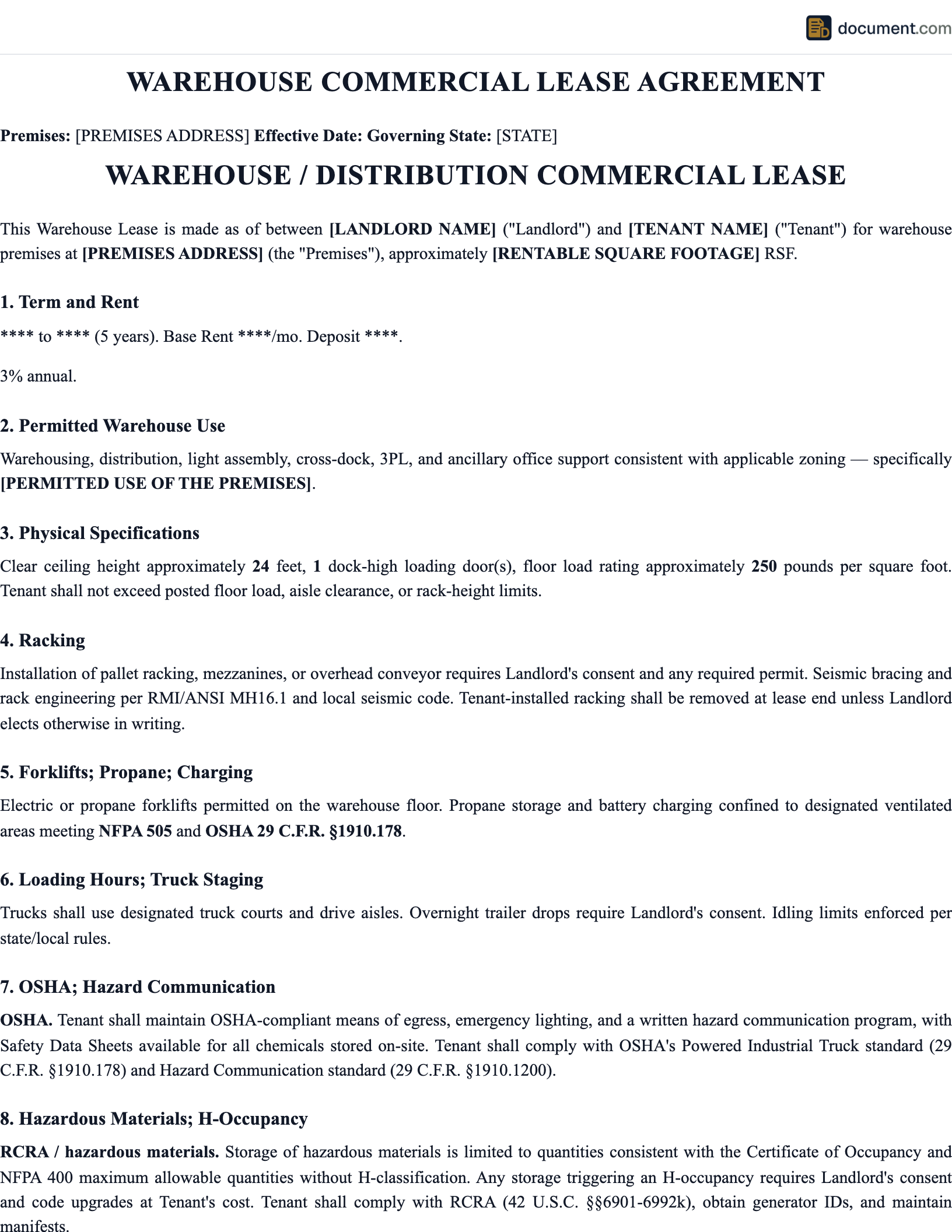
Sample South Carolina Warehouse Lease
Preview of our South Carolina-specific template. Your document will include all fields required for recording in any South Carolina county.
WAREHOUSE LEASE AGREEMENT
STATE OF SOUTH CAROLINA
Legal Document
PARTY INFORMATION
Name: [Full Legal Name]
Address: [South Carolina Address]
County: [County]
PROPERTY DESCRIPTION
County: [County] State: South Carolina
Legal Description: [Per Recorded Plat]
Parcel No.: [APN]
South Carolina Warehouse Lease FAQ
Common questions about filing in South Carolina, including requirements, fees, and tax implications.
Official South Carolina Resources
Official state resources for verifying requirements and finding your local recording office.
Important Considerations
South Carolina's Port of Charleston continues to grow and is investing in additional berth and terminal capacity. The port's ability to handle larger post-Panamax vessels is drawing cargo from other East Coast ports. Charleston-area warehouse tenants who depend on port proximity should understand that port expansion will bring additional industrial development to the market, potentially increasing competition for nearby space. Renewal options in current leases protect against being displaced by competing users.
The Greenville-Spartanburg automotive corridor faces a tight labor market as BMW, its suppliers, and other manufacturers compete for skilled manufacturing and warehouse workers. Warehouse operators should budget for South Carolina wages that may be above state average in this corridor and should understand that worker availability can affect operational scalability. Proximity to technical college training programs in the Greenville and Spartanburg areas can be an asset for operations that need a trained workforce.
South Carolina's inland ports at Greer (near Spartanburg) and Dillon (near the North Carolina border) extend container handling capabilities to upstate and border markets. The Greer inland port in particular has become an important asset for automotive supply chain operators in the Greenville-Spartanburg corridor, enabling direct container transfer without trucking to Charleston. Tenants whose operations would benefit from inland port access should confirm proximity and rail connection availability before signing in the upstate market.
South Carolina Market Note
South Carolina's combination of a deep-water port, BMW automotive cluster, right-to-work environment, and relatively low property taxes creates a compelling southeastern industrial location. The Charleston port market and upstate automotive market operate on different logistics and supply chain cycles. Understanding which demand driver fits your operations will determine the right South Carolina location and the appropriate lease structure.
Related Documents
Depending on your situation, you may need additional documents alongside this one. Below are commonly related documents that are frequently used together in real estate transactions.
Important Considerations
Before proceeding with your document, there are several important factors to consider. Each real estate transaction is unique, and understanding the specific requirements and implications of your situation will help ensure a smooth and legally compliant process.
Real estate laws and regulations are subject to change, and local requirements may differ from state-level rules. It is always advisable to verify current requirements with your local recording office before submitting any documents for recording.
If your transaction involves complex circumstances such as multiple parties, commercial properties, trusts, estates, or interstate elements, consulting with a licensed real estate attorney is strongly recommended. An attorney can provide guidance specific to your situation and help you avoid potential legal issues.
Keep copies of all documents related to your real estate transaction in a safe place. Recorded documents become part of the public record, but having your own copies ensures you can reference the terms and conditions at any time. Digital copies stored securely are also recommended as a backup.
Professional Recommendation
While our templates are designed to be comprehensive and legally compliant, we recommend having your completed document reviewed by a licensed attorney before recording, especially for high-value transactions or complex situations. Many attorneys offer flat-fee document review services that provide peace of mind at a reasonable cost.
Related Documents
Depending on your situation, you may need additional documents alongside this one. Below are commonly related documents that are frequently used together in real estate transactions.
Create your South Carolina Commercial Warehouse Lease Agreement in under 5 minutes.
Answer a few questions and download a South Carolina-compliant document, ready for the state agency.