



Pennsylvania Warehouse Lease Overview
Pennsylvania is a major eastern industrial state with distinct market zones. The Lehigh Valley and I-78 corridor in eastern Pennsylvania have emerged as top-ranked e-commerce and logistics locations, offering New York City market access at dramatically lower costs than New Jersey. The Philadelphia metro combines port access and massive consumer population proximity. Western Pennsylvania, centered on Pittsburgh, serves as a regional distribution point for Appalachian markets with I-376, I-79, and I-70 connectivity.
Pennsylvania's 67-county property tax structure creates significant variation in NNN lease economics across the state. The Realty Transfer Tax applies to certain property transfer events, and understanding which transactions trigger it is important. Pennsylvania's active brownfields program has enabled extensive redevelopment of former industrial sites, and many Pennsylvania industrial parks operate under Act 2 liability protections that define permissible use boundaries.
$25
Recording fee
2% (1%+1%)
Transfer tax
Required
Notarization
0
Witnesses required
Pennsylvania Requirements
Pennsylvania warehouse leases are governed by general contract law. No specific industrial lease statute applies. The variation in county property tax systems, the state's brownfields context, and the Lehigh Valley market dynamics require careful due diligence before signing any Pennsylvania warehouse lease.
Pennsylvania Specific Note
Pennsylvania property taxes vary significantly by county because each of the 67 counties uses its own assessment methodology and millage rates. School district levies are typically the largest component of the total tax bill. Before signing any NNN lease in Pennsylvania, confirm the specific county's current assessment of the parcel, obtain the tax bill for all taxing authorities, and negotiate a base year with a cap on increases.
Document Requirements
- Physical specifications: Document certified clear height, dock count, floor load rating, and sprinkler system specifications as exhibits
- County property tax due diligence: Pennsylvania has 67 counties with independent assessment systems; review current assessed value and multi-year tax bills for all taxing authorities before signing
- Act 2 use limitations (if applicable): For brownfield-redeveloped sites, review the Act 2 remediation agreement and any use limitations it imposes on tenant operations
- Municipal zoning confirmation: Pennsylvania has 2,500+ municipalities; confirm zoning classification and permitted use with the specific municipality in writing
- Lehigh Valley/I-78 corridor access: For eastern Pennsylvania distribution operations, address interstate access, truck routes, and proximity to the relevant PA Turnpike interchange
How to Execute a Pennsylvania Warehouse Lease
Executing a warehouse lease in Pennsylvania requires understanding the county property tax framework, the brownfields context of many industrial sites, and the distinct market dynamics of the Lehigh Valley, Philadelphia, and Pittsburgh markets. These steps apply across Pennsylvania's major industrial markets.
Identify the Correct Pennsylvania Market
Determine whether the Lehigh Valley I-78 corridor, Philadelphia metro, Pittsburgh, or a secondary market best fits your distribution needs. Each market has different rents, availability, proximity to population centers, and NNN cost profiles.
Conduct County Property Tax Due Diligence
Obtain the current property tax bill from the county showing all taxing authority levies (county, school district, municipality). Understand the county's assessment methodology. Negotiate a base year with a cap on annual increases before signing any NNN lease.
Review Environmental and Act 2 Status
Request Phase I environmental assessment results. If the property was remediated under Pennsylvania Act 2, review the remediation agreement and confirm that your intended use is consistent with the applicable cleanup standard and use limitations.
Confirm Municipal Zoning
Contact the specific municipality's planning office. Pennsylvania has more than 2,500 independent zoning jurisdictions. Confirm that your intended industrial use is permitted under the applicable zone before signing.
Execute and Distribute Copies
Both parties sign the fully negotiated lease. Set up utilities and any required business permits. Store executed originals securely.
Pennsylvania Fees & Costs
Typical costs for filing in Pennsylvania. Actual fees may vary by county.
| Fee / Tax | Amount |
|---|---|
| Recording Fee | $25 |
| Transfer Tax | 2% (1%+1%) |
| Notarization | $5 - $25 per signature |
| Certified Copy | $1 - $10 per page |
| Attorney Review (optional) | $150 - $500 |
Pennsylvania Tax Implications
Pennsylvania imposes a Realty Transfer Tax on transfers of beneficial interest in real property. A standard commercial lease is generally not a taxable transfer, but sale-leaseback transactions and certain long-term leases may trigger RTT liability. Consult a Pennsylvania real estate attorney on RTT implications for any non-standard commercial real estate transaction. Pennsylvania also imposes a Corporate Net Income Tax on business profits earned in the state.
Property taxes in Pennsylvania are assessed at the county level with significant variation across the state's 67 counties. School district levies are typically the largest component of the total tax burden. Some Pennsylvania counties use full market value assessments while others use fractional assessments at percentages of market value. This variation makes it essential to review the specific county's methodology and the current tax bill for all taxing authorities before agreeing to NNN terms.
CAM charges in Pennsylvania warehouse leases typically include parking lot and truck court maintenance, snow removal (meaningful in most Pennsylvania markets, heavy in western Pennsylvania and the Lehigh Valley in harsh winters), landscaping, property management fees, and common area utilities. The Lehigh Valley market has institutional ownership that typically provides structured CAM with reconciliation. Negotiate annual CAM reconciliation and audit rights as standard provisions.
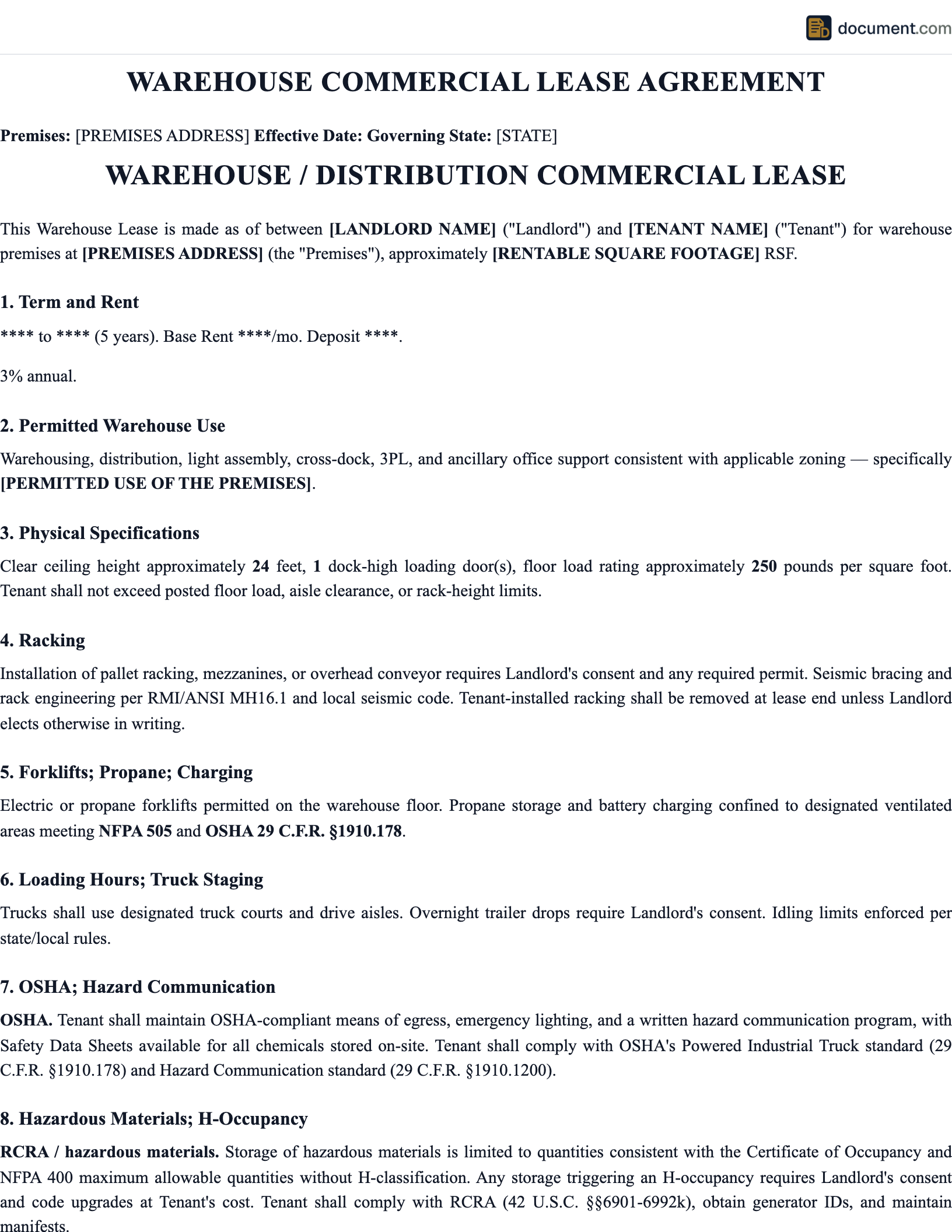
Sample Pennsylvania Warehouse Lease
Preview of our Pennsylvania-specific template. Your document will include all fields required for recording in any Pennsylvania county.
WAREHOUSE LEASE AGREEMENT
STATE OF PENNSYLVANIA
Legal Document
PARTY INFORMATION
Name: [Full Legal Name]
Address: [Pennsylvania Address]
County: [County]
PROPERTY DESCRIPTION
County: [County] State: Pennsylvania
Legal Description: [Per Recorded Plat]
Parcel No.: [APN]
Pennsylvania Warehouse Lease FAQ
Common questions about filing in Pennsylvania, including requirements, fees, and tax implications.
Official Pennsylvania Resources
Official state resources for verifying requirements and finding your local recording office.
Important Considerations
The Lehigh Valley industrial market has been one of the fastest-growing in the country and has tightened substantially over the past decade. Vacancy in Class A large-format facilities has been very low. Tenants who wait to negotiate renewal options until their term is expiring may find limited alternatives and face significantly higher rents. Securing renewal options with defined rate mechanisms in the initial lease is strongly advisable in this market.
Pennsylvania's Act 2 Land Recycling Program has enabled redevelopment of many former industrial sites in the Lehigh Valley, Reading, Allentown, Pittsburgh, and Philadelphia areas. Tenants leasing in Act 2-remediated properties should understand the specific use limitations in the remediation agreement. Some Act 2 cleanups are completed under industrial standards that permit industrial use but restrict future residential conversion. Confirm that planned operations are consistent with the applicable cleanup standard.
Pittsburgh's industrial market has been growing as technology sector expansion in the city generates demand for urban logistics and last-mile distribution. The Pittsburgh market is less constrained than the Lehigh Valley, offering more tenant negotiating flexibility. Western Pennsylvania markets benefit from I-376, I-79, I-70, and I-76 (Pennsylvania Turnpike) access to Ohio, West Virginia, and Maryland markets. For businesses serving the Appalachian region, Pittsburgh-area warehousing can be strategically positioned.
Pennsylvania Market Note
Pennsylvania offers distinct advantages across different markets: the Lehigh Valley provides New York metro access at a fraction of New Jersey costs; Philadelphia offers port access and massive consumer proximity; Pittsburgh offers Appalachian region distribution positioning. The 67-county property tax variation is the most important financial due diligence factor for NNN leases. Model total NNN cost including all county, school, and municipal tax authority levies before committing.
Related Documents
Depending on your situation, you may need additional documents alongside this one. Below are commonly related documents that are frequently used together in real estate transactions.
Important Considerations
Before proceeding with your document, there are several important factors to consider. Each real estate transaction is unique, and understanding the specific requirements and implications of your situation will help ensure a smooth and legally compliant process.
Real estate laws and regulations are subject to change, and local requirements may differ from state-level rules. It is always advisable to verify current requirements with your local recording office before submitting any documents for recording.
If your transaction involves complex circumstances such as multiple parties, commercial properties, trusts, estates, or interstate elements, consulting with a licensed real estate attorney is strongly recommended. An attorney can provide guidance specific to your situation and help you avoid potential legal issues.
Keep copies of all documents related to your real estate transaction in a safe place. Recorded documents become part of the public record, but having your own copies ensures you can reference the terms and conditions at any time. Digital copies stored securely are also recommended as a backup.
Professional Recommendation
While our templates are designed to be comprehensive and legally compliant, we recommend having your completed document reviewed by a licensed attorney before recording, especially for high-value transactions or complex situations. Many attorneys offer flat-fee document review services that provide peace of mind at a reasonable cost.
Related Documents
Depending on your situation, you may need additional documents alongside this one. Below are commonly related documents that are frequently used together in real estate transactions.
Create your Pennsylvania Commercial Warehouse Lease Agreement in under 5 minutes.
Answer a few questions and download a Pennsylvania-compliant document, ready for the state agency.