
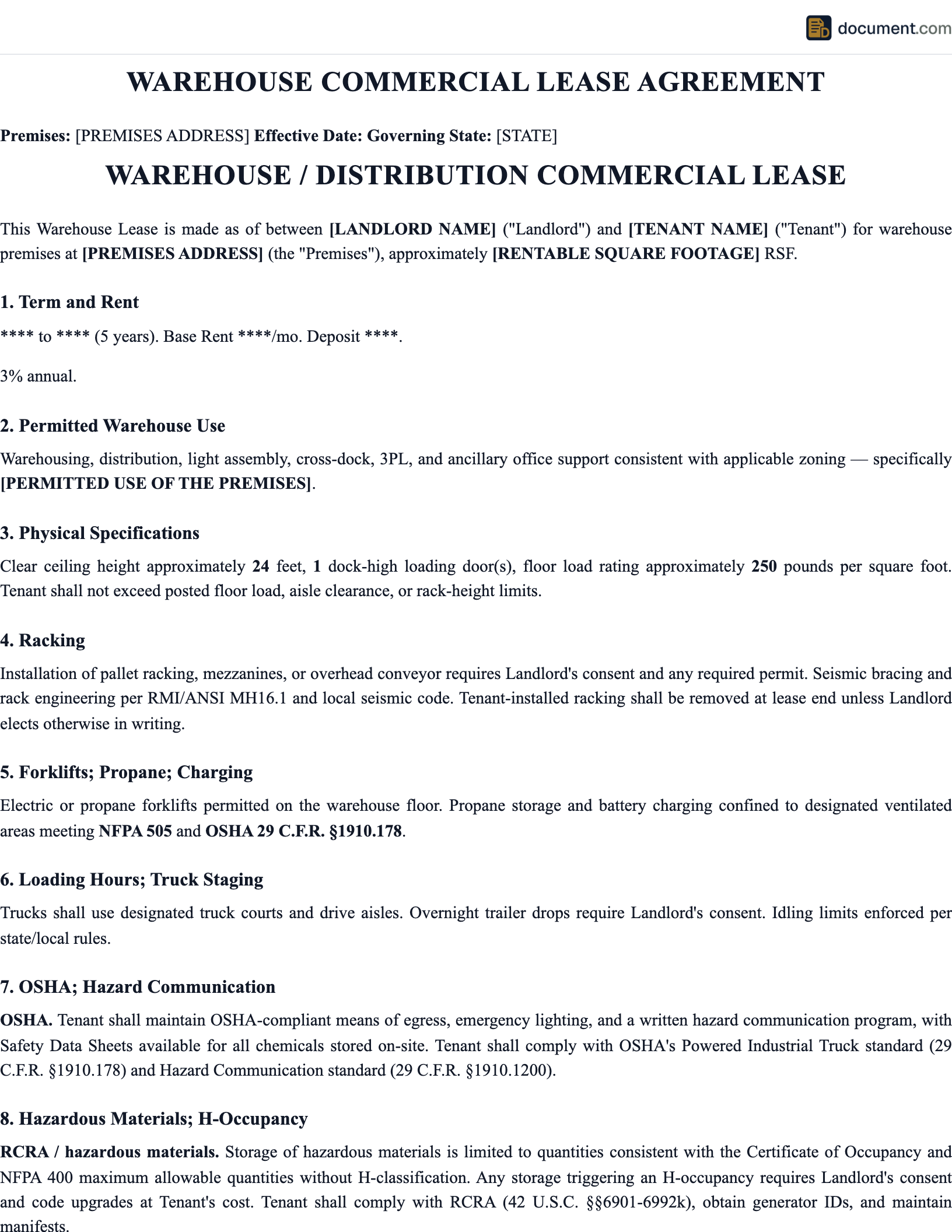



Oklahoma Warehouse Lease Overview
Oklahoma's industrial real estate market divides between energy-driven and general distribution demand. Oklahoma City, at the intersection of I-35, I-40, and I-44, serves as the state's primary logistics hub with national distribution connectivity. Tulsa's market is anchored by manufacturing, aviation maintenance, and the Port of Catoosa, which provides barge access to the Gulf of Mexico via the Arkansas River navigation system. Both markets offer significantly lower rents than major coastal and Midwest industrial markets.
The oil and gas industry provides meaningful but cyclical demand for equipment storage and oil field services warehousing throughout the state. Tenants and landlords in energy-dependent markets should understand that demand can shift rapidly with oil prices. Oklahoma has no specific commercial lease tax, moderate property taxes assessed at the county level, and generally tenant-friendly market conditions compared to supply-constrained industrial markets.
$18
Recording fee
$0.75 per $500
Transfer tax
Required
Notarization
0
Witnesses required
Oklahoma Requirements
Oklahoma warehouse leases are governed by general contract law. No specific industrial lease statute applies. Energy sector cyclicality and county property tax structures are the most important considerations in Oklahoma warehouse lease negotiations.
Oklahoma Specific Note
Oklahoma property taxes are assessed at the county level. County assessors value commercial real estate, and the applicable rate includes county, municipal, and school district components. NNN warehouse tenants should review current tax bills and three years of history. In energy-dependent counties in western Oklahoma, assessed values can fluctuate with broader energy sector conditions.
Document Requirements
- Permitted use: Define industrial use precisely, including any outdoor equipment or pipe storage that is common in energy sector leases
- Property tax base year: Establish a base year and cap on NNN property tax increases; county rates include multiple taxing authority levies
- Energy sector provisions (if applicable): For oil field services or energy equipment storage, address outdoor storage rights, security requirements, and lease term flexibility given cyclical demand
- Port of Catoosa access (Tulsa area): For barge-dependent operations near Catoosa, address port access, waterway permits, and load/unload rights in the lease
- Utility metering: Confirm separate metering for large industrial users; Oklahoma summers are hot and HVAC costs can be significant
How to Execute an Oklahoma Warehouse Lease
Executing a warehouse lease in Oklahoma requires understanding the energy sector demand cycle, county property tax structures, and the distinct logistics advantages of the Oklahoma City and Tulsa markets. These steps apply across both major Oklahoma industrial markets.
Identify Your Market and Demand Driver
Determine whether general distribution via Oklahoma City's interstate hub or Tulsa's manufacturing and port access better fits your operations. Energy sector operations should also assess whether term length should reflect cyclical demand uncertainty.
Review Property Tax History
Obtain county property tax bills and three years of history from the county assessor. Establish a base year and negotiate a cap on NNN property tax increases for multi-year leases.
Confirm Zoning and Permitted Use
Contact the applicable city or county planning department. Address outdoor storage rights explicitly if your operations include pipe storage, equipment staging, or other outdoor uses common in Oklahoma energy sector operations.
Negotiate CAM and Energy Provisions
Review CAM history for two or more years. For energy sector tenants, negotiate appropriate term and termination provisions that reflect cyclical demand. Negotiate a cap on controllable CAM and annual reconciliation requirements.
Execute and Distribute Copies
Both parties sign the fully negotiated lease. Set up utilities and any required business permits. Store executed originals securely.
Oklahoma Fees & Costs
Typical costs for filing in Oklahoma. Actual fees may vary by county.
| Fee / Tax | Amount |
|---|---|
| Recording Fee | $18 |
| Transfer Tax | $0.75 per $500 |
| Notarization | $5 - $25 per signature |
| Certified Copy | $1 - $10 per page |
| Attorney Review (optional) | $150 - $500 |
Oklahoma Tax Implications
Oklahoma does not impose a specific transfer tax on commercial lease transactions. Commercial real estate lease payments are generally not subject to Oklahoma sales tax for most industrial arrangements. Oklahoma does impose a corporate income tax on business income earned in the state, and tenants operating in Oklahoma pay state income taxes on Oklahoma-sourced profits.
Property taxes in Oklahoma are assessed at the county level. County assessors value commercial real estate, and the applicable tax rate includes county, city or town, and school district components. Oklahoma property taxes are moderate by national standards. NNN warehouse tenants should review current assessed values and tax bills and negotiate a base year with a cap on annual increases for multi-year lease terms.
CAM charges in Oklahoma warehouse leases typically include parking lot maintenance, landscaping, property management fees, and common area utilities. Oklahoma summers are hot, and cooling costs for shared building systems can be meaningful. For energy sector operations with outdoor storage, ask whether any CAM charges apply to outdoor storage areas and address security lighting and perimeter fencing maintenance responsibility explicitly.
Sample Oklahoma Warehouse Lease
Preview of our Oklahoma-specific template. Your document will include all fields required for recording in any Oklahoma county.
WAREHOUSE LEASE AGREEMENT
STATE OF OKLAHOMA
Legal Document
PARTY INFORMATION
Name: [Full Legal Name]
Address: [Oklahoma Address]
County: [County]
PROPERTY DESCRIPTION
County: [County] State: Oklahoma
Legal Description: [Per Recorded Plat]
Parcel No.: [APN]
Oklahoma Warehouse Lease FAQ
Common questions about filing in Oklahoma, including requirements, fees, and tax implications.
Official Oklahoma Resources
Official state resources for verifying requirements and finding your local recording office.
Important Considerations
Oklahoma warehouse tenants in the energy sector should build appropriate flexibility into their lease terms given the demonstrated cyclicality of the Oklahoma oil and gas market. The 2014-2016 oil price collapse left excess industrial space throughout the state. Lease terms that create long-term financial obligations during energy downturns can be financially painful. Where possible, negotiate options to terminate or contract space tied to defined triggering events.
The Port of Catoosa near Tulsa is a unique asset that creates distribution opportunities not available from most inland U.S. locations. Businesses that move heavy or bulk goods by barge should specifically evaluate Tulsa-area warehouse locations for their proximity to the McClellan-Kerr navigation system. Port-adjacent industrial space near Catoosa commands a premium but provides access to Gulf of Mexico shipping routes at freight rates that can be lower than truck-only alternatives.
Oklahoma City's I-35 and I-40 intersection creates genuine national distribution advantages at lower costs than most comparable U.S. distribution points. National retailers and third-party logistics providers have invested in large distribution centers in the Oklahoma City area specifically because of this multi-interstate accessibility and lower occupancy costs. Tenants evaluating national distribution network hub locations should model Oklahoma City occupancy costs against Kansas City, Memphis, and Dallas alternatives.
Oklahoma Market Note
Oklahoma offers legitimate logistics advantages at costs significantly below coastal and major Midwest markets. Oklahoma City's interstate hub and Tulsa's port access create distinct distribution capabilities. The energy sector component of the market adds demand but also adds volatility. Tenants not tied to the energy sector benefit from lower rents without the cyclical risk that affects energy-dependent industrial demand.
Related Documents
Depending on your situation, you may need additional documents alongside this one. Below are commonly related documents that are frequently used together in real estate transactions.
Important Considerations
Before proceeding with your document, there are several important factors to consider. Each real estate transaction is unique, and understanding the specific requirements and implications of your situation will help ensure a smooth and legally compliant process.
Real estate laws and regulations are subject to change, and local requirements may differ from state-level rules. It is always advisable to verify current requirements with your local recording office before submitting any documents for recording.
If your transaction involves complex circumstances such as multiple parties, commercial properties, trusts, estates, or interstate elements, consulting with a licensed real estate attorney is strongly recommended. An attorney can provide guidance specific to your situation and help you avoid potential legal issues.
Keep copies of all documents related to your real estate transaction in a safe place. Recorded documents become part of the public record, but having your own copies ensures you can reference the terms and conditions at any time. Digital copies stored securely are also recommended as a backup.
Professional Recommendation
While our templates are designed to be comprehensive and legally compliant, we recommend having your completed document reviewed by a licensed attorney before recording, especially for high-value transactions or complex situations. Many attorneys offer flat-fee document review services that provide peace of mind at a reasonable cost.
Related Documents
Depending on your situation, you may need additional documents alongside this one. Below are commonly related documents that are frequently used together in real estate transactions.
Create your Oklahoma Commercial Warehouse Lease Agreement in under 5 minutes.
Answer a few questions and download a Oklahoma-compliant document, ready for the state agency.