



Ohio Warehouse Lease Overview
Ohio is one of the most important logistics states in the country. Columbus anchors the market as a top-ranked national one-day-truck-drive distribution hub, with I-70 and I-71 providing cross-country and north-south connectivity. The Rickenbacker International Airport freight campus south of Columbus has attracted major national e-commerce and freight operators. Cleveland adds Lake Erie port access and automotive supply chain demand. Cincinnati combines Ohio River location with proximity to the DHL Aviation hub at CVG.
Ohio's industrial market benefits from relatively lower land costs compared to Chicago and coastal markets, strong interstate infrastructure, and a large manufacturing base that generates consistent industrial demand. County-level property tax assessment with six-year reappraisal cycles creates NNN lease provisions that must be negotiated carefully. Ohio does not impose sales tax on commercial real estate lease payments, creating a favorable cost environment for warehouse tenants.
$28
Recording fee
$1 per $1,000
Transfer tax
Required
Notarization
0
Witnesses required
Ohio Requirements
Ohio warehouse leases are governed by general contract law. No specific industrial lease statute applies. The multi-county industrial market and the state's reappraisal cycle create important NNN provisions, and automotive industry just-in-time requirements drive specific operational provisions for supply chain warehousing.
Ohio Specific Note
Ohio property taxes are assessed at the county level. County auditors reappraise commercial property every six years, with triennial updates. A reappraisal or update during a lease term can significantly change NNN property tax obligations. Review the county's appraisal schedule and last reappraisal date before signing a multi-year NNN lease. Franklin, Cuyahoga, and Hamilton counties have different effective rates.
Document Requirements
- Physical specifications: State certified clear height, dock door count and type, floor load rating, and sprinkler specifications as exhibits
- County tax base year and reappraisal provisions: Ohio county auditors reappraise every 6 years; establish a base year and negotiate tenant protection from sharp NNN increases following reappraisal
- Operating hours: For automotive just-in-time operations, address 24/7 access requirements and dock availability standards explicitly
- Permitted use: Define industrial use precisely under the applicable city or township zoning code; Ohio townships have independent zoning separate from adjacent municipalities
- Utility metering: Confirm separate metering for electricity and HVAC; large Ohio industrial facilities often have complex power configurations supporting manufacturing tenants
How to Execute an Ohio Warehouse Lease
Executing a warehouse lease in Ohio requires understanding which Ohio market serves your logistics needs and navigating the state's county-level property tax framework. The Columbus distribution hub, Cleveland automotive and port market, and Cincinnati air freight market each have distinct dynamics.
Identify the Target Ohio Market
Evaluate Columbus for national distribution (one-day truck reach), Cleveland for automotive supply chain and port access, Cincinnati for air freight proximity, or Toledo for automotive manufacturing support. Each market has different rents, availability, and infrastructure profiles.
Review County Tax History and Appraisal Cycle
Obtain the county auditor's current tax assessment and bill. Determine when the last reappraisal occurred and when the next triennial update is scheduled. Negotiate a base year with a cap on NNN tax increases to protect against reappraisal-driven cost spikes.
Confirm Zoning with City or Township
Ohio has both cities and townships with independent zoning. Confirm whether the parcel is in an incorporated municipality or unincorporated township territory and contact the appropriate planning authority to verify permitted industrial uses.
Negotiate NNN Terms with Standard Protections
Review two or more years of CAM history. Negotiate a cap on controllable CAM and a property tax base year. For automotive supply chain tenants, address 24/7 access and dock availability standards explicitly.
Execute and Distribute Copies
Both parties sign. Set up utilities and any required business registrations. Store executed originals securely. Columbus distribution tenants should register with the applicable county auditor for any available tax abatement programs.
Ohio Fees & Costs
Typical costs for filing in Ohio. Actual fees may vary by county.
| Fee / Tax | Amount |
|---|---|
| Recording Fee | $28 |
| Transfer Tax | $1 per $1,000 |
| Notarization | $5 - $25 per signature |
| Certified Copy | $1 - $10 per page |
| Attorney Review (optional) | $150 - $500 |
Ohio Tax Implications
Ohio does not impose sales tax on commercial real estate lease payments for most industrial warehouse transactions. Ohio does impose a Corporate Franchise Tax replacement Commercial Activity Tax (CAT) on gross receipts above $150,000. NNN warehouse tenants are responsible for property tax passthroughs, and Ohio's county-level six-year reappraisal cycle can create significant step-up events during a multi-year lease.
Property taxes in Ohio are assessed at 35% of appraised value, with county auditors setting appraisals every six years and conducting triennial updates. Franklin County (Columbus), Cuyahoga County (Cleveland), Hamilton County (Cincinnati), and Lucas County (Toledo) each have distinct effective rates. NNN tenants should review the current assessed value and tax bill, determine when the next appraisal event is scheduled, and negotiate base year protections before signing.
CAM charges in Ohio warehouse leases typically include parking lot maintenance, landscaping, property management fees, and common area utilities. Ohio winters can generate meaningful snow removal costs in Cleveland, Columbus, and Akron-Canton markets, and CAM history should be reviewed to understand winter variability. Negotiate annual reconciliation requirements and audit rights as standard provisions.
Sample Ohio Warehouse Lease
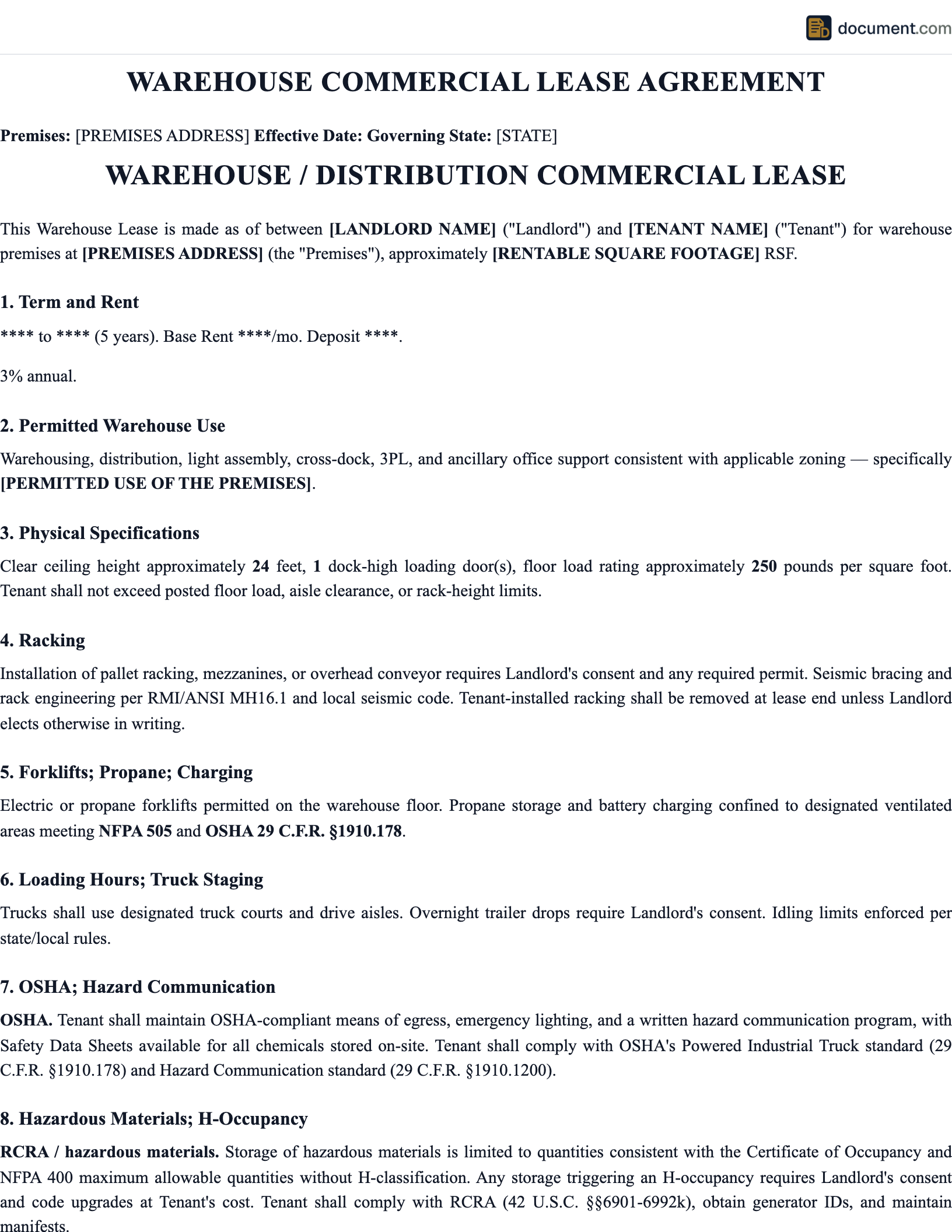
Preview of our Ohio-specific template. Your document will include all fields required for recording in any Ohio county.
WAREHOUSE LEASE AGREEMENT
STATE OF OHIO
Legal Document
PARTY INFORMATION
Name: [Full Legal Name]
Address: [Ohio Address]
County: [County]
PROPERTY DESCRIPTION
County: [County] State: Ohio
Legal Description: [Per Recorded Plat]
Parcel No.: [APN]
Ohio Warehouse Lease FAQ
Common questions about filing in Ohio, including requirements, fees, and tax implications.
Official Ohio Resources
Official state resources for verifying requirements and finding your local recording office.
Important Considerations
The Columbus distribution market around I-270 and Rickenbacker International Airport has been one of the most active industrial development markets in the Midwest. National e-commerce and logistics operators have committed to large-format facilities in this corridor. The result is a tighter market than it was five years ago, with more landlord leverage on lease terms. Securing renewal options in the initial lease is important for Columbus distribution center operators.
Cleveland's industrial market serves two distinct user profiles: automotive supply chain operators who need proximity to assembly plants in the Ohio-Michigan corridor, and general distribution operators who value the Lake Erie port and Great Lakes access. Automotive supply chain tenants should confirm that the facility's dock configuration, operating hours, and power infrastructure support just-in-time delivery requirements before signing.
Ohio has a number of Enterprise Zones and Community Reinvestment Areas that can provide property tax abatements for new industrial development or significant expansions. These programs are administered at the local level and have different eligibility requirements and abatement durations. Tenants planning large capital investments in Ohio industrial space should confirm whether the property is in an eligible area and consult with the applicable city or county economic development office before signing.
Ohio Market Note
Ohio's highway infrastructure, central eastern U.S. location, and cost-relative-to-coast advantages make it a top logistics state. Columbus is a legitimate national distribution hub at lower rents than Chicago or Atlanta. The county reappraisal cycle is a meaningful financial variable in NNN leases and must be negotiated carefully. Ohio's available tax abatement programs can significantly reduce effective occupancy cost for qualified operations.
Related Documents
Depending on your situation, you may need additional documents alongside this one. Below are commonly related documents that are frequently used together in real estate transactions.
Important Considerations
Before proceeding with your document, there are several important factors to consider. Each real estate transaction is unique, and understanding the specific requirements and implications of your situation will help ensure a smooth and legally compliant process.
Real estate laws and regulations are subject to change, and local requirements may differ from state-level rules. It is always advisable to verify current requirements with your local recording office before submitting any documents for recording.
If your transaction involves complex circumstances such as multiple parties, commercial properties, trusts, estates, or interstate elements, consulting with a licensed real estate attorney is strongly recommended. An attorney can provide guidance specific to your situation and help you avoid potential legal issues.
Keep copies of all documents related to your real estate transaction in a safe place. Recorded documents become part of the public record, but having your own copies ensures you can reference the terms and conditions at any time. Digital copies stored securely are also recommended as a backup.
Professional Recommendation
While our templates are designed to be comprehensive and legally compliant, we recommend having your completed document reviewed by a licensed attorney before recording, especially for high-value transactions or complex situations. Many attorneys offer flat-fee document review services that provide peace of mind at a reasonable cost.
Related Documents
Depending on your situation, you may need additional documents alongside this one. Below are commonly related documents that are frequently used together in real estate transactions.
Create your Ohio Commercial Warehouse Lease Agreement in under 5 minutes.
Answer a few questions and download a Ohio-compliant document, ready for the state agency.