
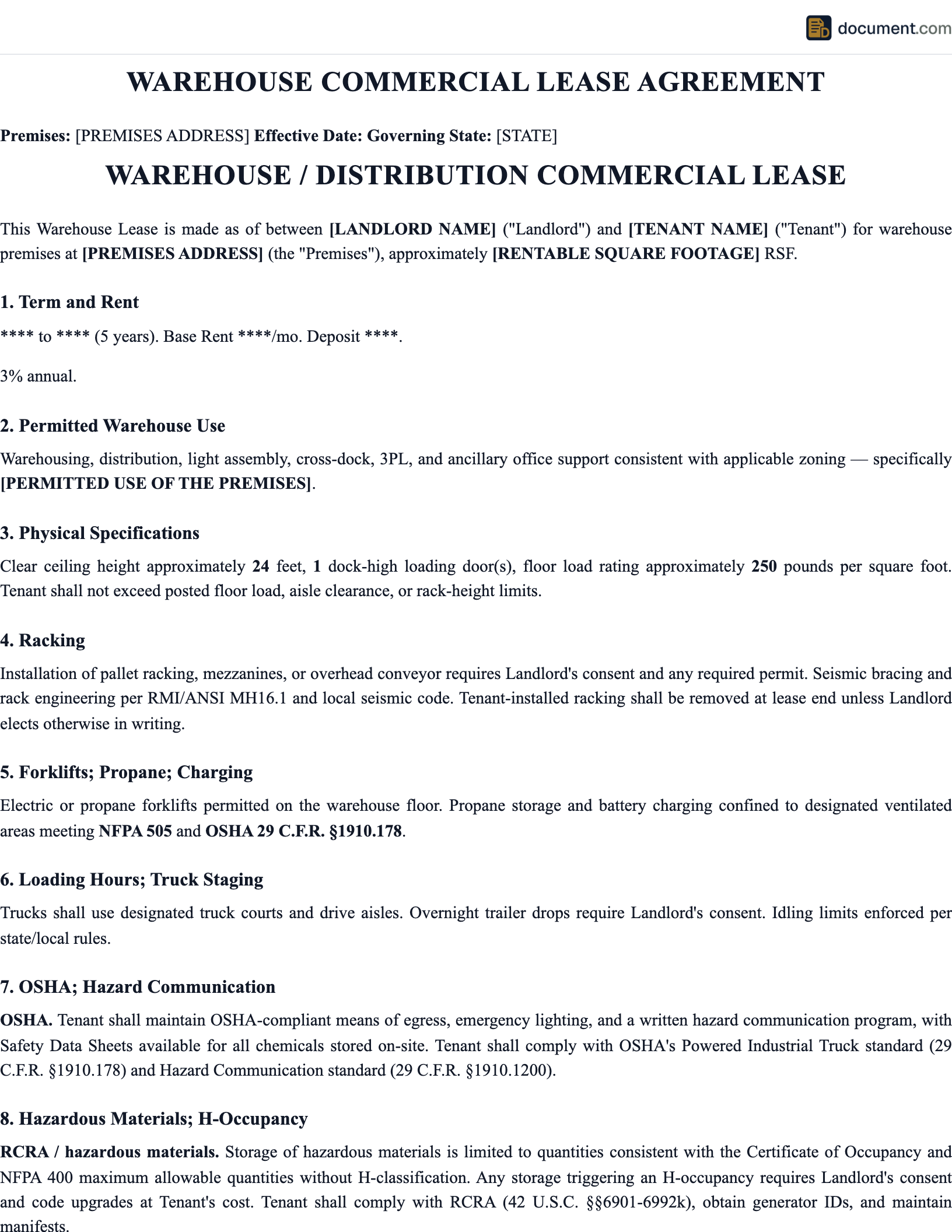



North Dakota Warehouse Lease Overview
North Dakota's industrial warehouse market spans two fundamentally different demand environments. The Fargo-Bismarck-Minot markets serve as regional logistics hubs for the Upper Midwest, with I-29 and I-94 connecting Fargo to Minneapolis and beyond. These markets have stable, agriculture-driven demand supplemented by regional distribution. Western North Dakota, centered on Williston and the Bakken oil formation, has cyclical demand tied directly to energy sector drilling activity.
North Dakota's winters are among the most severe in the continental United States, and warehouse leases must address heating infrastructure, dock access in extreme cold, and snow removal responsibility with more specificity than leases in moderate climates. The state has no transfer tax on commercial leases and no sales tax on commercial real estate payments, creating a favorable tax environment. Property taxes are assessed at the county level and are moderate compared to many other states.
$10
Recording fee
None
Transfer tax
Required
Notarization
0
Witnesses required
North Dakota Requirements
North Dakota warehouse leases are governed by general contract law. No specific industrial lease statute applies. The severe winter climate and, for western markets, the cyclical energy demand are the most important considerations shaping key lease provisions.
North Dakota Specific Note
North Dakota winters are severe, with temperatures regularly dropping below minus 20 degrees Fahrenheit. Any NNN warehouse lease must clearly assign heating system maintenance obligations, dock approach snow removal responsibility, and roof maintenance for heavy snow loads. Review the heating system type, age, and last service record before signing any North Dakota warehouse lease.
Document Requirements
- Heating system obligations: Specify maintenance responsibility, performance standards, and winterization requirements for extreme cold conditions
- Snow removal and ice management: Assign responsibility for truck court, dock approach, and parking lot clearing with defined response time standards
- Roof load capacity: Confirm the roof's snow load rating given North Dakota snowfall and the structural implications for rack storage below
- Permitted use: Define industrial use precisely, including any restrictions on outdoor equipment storage that may apply in extreme winter conditions
- Energy market terms (western ND only): For Williston-area leases, address cyclical energy demand with appropriate term and termination provisions
How to Execute a North Dakota Warehouse Lease
Executing a warehouse lease in North Dakota requires careful attention to heating infrastructure, snow removal obligations, and whether the property is in a stable agricultural-distribution market or the cyclical energy market of western North Dakota.
Identify the Market Type
Determine whether the facility is in a stable Fargo-Bismarck-Minot distribution market or in the cyclical western North Dakota energy market. Each has different demand patterns, landlord leverage, and appropriate lease term strategies.
Inspect Heating and Winter Infrastructure
Inspect the heating system type, last service date, and capacity rating for North Dakota winter conditions. Review the snow removal contract and roof inspection records. These are not optional due diligence items in a market where -30 degree Fahrenheit temperatures are possible.
Review Property Tax History
Obtain current county tax bills and three years of history from the county director of tax equalization. North Dakota property taxes are moderate, but NNN tenants should still establish a base year and negotiate a cap on increases for multi-year leases.
Negotiate Winter and Operational Provisions
Address heating system performance obligations, snow removal standards, and dock access maintenance explicitly. CAM charges for snow removal can be variable and should be reviewed historically before agreeing to NNN terms.
Execute and Distribute Copies
Both parties sign the fully negotiated lease. Set up utilities and heating fuel accounts in the tenant name where required. Store executed copies securely.
North Dakota Fees & Costs
Typical costs for filing in North Dakota. Actual fees may vary by county.
| Fee / Tax | Amount |
|---|---|
| Recording Fee | $10 |
| Transfer Tax | None |
| Notarization | $5 - $25 per signature |
| Certified Copy | $1 - $10 per page |
| Attorney Review (optional) | $150 - $500 |
North Dakota Tax Implications
North Dakota does not impose a transfer tax on commercial lease transactions and does not impose sales tax on commercial real estate lease payments. This creates a favorable baseline tax environment for warehouse tenants. North Dakota does impose a corporate income tax on business income earned in the state.
Property taxes in North Dakota are assessed at the county level by county directors of tax equalization. North Dakota property taxes are moderate compared to neighboring Minnesota and most coastal markets. NNN warehouse tenants should review current tax bills and negotiate a base year with a cap on increases. In western North Dakota energy counties, assessed values can fluctuate with energy market conditions.
CAM charges in North Dakota warehouse leases typically include snow removal (a significant and variable cost given the severe winters), heating fuel where shared systems exist, parking lot maintenance, and property management fees. Snow removal costs can vary dramatically between low-snowfall and high-snowfall years. Request three years of CAM history to understand the variability before agreeing to NNN terms.
Sample North Dakota Warehouse Lease
Preview of our North Dakota-specific template. Your document will include all fields required for recording in any North Dakota county.
WAREHOUSE LEASE AGREEMENT
STATE OF NORTH DAKOTA
Legal Document
PARTY INFORMATION
Name: [Full Legal Name]
Address: [North Dakota Address]
County: [County]
PROPERTY DESCRIPTION
County: [County] State: North Dakota
Legal Description: [Per Recorded Plat]
Parcel No.: [APN]
North Dakota Warehouse Lease FAQ
Common questions about filing in North Dakota, including requirements, fees, and tax implications.
Official North Dakota Resources
Official state resources for verifying requirements and finding your local recording office.
Important Considerations
North Dakota warehouse tenants in western markets near Williston should understand that energy sector activity directly drives the local industrial market. During drilling booms, industrial space tightens and rents rise. During downturns, vacancy increases and landlords become more flexible. Understanding the current oil price and drilling activity environment is essential context for negotiating lease terms in the Williston-Dickinson corridor.
Fargo's position at the I-29/I-94 interchange makes it the most liquid North Dakota industrial market and the most appropriate location for Upper Midwest regional distribution operations. The proximity to Minneapolis gives Fargo access to logistics networks without Minneapolis industrial rents. Agricultural storage and processing support is a consistent demand driver in the Fargo market and throughout the state.
North Dakota's population is concentrated in relatively small cities, and the industrial real estate market lacks the depth of major metros. Some landlords in smaller North Dakota markets use simplified lease forms that may not include standard NNN protective provisions. Commercial tenants should have any North Dakota warehouse lease reviewed by a commercial real estate attorney, particularly for multi-year commitments in markets with limited space alternatives.
North Dakota Market Note
North Dakota's favorable tax environment, I-29/I-94 logistics position, and agricultural demand base create a stable foundation for Upper Midwest distribution operations in the Fargo market. Western North Dakota is a different calculation: energy demand is real but cyclical, and lease terms should reflect that reality. The extreme winter climate is the common denominator for all North Dakota industrial leases.
Related Documents
Depending on your situation, you may need additional documents alongside this one. Below are commonly related documents that are frequently used together in real estate transactions.
Important Considerations
Before proceeding with your document, there are several important factors to consider. Each real estate transaction is unique, and understanding the specific requirements and implications of your situation will help ensure a smooth and legally compliant process.
Real estate laws and regulations are subject to change, and local requirements may differ from state-level rules. It is always advisable to verify current requirements with your local recording office before submitting any documents for recording.
If your transaction involves complex circumstances such as multiple parties, commercial properties, trusts, estates, or interstate elements, consulting with a licensed real estate attorney is strongly recommended. An attorney can provide guidance specific to your situation and help you avoid potential legal issues.
Keep copies of all documents related to your real estate transaction in a safe place. Recorded documents become part of the public record, but having your own copies ensures you can reference the terms and conditions at any time. Digital copies stored securely are also recommended as a backup.
Professional Recommendation
While our templates are designed to be comprehensive and legally compliant, we recommend having your completed document reviewed by a licensed attorney before recording, especially for high-value transactions or complex situations. Many attorneys offer flat-fee document review services that provide peace of mind at a reasonable cost.
Related Documents
Depending on your situation, you may need additional documents alongside this one. Below are commonly related documents that are frequently used together in real estate transactions.
Create your North Dakota Commercial Warehouse Lease Agreement in under 5 minutes.
Answer a few questions and download a North Dakota-compliant document, ready for the state agency.